both sides are blurred, the non-standard
lane boundaries or the lane boundaries
are covered, and there is no vehicle run-
ning directly in front.
〉
There is an object on the road that af-
fects the identification of the lane boun-
daries (such as water, gaps, ruts, text
signs, bumps or pits).
〉
Low visibility (such as rain, snow, fog
and night etc.).
〉
The vehicle is strongly affected by the
side wind.
〉
The lanes merge or separate.
〉
A strong light hits the camera or the light
intensity changes abruptly.
〉
The front windshield around the camera
is polluted, frozen, damaged or covered.
〉
Vehicles are running on a sharp turn or a
narrow road.
〉
If the vehicle is driving too close to the
preceding vehicle, the camera detection
scope is hindered.
Functional limitations
Under the following conditions, the cruise
assist system may not take the braking
measures:
〉
A vehicle suddenly appears in front of
you.
〉
A vehicle is running at a low speed in
front of you when you are driving at a
speed of over 60 km/h.
〉
An oncoming vehicle is running in the
same lane.
〉
A vehicle or object crossing the lane is
seen.
〉
Pedestrians or animals and small vehi-
cles (such as bicycles and motorcycles)
are seen.
〉
The vehicle in front of decelerates sud-
denly.
〉
Water, snow or mud splashed by sur-
rounding vehicles hinders the sensor de-
tection.
〉
The vehicle head tilts up due to overload
in the luggage area.
〉
The vehicle is running on a winding or
narrow road.
706CBE4C4337
〉
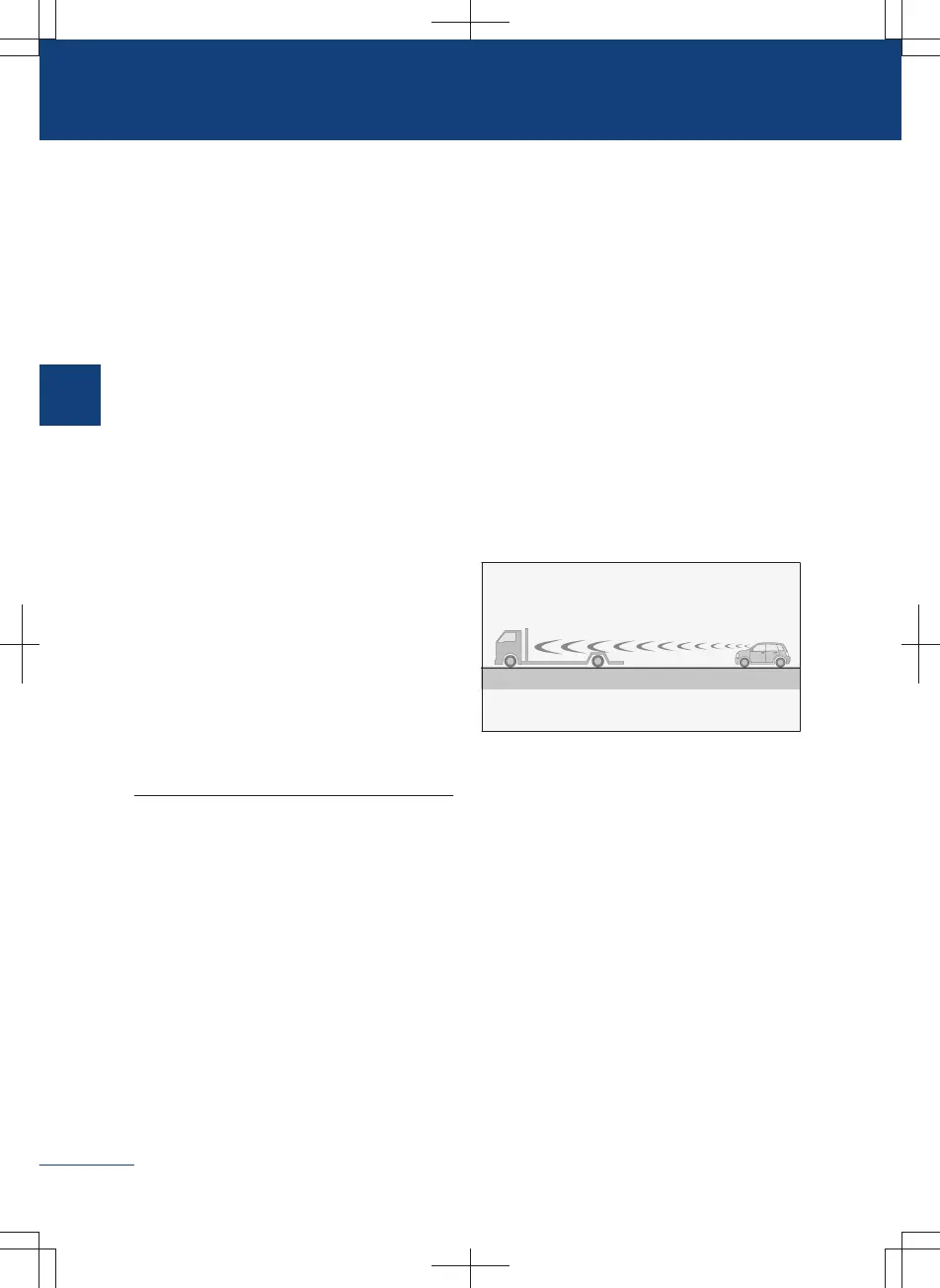
The followed vehicle has a relatively
small tail dimension or very large ground
clearance.
〉
The steering wheel operation is unstable
or your position in the lane is unstable.
Sensor
The cruise assist system identifies lane
boundaries and detects targets based on
the following components.
〉
Camera.
The camera is located on the upper part
of the windshield.
〉
Sensor.
128
2
Driving


 To Next Page