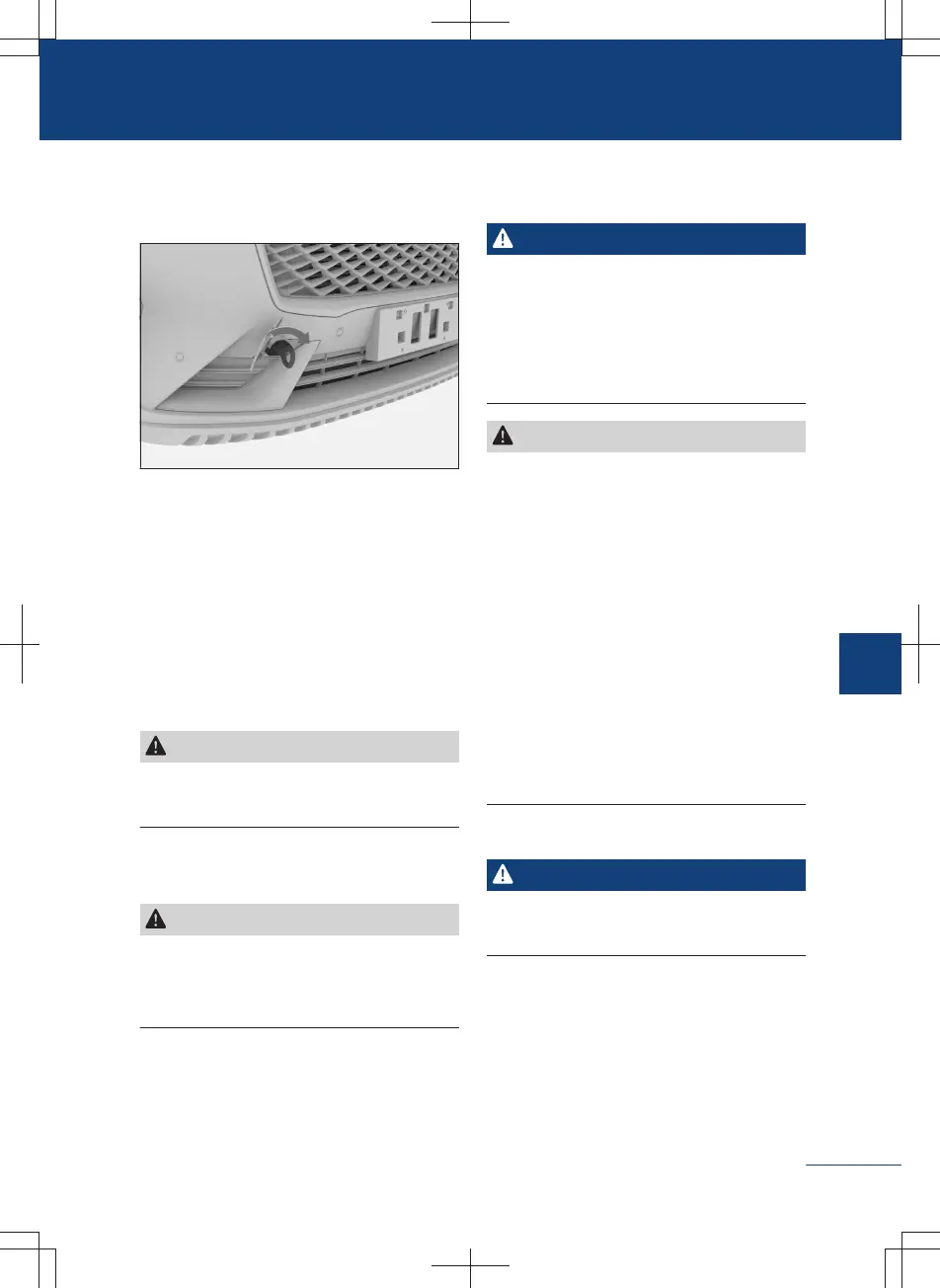
2. Screw the tow hook clockwise into the
hole and tighten it to ensure that it is
securely installed.
0F0386532D3E
3. Attach the rope to the tow hook, taking
care not to damage the body.
The distance between the towing vehi-
cle and towed vehicle should be be-
tween 4 m and 10 m.
Attach a piece of white cloth (0.3 m X
0.3 m above) in the middle of the tow-
ing rope.
Caution
Do not use a steel rope to tow as that will
damage the bumper.
4. Start the vehicle and switch the gear to
N position.
Caution
When you cannot switch the transmission
gear to N, do not use tow hooks for tow-
ing.
5. Turn on the hazard warning lamp, re-
lease the parking brake and wait for
traction.
The towing speed is not greater than
12 km/h and the towing distance is not
greater than 25 km.
Warning
If the vehicle requires a traction due to an
accident, a service provider shall be en-
trusted as far as possible. Do not use tow
hooks for towing, as this may damage the
tow hook and suspension components.
Caution
〉
If the vehicle is not started, the assist
system will not function and steering and
braking operations will be more difficult,
When driving, try to reduce the speed of
the vehicle.
〉
During the towing process, pay attention
to the brake lamps of the vehicle ahead
to avoid the tow rope become slack.
〉
When driving downslope for an exten-
ded time, please don't use a rope to tow
the vehicle.
〉
Do not tow the vehicle backward.
Towing a faulty vehicle
Warning
Traction must comply with local regula-
tions regarding trailer towing.
The specific towing steps are as follows:
219
5
Emergency



 To Next Page