268
PARAMETERS
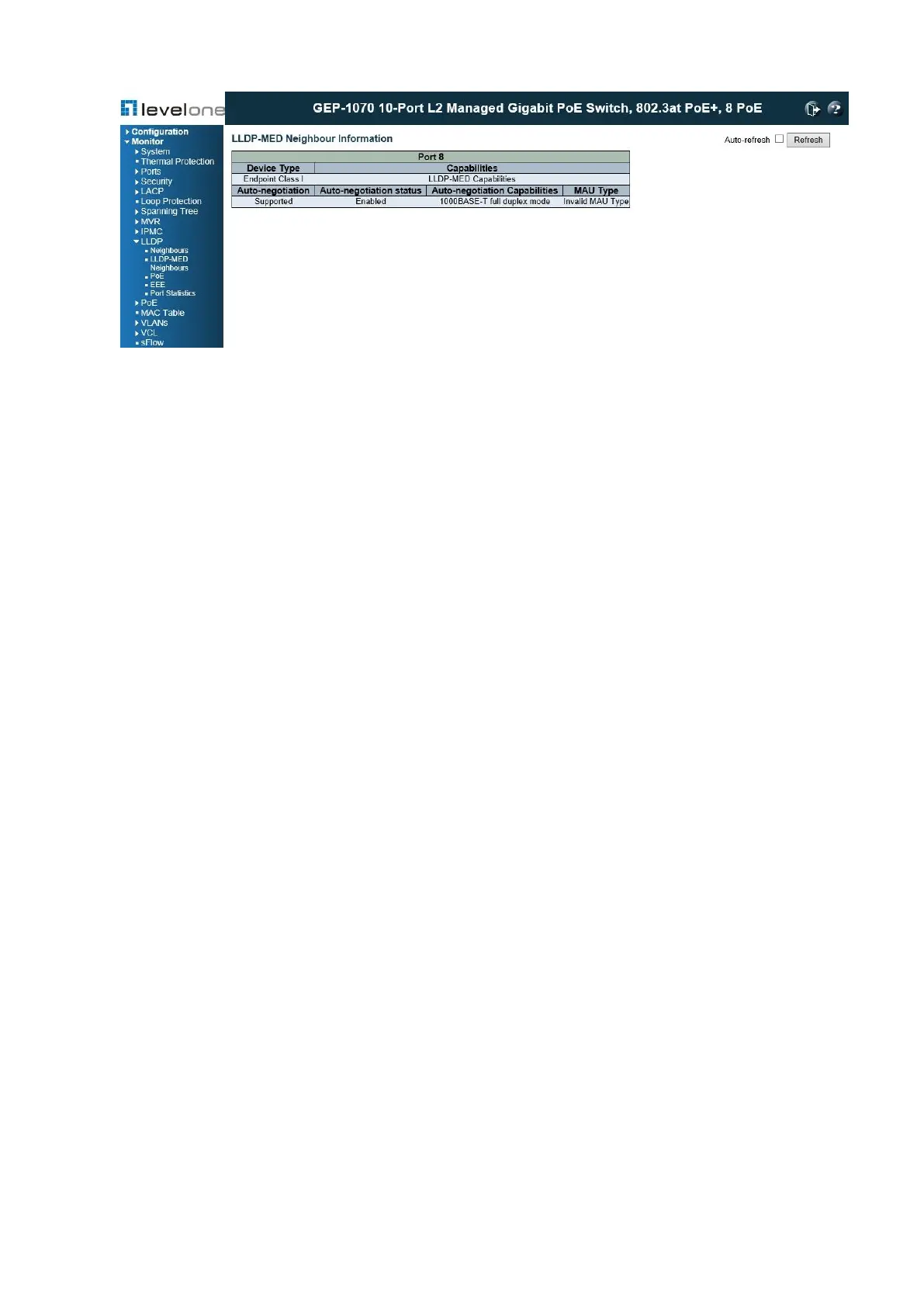
These parameters are displayed:
◆ Port – The port on which an LLDP frame was received.
◆ Device Type – LLDP-MED devices are comprised of two primary types:
■ LLDP-MED Network Connectivity Devices – as defined in TIA-1057, provide access to
the IEEE 802 based LAN infrastructure for LLDPMED Endpoint Devices. An LLDP-MED
Network Connectivity Device is a LAN access device based on any of the following
technologies:
■ LAN Switch/Router
■ IEEE 802.1 Bridge
■ IEEE 802.3 Repeater (included for historical reasons)
■ IEEE 802.11 Wireless Access Point
■ Any device that supports the IEEE 802.1AB and MED extensions defined by TIA-1057
and can relay IEEE 802 frames via any method.
■ LLDP-MED Endpoint Device – Within this category, the LLDP-MED scheme is broken
into further Endpoint Device Classes, as defined in the following.
Each LLDP-MED Endpoint Device Class is defined to build upon the capabilities defined
for the previous Endpoint Device Class. For example will any LLDP-MED Endpoint Device
claiming compliance as a Media Endpoint (Class II) also support all aspects of TIA-1057
applicable to Generic Endpoints (Class I), and any LLDP-MED Endpoint Device claiming
compliance as a Communication Device (Class III) will also support all aspects of TIA-1057
applicable to both Media Endpoints (Class II) and Generic Endpoints (Class I).
■ LLDP-MED Generic Endpoint (Class I) – Applicable to all endpoint products that require
the base LLDP discovery services defined in TIA-1057, however do not support IP media
or act as an end-user communication appliance. Such devices may include (but are not
limited to) IP Communication Controllers, other communication related servers, or any
device requiring basic services as defined in TIA-1057.
Discovery services defined in this class include LAN configuration, device location, network




 To Next Page