PART 1: CX-Programmer
OMRON CHAPTER 2 – Quick Start Guide
CX-Programmer _Page 15
NUMBER A literal numeric value - not an address. The value can be signed, or floating
point. NUMBERs are used for any literal value or for timer/counter identifiers
(for TIM/CNT, only unsigned integer values are allowed).
Floating point values are only suitable within IEEE REAL type operands.
Note: When used as BCD number operands, the value is treated as if it were
entered in decimal with a ‘#’ on the front. E.g. using a NUMBER ‘1234’ is
equivalent to typing ‘#1234’ as the operand, so that the decimal
interpretation is made of the value.
The value of a NUMBER data type is assumed to be decimal, unless it is
prefixed with '#' for a hexadecimal value.
Note: NUMBERs entered in hexadecimal are converted to decimal for BCD
operands (e.g. a NUMBER defined as ‘#10’ will appear as ‘#16’ for a BCD
operand).
REAL Address of a double word floating point value (IEEE format - use the UDINT
type for the BCD, FDIV format).
LREAL Address of a long word floating point value (IEEE format - use the ULINT
type for the BCD format).
UDINT Address of an unsigned, double binary word.
UDINT_BCD Address of an unsigned, double BCD word.
UINT Address of an unsigned, single binary word.
UINT_BCD Address of an unsigned, single BCD word
ULINT Address of an unsigned, quad binary word.
ULINT_BCD Address of an unsigned, quad BCD word.
WORD Address of a bit string of 16 bits.
DWORD Address of a bit string of 32 bits.
LWORD Address of a bit string of 64 bits.
TIMER Used for a timer number, Timer Completion Flag, or timer present value.
Note: TIMERs can be used only for CJ2 CPU Units with unit version 1.0 or
later and only with CX-Programmer version 8.3.
COUNTER Used for a counter number, Counter Completion Flag, or counter present
value.
Note: COUNTERs can be used only for CJ2 CPU Units with unit version 1.0
or later and only with CX-Programmer version 8.3.
STRING The data is handled as character strings. The size can be set between 1 and
255 characters.
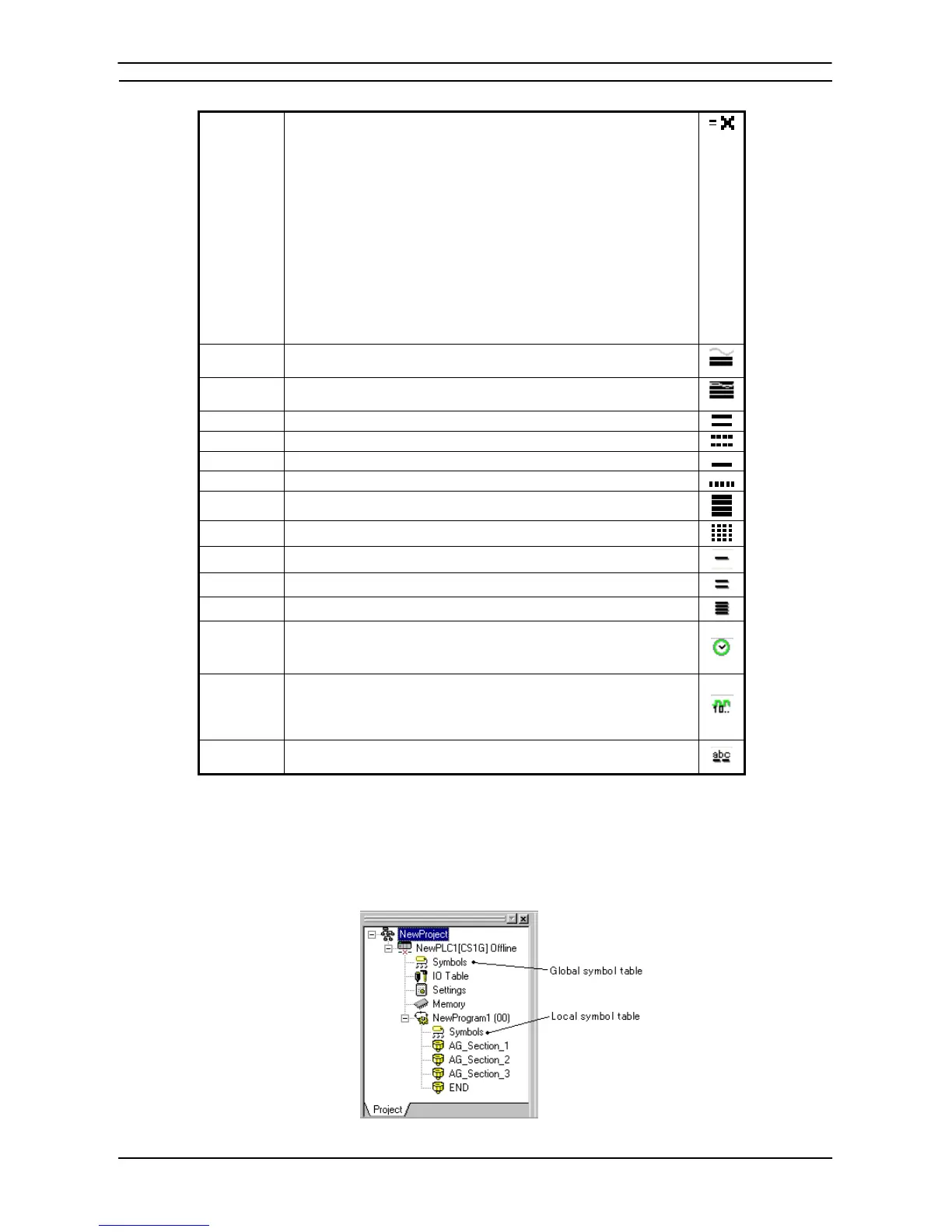
Each program within a PLC has a ‘local’ symbol table that consists of symbols that are for use specifically in
that program. Each PLC within a project has a ‘global’ symbol table that consists of symbols that can be used in
any of its programs. When a PLC is added to a project, its global symbol table is filled with a pre-set list of
symbols, dependant upon PLC type.
Each symbol name must be unique within its table. However, it is possible to use the same name in a local and a
global table – in this case, the local symbol takes precedence over the global symbol of the same name.




 To Next Page