
 Need help?
Do you have a question about the Planet IGS-20040MT and is the answer not in the manual?
Lists the items included in the product package for the Industrial Managed Switch.
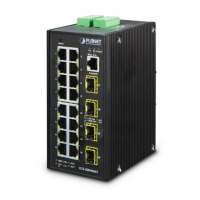
Provides a detailed overview of the PLANET IGS-20040MT Industrial Managed Ethernet Switch.
Explains the structure and organization of the user's manual for easy navigation.
Details the key features of the Industrial Managed Switch, including physical ports, case, layer 2, QoS, multicast, and security.
Lists the technical specifications of the IGS-20040MT switch, covering hardware, software, and environment.
Describes the hardware features, indicators, and ports of the Industrial Managed Switch.
Provides step-by-step instructions for installing the Industrial Managed Switch and making network connections.
Explains the cabling requirements for 10/100/1000Base-T and SFP interfaces, including cable types and connectors.
Lists the necessary requirements for accessing and managing the Industrial Managed Switch.
Compares the advantages and disadvantages of different management access methods like Console, Telnet, Web, and SNMP.
Explains how to manage the switch using Command Line Interface (CLI) via console or remote Telnet.
Describes how to manage the switch using the Web-based interface via a standard web browser.
Explains how to configure and manage the switch using SNMP-based network management applications.
Guides on using the Smart Discovery Utility to list and manage switches in the Ethernet environment.
Provides an overview of the web-based interface for configuring and managing the Industrial Managed Switch.
Covers system settings for displaying and configuring administrative details, including information, IP, users, and maintenance.
Explains the SNMP protocol, its components, operations, community settings, and configuration.
Details how to display or configure the switch's ports, including configuration, statistics, SFP modules, and mirroring.
Explains how to optimize port usage by linking groups of ports to form Link Aggregated Groups (LAGs) for increased bandwidth and redundancy.
Covers Virtual Local Area Network (VLAN) configuration, including overview, IEEE 802.1Q, port configuration, and types.
Explains the Spanning Tree Protocol (STP) for loop detection, backup links, and network topology stability.
Details multicast features like IGMP snooping, MLD snooping, and MVR for efficient multicast traffic management.
Explains Quality of Service (QoS) features for traffic prioritization, including classification, scheduling, and DSCP settings.
Covers Access Control Lists (ACLs) and Access Control Entries (ACEs) for defining traffic access rules and policies.
Details authentication methods like 802.1X, MAC-based, and RADIUS/TACACS+ for controlling network access.
Explains security features such as Port Limit Control, DHCP Snooping, IP Source Guard, and ARP Inspection.
Describes how the switch builds and manages MAC address tables, including configuration and status.
Covers Link Layer Discovery Protocol (LLDP) and LLDP-MED for network device discovery and management.
Provides tools for physical and IP layer network diagnostics, including Ping and Cable Diagnostics.
Explains how to enable loop protection to prevent broadcast loops in the Industrial Managed Switch.
Details RMON (Remote Network Monitoring) features for network traffic monitoring, including alarms, events, and statistics.
Explains the Precision Time Protocol (PTP) for synchronizing clocks in computer networks, including configuration and status.
Covers Ethernet Ring Protection Switching (ERPS) for fast redundant recovery and loop protection in ring topologies.
Describes the address table used by the switch to store node information including MAC address and port number.
Explains how the switch records source address and port number from incoming packets for future packet handling.
Details how the switch looks up destination addresses and forwards or filters packets based on the address table.
Explains the Store-and-Forward packet-forwarding technique, including error checking and efficiency.
Describes the built-in auto-negotiation feature that sets the best bandwidth and duplex mode for network connections.
Provides the RJ45 pin assignments for 1000Mbps/1000Base-T MDI and MDI-X connections.
Shows the standard RJ45 connector and pin assignments for 10/100Mbps Ethernet connections.
Access Control Entry: Describes access permission associated with a particular ACE ID.
Access Control List: A list of ACEs specifying users or groups permitted or denied to traffic objects.
Dynamic Host Configuration Protocol: Assigns dynamic IP addresses to devices on a network.
Ethernet Protection Switching: Provides sub-50ms protection and recovery switching for Ethernet traffic in a ring topology.
Internet Group Management Protocol: Manages multicast group memberships for IP multicast.
Link Layer Discovery Protocol: Discovers basic information about neighboring devices on a local broadcast domain.
Maps MAC addresses to switch ports for frame forwarding decisions, containing static and dynamic entries.
Quality of Service: Guarantees bandwidth relationships between individual applications or protocols for traffic management.
Remote Authentication Dial In User Service: Provides centralized access, authorization, and accounting for network access.
Rapid Spanning Tree Protocol: Provides faster spanning tree convergence after topology changes.
Simple Network Management Protocol: Enables network management systems to learn network problems by receiving traps.
Spanning Tree Protocol: Ensures a loop-free topology for any bridged LAN.
Virtual LAN: Restricts communication between switch ports and segments networks into different broadcast domains.
 General
| Switch type | Managed |
|---|---|
| Switch layer | L2+ |
| Traffic classification | Yes |
| Console port | RJ-45 |
| Fiber optic connector | MiniGBIC |
| SFP module slots quantity | 4 |
| Installed SFP modules quantity | 0 |
| Basic switching RJ-45 Ethernet ports type | Gigabit Ethernet (10/100/1000) |
| Basic switching RJ-45 Ethernet ports quantity | 16 |
| 10G support | No |
| Number of VLANs | 4095 |
| Networking standards | IEEE 1588v2, IEEE 802.1D, IEEE 802.1Q, IEEE 802.1ab, IEEE 802.1ad, IEEE 802.1ag, IEEE 802.1p, IEEE 802.1s, IEEE 802.1w, IEEE 802.1x, IEEE 802.3, IEEE 802.3ab, IEEE 802.3ad, IEEE 802.3ah, IEEE 802.3u, IEEE 802.3x, IEEE 802.3z |
| Virtual LAN features | Stacked VLAN, Private VLAN, Tagged VLAN, Protocol-based VLAN |
| Copper ethernet cabling technology | 10BASE-T, 100BASE-TX, 1000BASE-T |
| Stackable | - |
| Certification | FCC, CE |
| Product color | Blue, White |
| Housing material | Aluminum |
| International Protection (IP) code | IP30 |
| Fiber ethernet cabling technology | 100BASE-FX, 1000BASE‑BX, 1000BASE‑LX, 1000BASE‑SX |
| Throughput | 29.7 Mpps |
| Jumbo frames | 9216 |
| MAC address table | 8000 entries |
| Number of IP interfaces | 8 |
| Power consumption (max) | 17 W |
| Power consumption (typical) | 8 W |
| Heat dissipation | 27 BTU/h |
| Storage temperature (T-T) | -40 - 85 °C |
| Operating temperature (T-T) | -40 - 75 °C |
| Operating relative humidity (H-H) | 5 - 95 % |
| Supported network protocols | IPv4 / IPv6 |
| Authentication | MAC-based authentication, Port-based authentication |
| Security algorithms | 802.1x RADIUS, SSH, SSL/TLS |
| Number of multicast groups filtered | 255 |
| Harmonized System (HS) code | 85176990 |
 Weight and Dimensions
| Depth | 107.3 mm |
|---|---|
| Width | 76.8 mm |
| Height | 152 mm |
| Weight | 1043 g |


 To Next Page