Point Grey Flea3 USB 3.0 Technical Reference 7 Imaging Parameters and Control
7.8 White Balance
The camera supports white balance adjustment, which is a system of color correction to account for differing lighting
conditions. Adjusting white balance by modifying the relative gain of R, G and B in an image enables white areas to
look "whiter". Taking some subset of the target image and looking at the relative red to green and blue to green
response, the objective is to scale the red and blue channels so that the response is 1:1:1.
The user can adjust the red and blue values. Both values specify relative gain, with a value that is half the maximum
value being a relative gain of zero.
White Balance has two states:
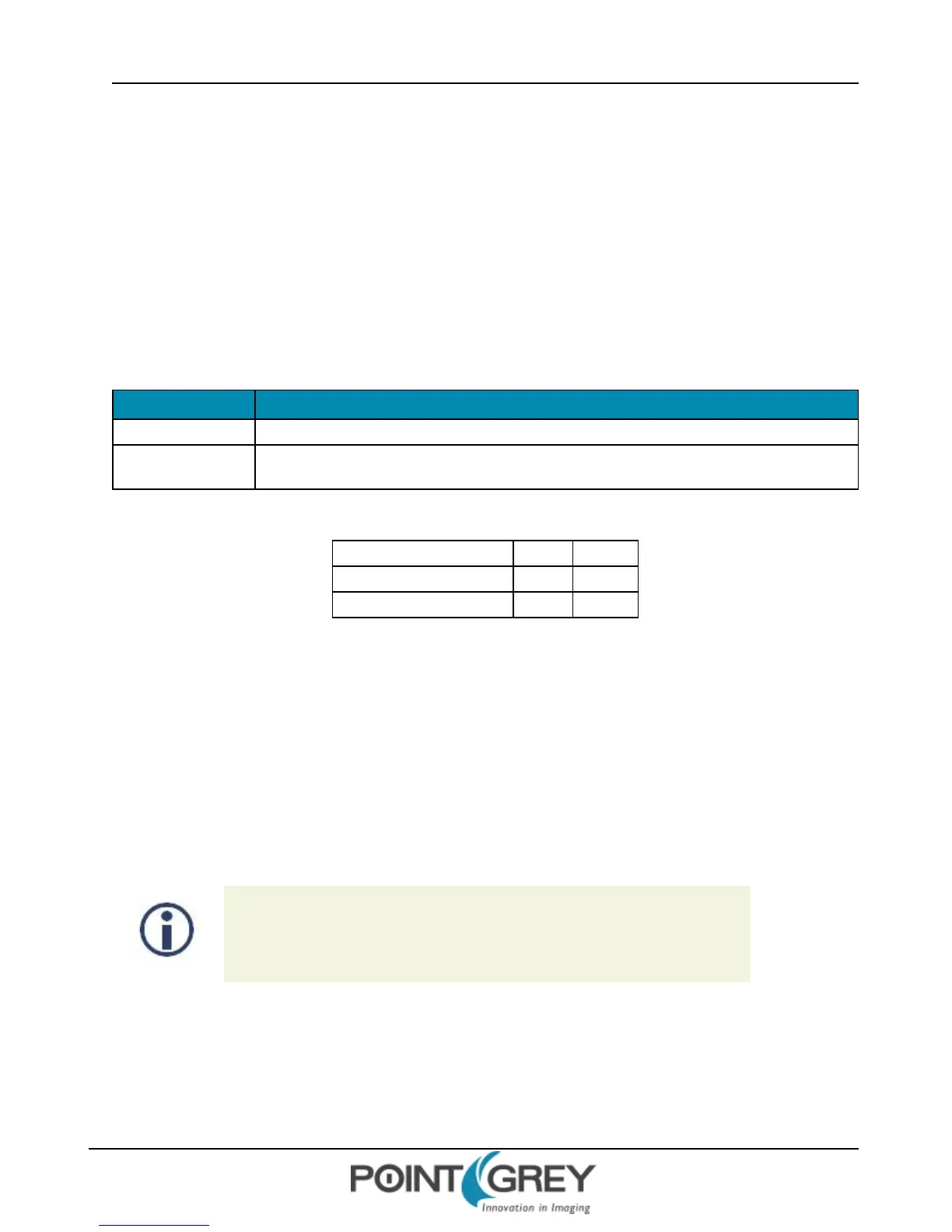
State Description
Off The same gain is applied to all pixels in the Bayer tiling.
On/Manual
The Red value is applied to the red pixels of the Bayer tiling and the Blue value is applied to the blue
pixels of the Bayer tiling.
The following table illustrates the default gain settings for most cameras.
Red Blue
Black and White 32 32
Color 1023 1023
The camera can also implement Auto and One Push white balance. One use of One Push/Auto white balance is to
obtain a similar color balance between cameras that are slightly different from each other. In theory, if different
cameras are pointed at the same scene, using One Push/Auto will result in a similar color balance between the
cameras.
One Push only attempts to automatically adjust white balance for a set period of time before stopping. It uses a “white
detection” algorithm that looks for “whitish” pixels in the raw Bayer image data. One Push adjusts the white balance
for a specific number of iterations; if it cannot locate any whitish pixels, it will gradually look at the whitest objects in
the scene and try to work off them. It will continue this until has completed its finite set of iterations.
Auto is continually adjusting white balance. It differs from One Push in that it works almost solely off the whitest
objects in the scene.
The white balance of the camera before using One Push/Auto must already be
relatively close; that is, if Red is set to 0 and Blue is at maximum (two extremes),
One Push/Auto will not function as expected. However, if the camera is already
close to being color balanced, then One Push/Auto will function properly.
Revised 9/27/2012
Copyright ©2011-2012 Point Grey Research Inc.
109


 To Next Page