11-14 Testing and Troubleshooting Date Code 20010731
SEL-352-1, -2 Instruction Manual
PHASE VOLTAGE ELEMENT TESTS
Purpose: Verify the pickup thresholds of the phase voltage elements.
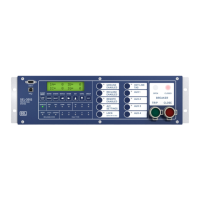
Method: 1. Using the TARGET F command with the element name, set the bottom row of
the front-panel target LEDs to display the appropriate phase voltage element.
Select one or more of the phase voltage elements from the Relay Word as
indicated below. Many of the elements appear in the same Relay Word row, so
they can be monitored simultaneously.
Setting
Elements
27D X27D3, X27DA, X27DB, X27DC,
Y27D3, Y27DA, Y27DB, Y27DC
59L X59L3, X59LA, X59LB, X59LC,
Y59L3, Y59LA, Y59LB, Y59LC
59H X59H, X59HA, X59HB, X59HC
2. Apply voltage to one phase and observe the pickup and dropout of each element.
Record the results. The elements with a 3 at the end of the label require all three
phase elements to be picked up.
3. Verify the results with the indicated setting.
NEGATIVE-SEQUENCE OVERVOLTAGE ELEMENT TEST
Purpose: Verify the pickup threshold of the negative-sequence overvoltage elements.
Method: 1. Using the TARGET F command with the element name, set the bottom row of
the front-panel target LEDs to display the appropriate negative sequence
overvoltage element. Select one of the negative-sequence overvoltage elements
from the Relay Word as indicated below:
Setting
Elements
47Q 47Q, Y47Q, X47Q
2. Apply voltage to one phase of the X voltage input. Increase the phase voltage and
observe the pickup and dropout of the 47Q element. Record the results. Repeat
for one phase of the Y voltage input.
3. Verify the results with the indicated setting. Negative-sequence voltage V
2
equals
one-third of the applied single-phase voltage. Thus, with a 47Q setting of 10 V,
the elements pick up when you apply a single-phase voltage of 30 V.


 To Next Page