Date Code 20010731 Introduction and Specifications 1-3
SEL-352-1, -2 Instruction Manual
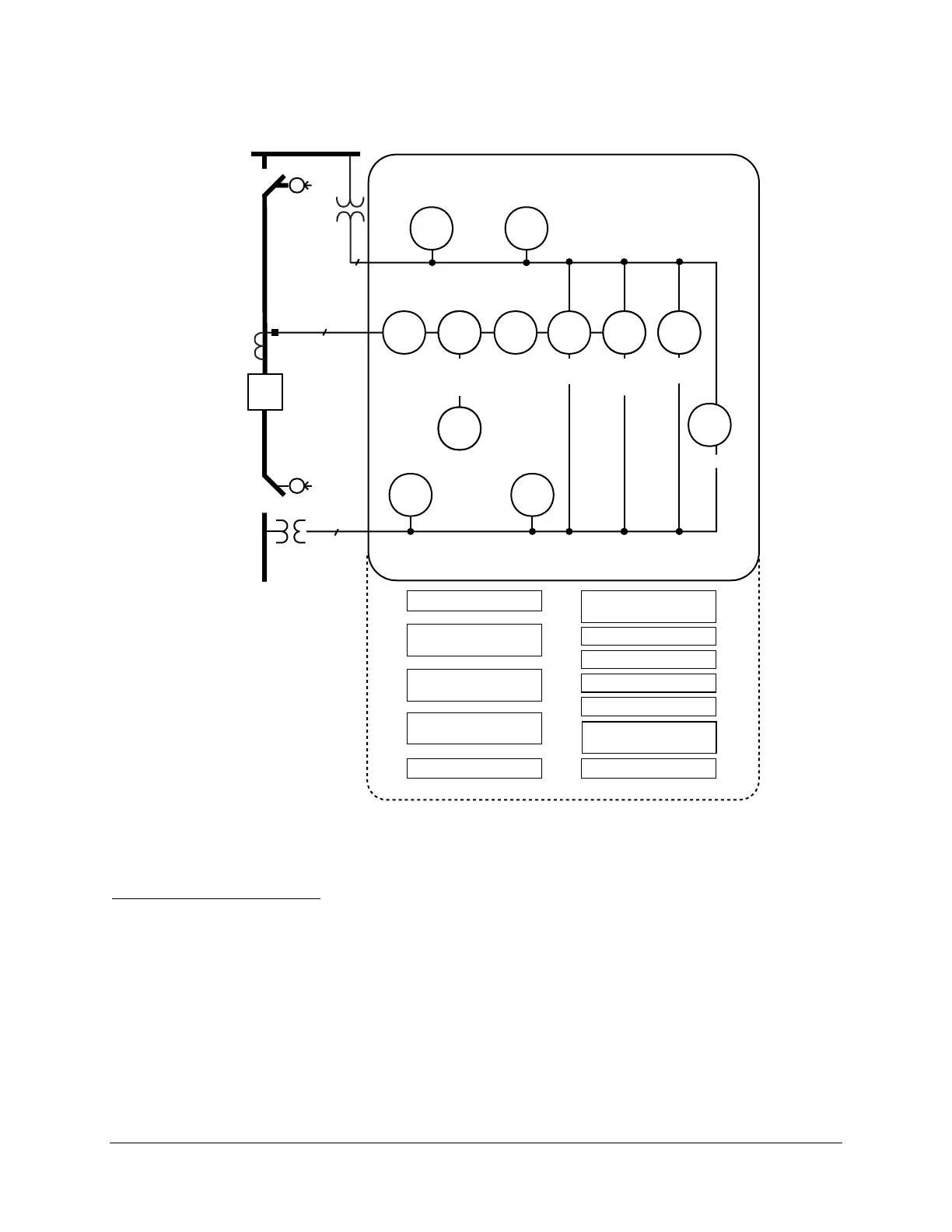
RELAY FUNCTIONS
SEL-352 Relay
37OP50
27
3
52
Undervoltage
59
25
Overvoltage
• Phase
• Neg. Seq.
1 or 3
27
Overcurrent
Undervoltage
Current
Unbalance
Synchronism
Check
87V
M
MOD
TRIP
1 or 3
46
M
MOD
TRIP
i2061 20010205
Motor
Operated
Disconnect
(MOD)
RMS
Overcurrent
62
P
Q
59
Overvoltage
• Phase
• Neg. Seq.
P
Q
50
P
G
26
Breaker
Failure
Timer
Synchronism
Check
Current
Unbalance
Overcurrent
• Phase
• Ground
Breaker
Overpower
Voltage
Differential
Insertion
Resistor
Thermal
Event Reports and
Sequential Events Recorder
SELOGIC Control Equations
Remote and Local
Control Switches
Local DisplayLocal Display
Breaker Operation and
Wear Monitors
®
Point-on-Wave Closing
Trapped Line Charge Detection
Flashover Protection
Breaker Isolation Control
Single-Pole
Fail-to-Close Detection
DNP 3.00 Level 2 Slave*
SELOGIC Control Equation
Analog Compares
®
*optional
Figure 1.2: Functional Overview
Breaker Failure Detection
The SEL-352 Relay has five fault current-driven breaker failure detection schemes, including one
specifically designed for ring-bus or breaker-and-a-half applications. Tailor the relay to your
circuit breaker failure detection requirements by selecting the most appropriate scheme or use
SELOGIC control equations to implement your own scheme.
The relay detects failures to interrupt fault, load, or line-charging current. It also detects failure
of breaker poles to complete a close sequence and can detect open breaker flashover failures. If
trip or close resistors remain in service after an operation, the relay detects this failure using a
thermal model.


 To Next Page