Date Code 20080110 Testing and Troubleshooting 10-17
SEL-387E Instruction Manual
Step 1.
Purpose: Set the torque-control equation for the desired condition.
Method: Execute the
SET
command via the relay serial port and set the desired
torque-control equation to the desired condition. For a test example, a
digital input is used. Enter
SET 51P1TC <Enter>
. When prompted, set
51P1TC to IN101. For an alternate way of testing, use the relay serial
port to set the 51P1TC to 1 (always asserted) or 0 (always deasserted),
instead of asserting an input.
Step 2.
Purpose: Assert the torque-control equation.
Method: Apply the appropriate conditions to assert the torque-control equation.
For this test example, apply control voltage to IN101.
Step 3.
Purpose: Display the appropriate Relay Word bit to verify the torque-control
equation.
Method: Execute the
TARGET
command (i.e.,
TAR F IN101 <Enter>
). The
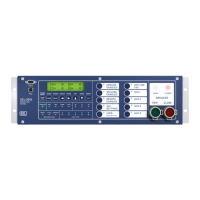
SEL-387E Relay now displays the state of the six input elements in the
second row of the front-panel LEDs. If multiple elements are used in the
torque-control equation, several
TARGET
commands must be issued to
view the individual elements.
Step 4.
Purpose: Display the appropriate Relay Word bit on the front-panel LEDs for the
desired overcurrent element.
Method: Execute the
TARGET
command (i.e.,
TAR F 51P1 <Enter>
). The
SEL-387E Relay now displays the state of several overcurrent elements in
the second row of the front-panel LEDs. The 51P1 bit is the fourth LED
from the left.
Step 5.
Purpose: Execute and verify an overcurrent test.
Method: Referring to the overcurrent tests previously outlined in this section,
execute an overcurrent test and verify its operation.
Step 6.
Purpose: Verify that the torque-control equation disables the overcurrent element
when deasserted.
Method: Remove the torque-control conditions to deassert the torque-control
equation. For this test example, remove control voltage from IN101.
Reexecute the same overcurrent test and verify that it does not operate.
Combined Overcurrent Elements
The SEL-387E Relay has one set of combined overcurrent elements. Set EOCC = Y to enable
this set, which uses the sum of currents from Windings 1 and 2. The set has a phase overcurrent
and a residual overcurrent element, both of which are inverse-time elements using the same
curves as the similar Winding 51 elements. This set consists of units 51PC1 and 51NC1.
The test for the combined overcurrent elements is intended to simulate the application for these
elements, namely a ring bus or breaker-and-a-half scheme where two sets of CT inputs from two


 To Next Page