10-24 Testing and Troubleshooting Date Code 20080110
SEL-387E Instruction Manual
Step 4.
Purpose: Connect and ramp a single-current test source until the appropriate LED
illuminates.
Method: Connect a single-current test source as shown in
Figure 10.6. Turn on the
current test source for the winding under test, and slowly increase the
magnitude of current applied until the 87R element asserts. Note the
magnitude of the current applied. It should equal the value calculated in
step 2, ±5% ±0.02 I
nom
.
Step 5.
Purpose: Repeat the test for each phase for each winding if desired.
Method: Repeat Steps 1 through 4 for each phase. Remember to view the
appropriate TARGET and apply current to the appropriate winding. The
computer terminal will display the LED labels from left to right when the
TAR F
command is issued.
SLP1 Restrained Differential Threshold
Step 1.
Purpose: Verify the differential characteristic settings and set winding
compensation.
Method: Execute the
SHO TAP1 <Enter>
command via the relay front panel or
serial port and verify the (TAP
n
) settings, the restraint slope 1 percentage
(SLP1) setting, the restraint slope 2 percentage (SLP2) setting, the
restraint current slope 1 limit (IRS1) setting, and the O87P minimum
pickup setting.
Execute the
SET W1CTC <Enter>
command and set the W
n
CTC
settings for the two windings to be used to the same value (0, 1, …, 12).
Save the settings.
Step 2.
Purpose: Display the appropriate Relay Word bit on the front-panel LEDs.
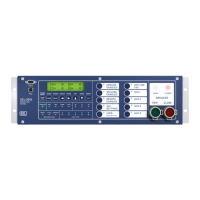
Method: Execute the
TARGET
command (i.e.,
TAR F 87R <Enter>
). The
SEL-387E Relay now displays the state of several differential elements in
the second row of the front-panel LEDs. The 87R bit is the right-most
LED.


 To Next Page