Date Code 20080110 Control Logic 4-17
SEL-387E Instruction Manual
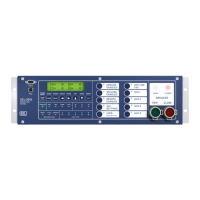
any of the 23 Relay Word bits associated with Winding 2 overcurrent elements. LED 14 remains
lit until reset by the TRGTR element. TRGTR is asserted for one cycle either via the TARGET
RESET pushbutton on the front panel or via the serial port command TAR R.
LED 15 – W3 – Winding 3 Overcurrent Element Operation
This LED will illuminate if any Winding 3 overcurrent element present in the TR1 through TR4
settings is asserted at the rising edge of the trip or one cycle later. Applicable elements include
any of the 23 Relay Word bits associated with Winding 3 overcurrent elements. LED 15 remains
lit until reset by the TRGTR element. TRGTR is asserted for one cycle either via the TARGET
RESET pushbutton on the front panel or via the serial port command TAR R.
LED 16– 50/51 – Overcurrent Trip
This LED will illuminate if any overcurrent element present in the TR1 through TR4 settings is
asserted at the rising edge of the trip or one cycle later. Applicable elements include any of the
overcurrent elements indicated by Relay Word bits “50***”, “50***T”, or “51**(*)T. LED 16
remains lit until reset by the TRGTR element. TRGTR is asserted for one cycle either via the
TARGET RESET pushbutton on the front panel or via the serial port command TAR R.
T
RIP AND
C
LOSE
L
OGIC
The trip logic and close logic for the SEL-387E Relay operate in a similar manner. Each has a
SEL
OGIC
control equation setting to set or latch the logic and another SEL
OGIC
control equation
setting to reset or unlatch the logic. Each also has other elements or functions that will unlatch
the logic. The output of each logic is a Relay Word bit that can be assigned to operate output
contacts, or in any other manner for which a Relay Word bit can be used. The specifics of each
type of logic are discussed below.
Trip Logic
There are four specific sets of trip logic within the SEL-387E Relay. They are designed to
operate when SEL
OGIC
control equation trip variable setting TRm is asserted (m = 1, 2, 3, 4), and
to unlatch when SEL
OGIC
control equation setting ULTRm is asserted. The output of the logic is
Relay Word bit TRIPm. The logic operates much like the Latch Bit function in SEL
OGIC
control
equation Sets 1 through 3, with additional characteristics. In the trip logic the set or latch
function has priority over the reset or unlatch function.
Figure 4.7 shows the logic diagram for the TRIP1 logic. The remaining logic for TRIP2 through
TRIP4 is identical, using variables TR2 through TR4 and ULTR2 through ULTR4, respectively.


 To Next Page