The principle behind the reagent tests is that the reagents necessary for the
color reaction are com bined in the form of liquid concentrates or solid-sub-
stance mixtures
. A few drops of the reagent concentrate are added to the
sample.
This means that there is no need to dilute the sample, which in turn
enhances the sensitivity of the detection
. The procedure generally used in
classical photometry by which the sample is made up to a defined volume
in a volumetric flask is dispensed with.
The method is selected automatically by means of the scanning of the bar
code by the AutoSelector.
All cells formats used are automatically identified and the correct measur-
ing range is selected automatically.
Subsequently the result is automatically shown on the display
.
2.1.2 Spectroquant
®
Reagent Tests
Spectroquant
®
photometers
Release 06/2014
7
2 Photometric Test Kits
2.1.1 Spectroquant
®
Cell Tests
Additional reagent(s)
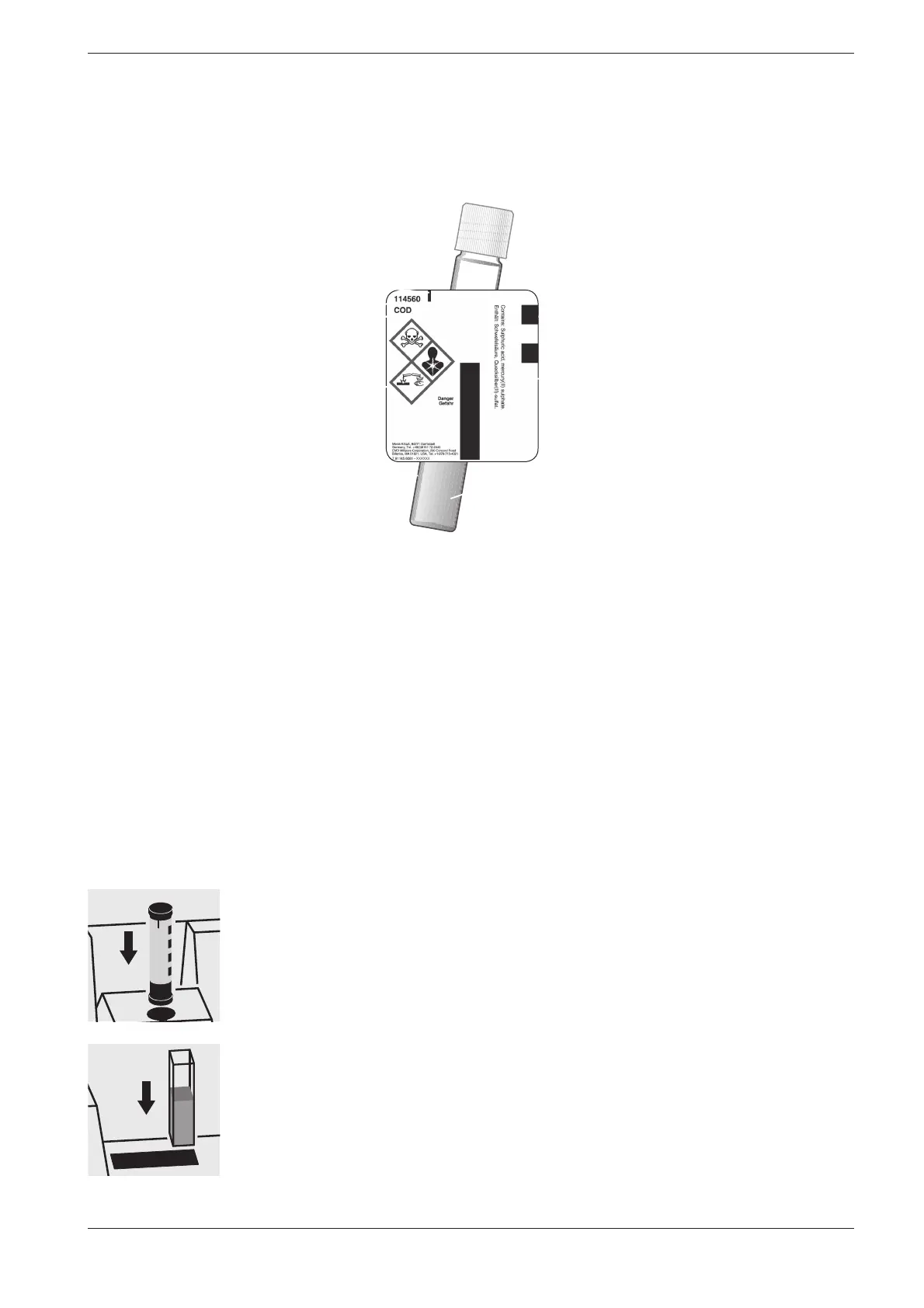
Certain cell tests, e. g. COD or nitrite, already contain all necessary rea-
gents in the cells, and the sample must merely be added with a pipette.
In other tests, however for reasons of chemical compatibility it is neces-
sary to separate the test into two or three different reagent mixtures. In
such cases, besides the sample a metered reagent must also be added.
Identification mark for the
correct insertion into the cell
compartment of the photo-
meter
Cat. No. of test kit
Designation of test kit
Risk phrases
Special cell in
optical quality
Leakproof cap
Bar code for identification
in the photometer
Details regarding contents
Highly precise dosage of
the reagent



 To Next Page