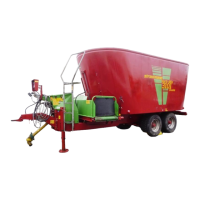
This document is an operating manual for the Strautmann Verti-Mix Double K fodder mixing trailer, available in models 1300, 1500, 1800, and 2100. It provides comprehensive information on the machine's design, operation, maintenance, and safety.
Product Description
The Verti-Mix Double K series fodder mixing trailers are designed for chopping, homogeneous mixing, transporting, and discharging various types of silage and normal fodders for livestock, provided the dry matter content of the total mixture exceeds 30%. Loading should only be done via a tractor with a front loader, a yard or wheeled loader, or dedicated feeding aids like a mineral feed funnel.
The machine consists of several key components:
- Drawbar (1): Connects the trailer to the tractor.
- PTO drive shaft (2): Transmits power from the tractor to the mixing augers.
- Storage yoke for PTO drive shaft (3): Secures the PTO drive shaft when not in use.
- Support stand (4): Stabilizes the uncoupled machine.
- Ladder, platform (5): Allows for monitoring of the mixing process.
- Counter-cutter (6): Aids in finer chopping and faster mixing of fodder.
- Mixing container (7): Holds and mixes the fodder.
- Angular gearbox for mixing auger drive (8): Part of the drive mechanism for the mixing augers.
- Shear pin safeguard (9): Protects the power train from overload.
- Brake axle (10): Provides braking capability.
- Wheels (11): Support the trailer.
- Parking brake (12): Secures the uncoupled machine.
- Rear crossover conveyor (13): Optional equipment for side discharge.
- Left rear protective device for crossover conveyor (14): Safety guard for the crossover conveyor.
- Hose cupboard for supply lines (15): Stores hydraulic and electrical supply lines.
- Operating terminal of weighing device (16): Optional display for the weighing system.
- Tilting support for the weighing device control terminal (17): Allows adjustment of the weighing device display.
- Electrohydraulic control block (18): Optional control unit for hydraulic functions.
Other notable features include:
- Opening scale for discharge door (1) and Indicator for opening width of discharge dosing slide (2): Help regulate fodder discharge.
- Wheel chocks (3): Used to secure the machine.
- Compensating reservoir for gear lubricant oil of the angular gears (4): Maintains oil level for the angular gears.
- Protective device front side discharge (8): Guards against accidental touching of the powered mixing auger.
Technical Specifications
The Verti-Mix Double K series comes in various models with different capacities and power requirements:
| Model |
Unit |
1300 DK |
1500 DK |
1800 DK |
2100 DK |
| Permissible laden weight |
kg |
11800 |
12000 |
|
|
| Admissible axle load |
kg |
10000 |
10000 |
|
|
| Permissible vertical load |
kg |
1800 |
2000 |
|
|
| Unladen weight |
kg |
4860 |
5330 |
6150 |
6610 |
| Usable mixing capacity* |
m³ |
13 |
15 |
18 |
21 |
| Maximum operating pressure |
bar |
210 |
|
|
|
| Oil flow rate |
l/min |
25 - 45 |
|
|
|
| P.T.O. speed |
min⁻¹ |
540 |
|
|
|
| Sound pressure level |
dB(A) |
84 |
|
|
|
Minimum power required (kW/PS):
- Without switchgear, 20 min⁻¹: 46/63 (1300 DK), 50/68 (1500 DK)
- Without switchgear, 24 min⁻¹: 53/72 (1300 DK), 57/78 (1500 DK), 64/88 (1800 DK), 71/96 (2100 DK)
- With switchgear, 16/13 min⁻¹: 41/55 (1300 DK), 44/60 (1500 DK), 50/67 (1800 DK), 54/74 (2100 DK)
- Without switchgear, 29 min⁻¹: 60/81 (1300 DK), 65/88 (1500 DK), 73/99 (1800 DK), 80/109 (2100 DK)
- With switchgear, 19/16 min⁻¹: 46/63 (1300 DK), 50/68 (1500 DK), 56/76 (1800 DK), 62/84 (2100 DK)
Dimensions of trailer (length, width, height, track, discharge height) vary by model and equipment (e.g., with/without rear crossover conveyor, different tire sizes, overflow ring). Tyre pressures range from 8.5/123 to 9/130 bar/psi depending on the tyre size and model.
Usage Features
The machine can be operated via direct tractor connection (standard), hand lever operating gear (optional), Bowden cable operation (optional), or electro-hydraulic control (optional).
Mixing Container and Mixing Auger:
- Mixing augers chop and mix fodder components.
- Cutting knives can be set in degressive (for pre-cut fodder) or aggressive (for long-fibre fodder) positions.
- Optional two-gear switchgear allows different mixing auger speeds (gear level I for small mixtures/evacuating residuals, gear level II for full containers/low-power tractors/straw blowers).
- An overflow ring (optional) prevents fodder from being thrown over the container edge.
- Counter-cutters (optional hydraulic) can be extended into the mixing container for finer chopping.
- A feed funnel (optional) allows easy filling of mineral feed.
- A ladder is provided for monitoring the mixing process.
Discharge Options:
- Front side discharge: Fodder is thrown directly into the feeding trough.
- Discharge conveyor for right-hand front discharge (optional): Transports fodder to elevated troughs. Speed can be manually or remotely adjusted.
- Discharge at the rear centre with protective device: Fodder is transported to the feeding table.
- Rear crossover conveyor (optional): Powered by a hydraulic motor, can discharge fodder to the right or left. Speed can be manually or remotely adjusted.
- Conveyor extension (optional): Extends the crossover conveyor for higher feeding troughs.
- Discharge door: Opened and closed via a hydraulic cylinder. Opening width determines fodder quantity.
Straw Blower (optional):
- Used for bedding lie-down areas.
- Mounted at the rear, has its own on-board hydraulic system, and is operated electro-hydraulically.
- Requires specific PTO shaft speeds for operation (750±100 min⁻¹ without switchgear, 1000±100 min⁻¹ with switchgear).
- Elimination of blockages: Requires switching off the PTO, closing the discharge door, securing the machine, waiting for the blower wheel to stop, and then accessing the blow-out pipe or blower casing.
Weighing Device (optional):
- Determines fodder quantities, can save recipes, and transfer data to a PC.
- Weight display can be swivelled for better visibility.
- Load is determined via 3 weighing rods mounted in the drawbar and at the axle.
Drawbar:
- Vertically adjustable for top hitching (flanged hitch ring 40 mm) or bottom hitching (flanged hitch ring 50 mm, tow-hook, or hitch pin).
- Proper adjustment ensures horizontal alignment of the mixing trailer.
Support Stand:
- Mechanical support stand (standard): Operated via a crank handle, with spindle and telescopic quick adjustment.
- Hydraulic support stand (optional): Operated remotely from the tractor.
PTO Drive Shaft:
- Transmits power from tractor to machine.
- Equipped with shear bolt couplings to protect the power train.
- Must be correctly fitted and guarded.
Hydraulic Hose Lines:
- Connect the machine's hydraulic components to the tractor's hydraulic system.
- Colour-flagged plugs (red for pressure, blue for return).
Ground Drive:
- Hydraulic working brake (standard): For speeds up to 6 km/h, not licensed for public roads in Germany.
- Two-line service brake system (optional): Compressed-air brake system for speeds up to 25 km/h. Includes a brake force regulator.
- Hydraulic service brake system (optional for export): For speeds up to 25 km/h.
- Parking brake: Secures the uncoupled machine.
Maintenance Features
- General Maintenance: Regular cleaning, lubrication, and timely replacement of worn/damaged parts are crucial for longevity and warranty.
- Oil Checks:
- Angular gearbox: Check oil level regularly, top up if necessary, change oil after 50 service hours (first time) then every 1000 service hours or once a year. Capacity: 20 litres.
- Switchgear: Check oil level regularly, top up if necessary, change oil after 50 service hours (first time) then every 1000 service hours or once a year. Capacity: 13 litres.
- Flat-type cylindrical gearing (on-board hydraulic system without switchgear): Check oil level regularly, top up if necessary, change oil after 50 service hours (first time) then every 1000 service hours or once a year. Capacity: 0.75 litres.
- On-board hydraulic system (for hydraulic functions or blower drive): Check hydraulic oil level, top up if necessary, change oil after 500 service hours (first time) then every 3000 service hours or every 2 years. Capacity: 21 litres (hydraulic functions) or 52 litres (blower drive).
- Shear Bolts: Replace shear bolts of the same class (8.8) when they shear off due to overload.
- Discharge Door: Check and adjust the gap between the discharge door and mixing container (approx. 5 mm).
- Cutting Knives: Grind cutting knives when blunt. Swivel or replace damaged knives. Wear protective goggles and gloves.
- Conveyors (crossover, discharge, extension): Check tension before each start-up. Straighten if not running straight or rubbing. Clean driving, supporting, and guide rollers. Lubricate flanged bearings every 25 service hours.
- Hydraulic Hose Lines: Check for defects annually by a specialist. Replace damaged or aged lines (max. 6 years old). Ensure proper connection and routing.
- Tyres: Check pressure every 14 days. Never overload. Repair deep cuts. Relieve pressure during long downtimes.
- Brake System: Check for proper functioning before start-up. Have it checked by an authorized workshop every 200 service hours. Clean in-line filters of compressed-air brake system every 3-4 months.
- Torque Settings: Adhere to specified torque settings for metric screw connections.
- Preserving/Long Downtimes: Clean, lubricate, oil, grease, and correct paint damage before long downtimes.

 Need help?
 General

 To Next Page