9-11
Catalyst 2950 Desktop Switch Software Configuration Guide
78-11380-03
Chapter 9 Configuring STP
Understanding Advanced STP Features
Understanding UplinkFast
Switches in hierarchical networks can be grouped into backbone switches, distribution switches, and
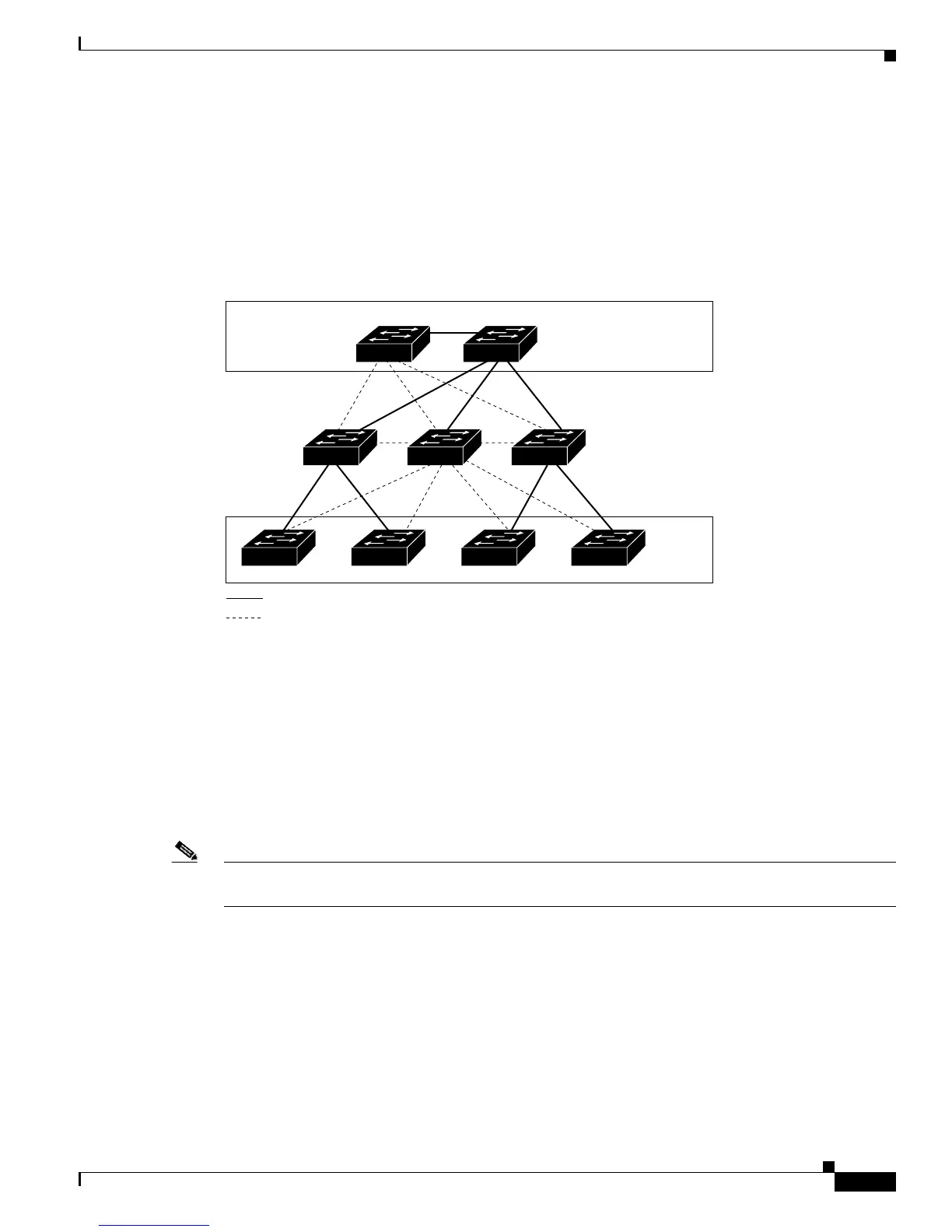
access switches. Figure 9-5 shows a complex network where distribution switches and access switches
each have at least one redundant link that STP blocks to prevent loops.
Figure 9-5 Switches in a Hierarchical Network
If a switch looses connectivity, it begins using the alternate paths as soon as STP selects a new root port.
When STP reconfigures the new root port, other interfaces flood the network with multicast packets, one
for each address that was learned on the interface.
By using STP UplinkFast, you can accelerate the choice of a new root port when a link or switch fails
or when STP reconfigures itself. The root port transitions to the forwarding state immediately without
going through the listening and learning states, as it would with normal STP procedures. UplinkFast also
limits the burst of multicast traffic by reducing the max-update-rate parameter (the default for this
parameter is 150 packets per second). However, if you enter zero, station-learning frames are not
generated, so the STP topology converges more slowly after a loss of connectivity.
Note UplinkFast is most useful in wiring-closet switches at the access or edge of the network. It is not
appropriate for backbone devices. This feature might not be useful for other types of applications.
UplinkFast provides fast convergence after a direct link failure and achieves load balancing between
redundant links using uplink groups. An uplink group is a set of interfaces (per VLAN), only one of
which is forwarding at any given time. Specifically, an uplink group consists of the root port (which is
forwarding) and a set of blocked ports, except for self-looping ports. The uplink group provides an
alternate path in case the currently forwarding link fails.
Figure 9-6 shows an example topology with no link failures. Switch A, the root switch, is connected
directly to Switch B over link L1 and to Switch C over link L2. The interface on Switch C that is
connected directly to Switch B is in a blocking state.
3550 3550
2900 2950T 3500 XL
2950 2950 2950 2950
Active link
Blocked link
Root bridge
Backbone switches
Distribution switches
Access switches
60998





 To Next Page