FARO
®
Laser Scanner Manual
5
Chapter 2: Introduction
• high mobility due to its small size, light weight, and the integrated quick
charge battery.
• High Dynamic Range (HDR) imaging method merges images captured with
different exposure settings to one image with a greater dynamic range of
luminosity.
• photorealistic 3D color scans due to the integrated color camera.
• integrated dual axis compensator to automatically level the captured scan
data,
• integrated GPS sensor to determine the scanner position.
• integrated compass and altimeter to give the scans an orientation and a
height information.
• WLAN to remotely control the scanner.
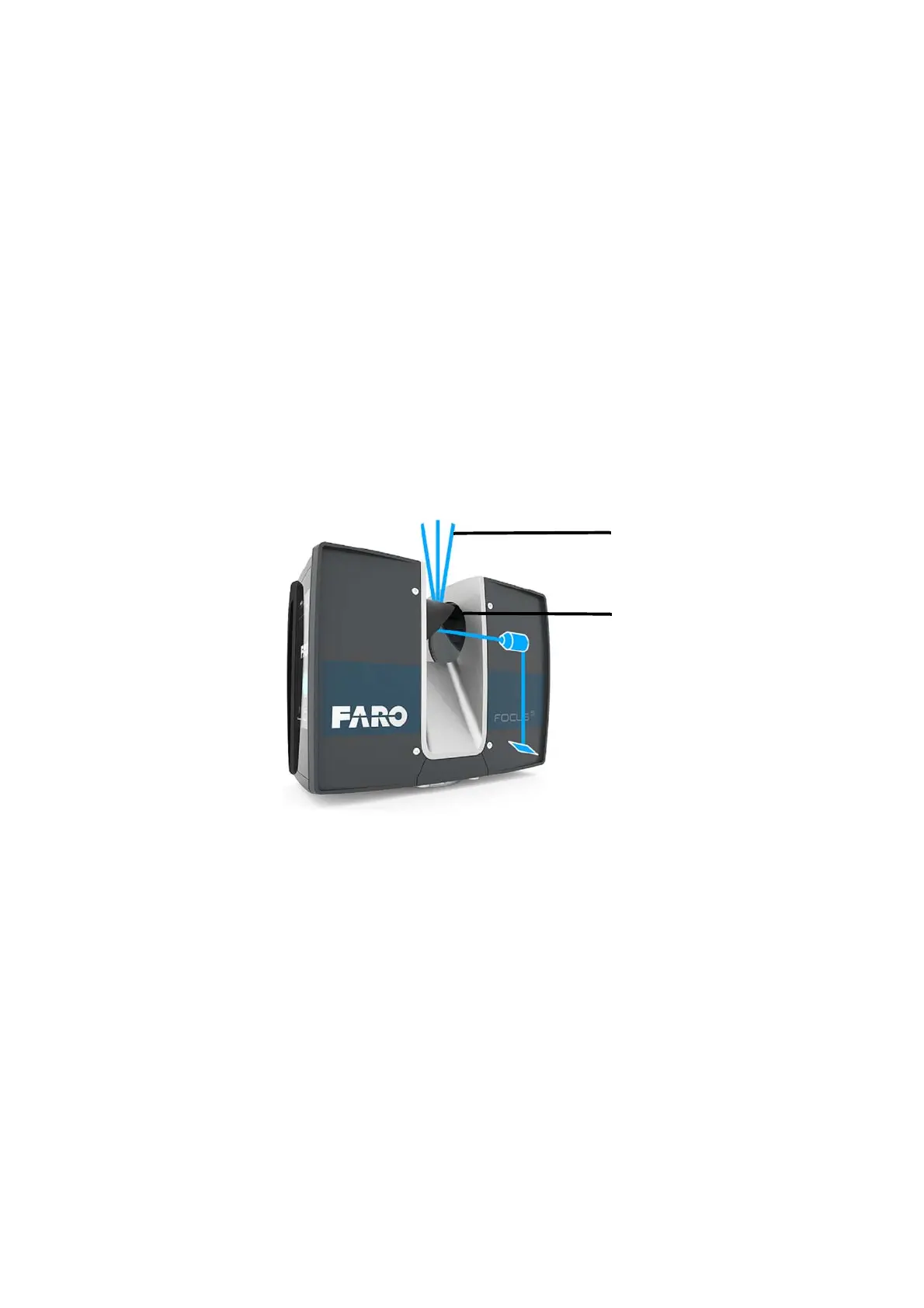
The FARO Laser Scanner works by sending an infrared laser beam into the
center of a rotating mirror. The mirror deflects the laser beam on a vertical
rotation around the environment being scanned; scattered light from
surrounding objects is then reflected back into the scanner.
Figure 2-2: Laser Deflection
To measure the distance, FARO Laser Scanner uses phase shift technology,
where constant waves of infrared light of varying length are projected outward
from the scanner. Upon contact with an object, the light is reflected back to the
scanner. The distance from the scanner to the object is accurately determined
by measuring the phase shifts in the waves of the infrared light.
HYPERMODULATION
TM
greatly enhances the signal-to-noise ratio of the
modulated signal with the help of a special modulation technology. The x, y, z
coordinates of each point are then calculated by using angle encoders to
measure the mirror rotation and the horizontal rotation of the FARO Laser
Scanner. These angles are encoded simultaneously with the distance
measurement. The scanner covers a 360° x 300° field of view.
Info einfügen, dass der senkrechte Sichtbereich nicht durchgängig 300°C
betragen kann.


 To Next Page