96 Technical data
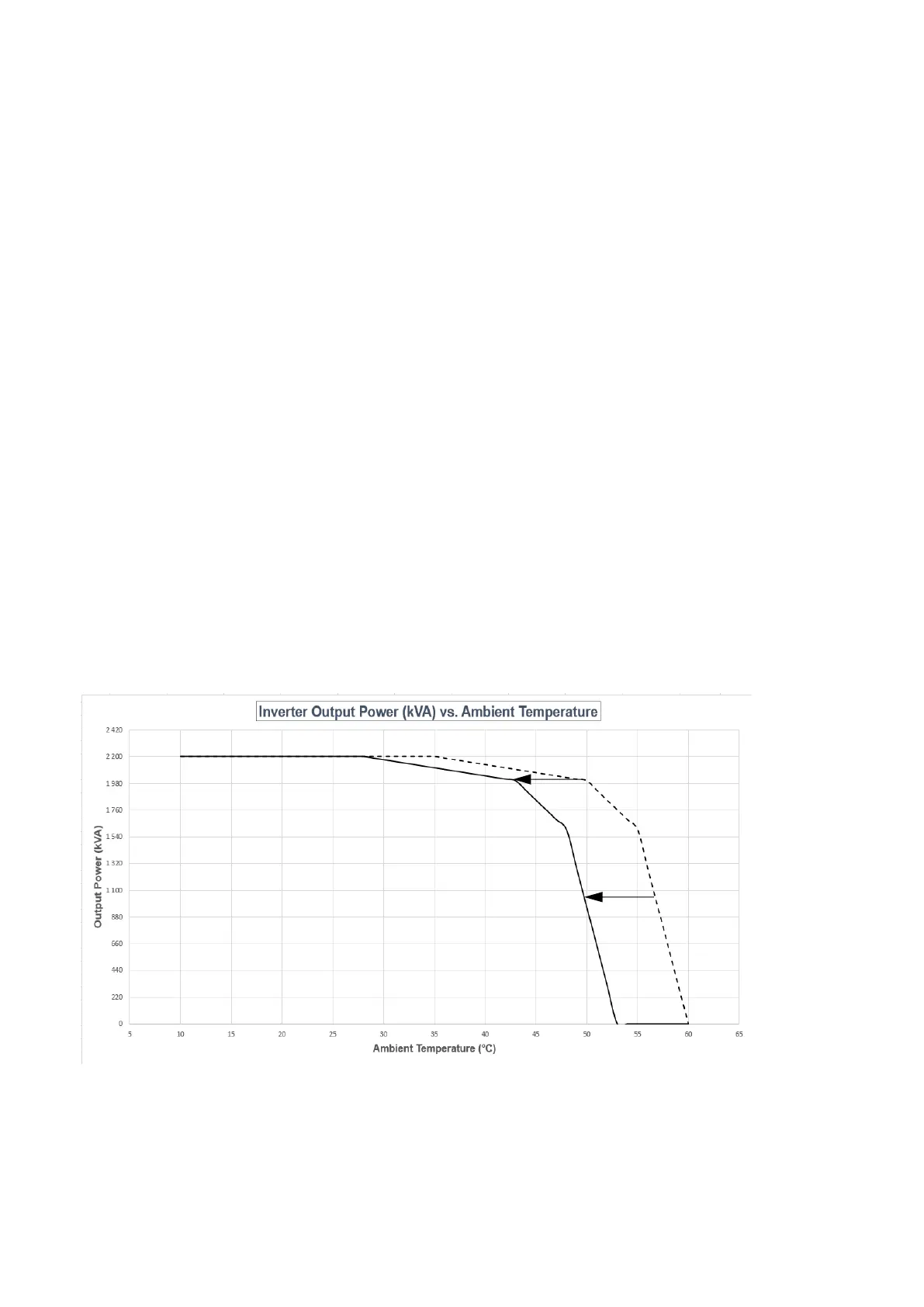
Altitude derating
The inverter load capacity (current and power) decreases if the installation site altitude is
higher than 1000 meters (3281 ft). The thinner air at high elevations decreases capacity of
the cooling system. To calculate the altitude effect for installations at elevation of:
• 1000...2000 m, add 1/2 K per 100 m to the inverter temperature derating curves (for
example, an installation altitude of 1200 m adds 1 K).
• 2000...4000 m, add first 1/2 K per 100 m up to 2000 m and then 1/4 K per 100 m to
the inverter temperature derating curves (for example, an installation altitude of
3500 m adds 8.75 K).
When you calculate the available inverter power, account for the different ratios of S(%)
per °C at different inverter operating temperatures.
This calculation example is for a site at 2800 m with an ambient temperature of 40 °C:
1. Calculate the altitude corrected temperature:
• 1000 m to 2000 m adds: 1/2 K / 100 m * (2000 m - 1000 m) = 5 °C
• 2000 m to 2800 m adds: 1/4 K / 100 m * (2800 m - 2000 m) = 2 °C
• Altitude corrected temperature: 40 °C + 5 °C + 2 °C = 47 °C
2. Calculate the inverter power difference with relation to the nominal (50 °C) value with
the altitude corrected temperature: (50 °C - 47 °C) * 2/3 S(%)/ °C = 2 S(%).
3. Add the result to the inverter nominal power (100 S(%)): 100 S(%) + 2 S(%) = 102
S(%).
4. Based on the calculation, in these conditions the inverter can produce 102% of its
nominal power.
5. 1.02 * 2000 kVA = 2040 kVA
If the total equivalent temperature (site °C + altitude K) exceeds the nominal temperature
of 50 °C, contact FIMER for more information.
7 °C
7 °C


 To Next Page