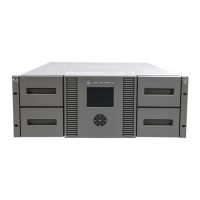
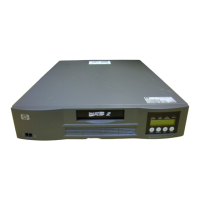
virtual tape library. Software emulation of a physical tape library is calle d
a virtual tape library.
See also virtual tape library.
logical unit num-
ber (LUN)
An address used in the SCSI protocol to access a device within a target. In the
case of the VLS, a LUN is assigned to each virtual library and tape drive.
LUN mapping A mechanism of changing the LUN assignments for a specifichost.
LUN masking An authorization process that makes a LUN available to some hosts and
unavailable to other hosts.
master server A computer that provides administration and control for backup and restore
operations for a ll clients and servers in a master and m e d ia server cluster. This
is called the primary node on the VLS300. When configu
ring the VLS300, set
the primary node using the letter “m”.
mean time until
data loss (MTDL)
The average time until a component failure can be expected to cause data loss.
This includes the consideration that RAID redundancy can protect against data
loss from the failure of a single component.
media access con-
trol (MAC) address
A l ow-level unique hardware identifier for every Ethernet port in the world that
is physically stored inside a net work card or similar network interface. MAC
addresses are assigned by the IEEE.
media server A computer whose p urpose is to move or copy data from one location to
another, such as from network clients to tape cartridges in a library.
node A server that contains the hardware and software required to run a virtual
librar y system. This refers to a hardware assembly containing a p ower supply,
cooling fans, motherboard, expansion boards, and internal hard drives to
support the VLS system.
oversubscription A condition that exists when more vir tual media storage is configu red on a VLS
than there is physical storage available.
Because the VLS dynamically allocates storage space as user data is written,
the VLS allows you to a llocate more storage for virtual m edia than is physically
available.
port mapping A mechanism of assigning a LUN (virtual device) , such as a virtual library or
tape drive, to a specific FC host port. Port mapping allows you to load-balance
the LUN s among the FC host por ts to m a ximize bandwidth.
At this time, you must manually load-balance the virtual tape drives in a VLS.
primary node O n the VLS300, a computer (node) that provides primary administrating a nd
control for backup and restore operations on a server cluster and provi des
communication and control for all secondary servers on the system. W hen
configuringtheVLS300,designatetheprimarynodeassuchusingtheletter“m”.
RAID A RAID volume appears to the operating system to b e a single logical disk.
RAID improves performance by disk striping, which involves partitioning
each drive’s storage space into units. By placing data on multiple disks, I/O
operations can overlap in a balanced way, improving performance.
R
AID 1-level data
storage
C
onsists of at least two drives that uses mirroring (100% duplication of the
storage of d ata). There is no striping. Read per formance is improved since
either disk can be read at the same time. Write performance is the same as
for single disk storage.
RAI D 5-level data
storage
Provides data striping at the byte level and also stripe error correction
information. R AID 5 configurations can tolerate one drive failure. Even with a
failed drive, the data in a R AID 5 volume can still be accessed normally.
HP StorageWorks
173


 To Next Page
 Loading...