Chapter 2. The Validator AVS Hardware
Kaye Validator AVS User’s Manual 33
2.5.1 Sensor and IRTD Installation
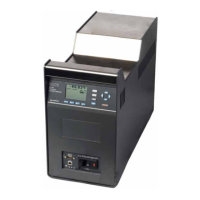
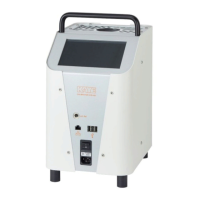
The Kaye LTR-90, LTR -25/140, LTR -40/140, and the HTR 400 temperature references
have inserts for thermocouples and two Kaye IRTDs. Failure to use these inserts to achieve
proper thermocouple placement in the temperature reference will result in reduced accuracy
during calibration.
The Kaye CTR -80 temperature reference has three thermocouple wells and two 12-inch
nylon spacers to allow you to properly position your thermocouples and Kaye IRTDs.
LTR-90, LTR -25/140, LTR -40/140, and HTR 400
To insert thermocouple sensors into the LTR-90, LTR -25/140, LTR -40/140, and
HTR 400:
• For LTR-90, insert the thermocouple sensors through the rubber insulator first.
IMPORTANT: The LTR-90 comes with a rubber insulator. This rubber insulator must be
used at all times. If it is not used, specifications are not guaranteed. Also, at
cold temperatures, there will be significant ice buildup, that will affect
accuracy and uniformity.
• Insert the thermocouple sensors into the inserts and push all the way down into the well.
For 22 gauge wire, three Type T PTFE or Kapton thermocouples fit into each well.
For 28 gauge wire, six Type T PTFE thermocouples fit into each well.
To install the IRTD into the LTR-90, LTR -25/140, LTR -40/140, and HTR 400:
• For LTR-90, insert the IRTD through the rubber insulator first.
• Insert the IRTD very slowly into one of the two reference wells (the two small wells) in
the LTR-90, LTR -25/140, LTR -40/140, or HTR 400. Do not drop it from the top of the
well. To prevent mechanical shock to the IRTD when immersing it in a new temperature
environment, ensure that the immersion process takes place over a 30-second interval.
The IRTD should fit snugly, but still be easily removed.


 To Next Page