5-20 LeeBoy 6150 Conveyor Paver
Maintenance
Each element is covered by a thin strip of insulation
to keep heat from escaping. A support bar and shield
protects the element assembly.
Each element is clamped onto the screed plate to
provide a positive and efcient connection. Enough
pressure should be applied to the element assembly
to sufciently hold it securely against the screed plate
surface.
To remove an element:
1. Remove top cover from the extension screed plate.
2. Loosen all the clamping studs over the element.
3. Remove and replace element.
4. After tightening the clamping stud, lock the clamp by
tightening the stud jam nut.
Generator
Voltage Testing
The generator is hydraulically-driven. (Figure 5-21)
When the hydraulic system is at normal operating
temperature and the engine is running at 1800 RPMs or
higher, the generator produces 240 VAC.
The generator voltage depends upon speed (RPMs),
increasing voltage as RPMs increase and decreasing
voltage as RPMs decrease. The voltage will decrease
signicantly if the engine speed is slower than 1800
RPMs.
NOTE: When testing the generator voltage ensure the
paver engine is at 1800 - 2200 RPMs, and the
hydraulic temperature is at normal operating
levels.
Test the generator voltage at the generator and at the
control box using the following procedure:
1. Use a volt meter to measure between the two main
input wires L-1 (black wire) and L-2 (white wire) at
the generator. (Figure 5-21) If you measure from
L-1 to the frame of the paver, or ground, the voltage
will be half the rated output of the generator.
2. Using the volt meter, measure between the black
and white input wires inside the control box on the
wire junction. The voltage should be the same as
what you measured at the generator.
If the voltage is lower, make certain the generator is
turning the correct speed by testing with a Hz meter or
photo tachometer. If the voltage is still low, contact your
authorized LeeBoy dealer for generator speed tuning
(see next section).
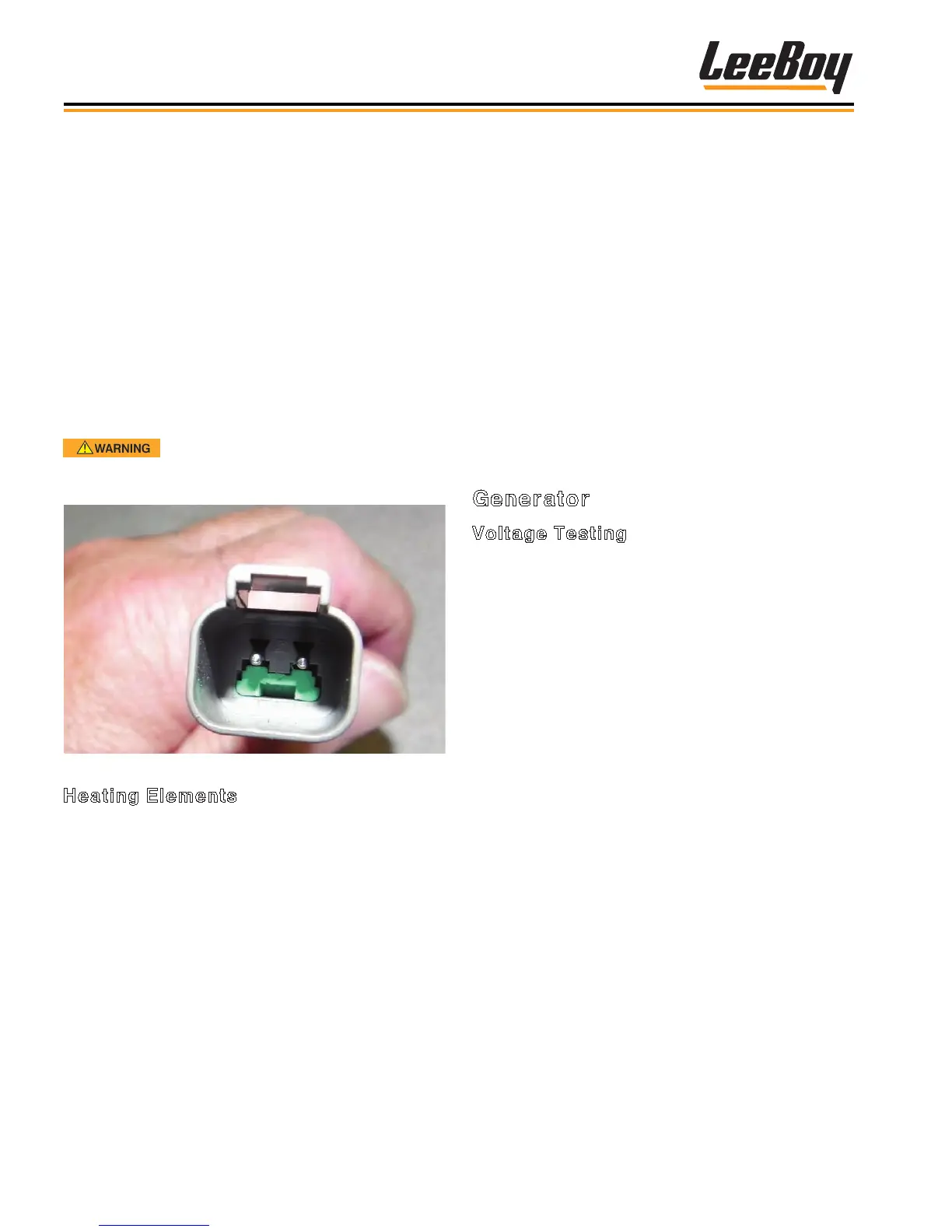
To test the element:
1. Disconnect elements one at a time from the
connection point on the lower side of the control
box, keeping track of connector placement.
2. Using an ohm meter, test the resistance through the
element between the two pins in the plug. (Figure
5-20)
NOTE: You do not have to test the plug attached to
the lower side of the control box.
3. Before replugging the element, check each wire
pin with an ohm meter test lead, placing the lead
on a steel section of the screed frame. If there is
any continuity through the element to the frame, the
element must be replaced.
DO NOT operate an element with a
known electrical shortage. Replace faulty elements
and wiring immediately.
Figure 5-20. Plug
Heating Elements
Each heating element is sized to t properly and provide
sufcient heat to the screed plate. Elevated temperature
prevents mix from sticking to the lower surface of the
screed plate.
An element assembly consists of four main components:
• The element.
• The wire protector adapter.
• The wire protector.
• The two-pin wire plug at the end of the element
protector.



 To Next Page