4-32 LeeBoy 6150 Conveyor Paver
Operation
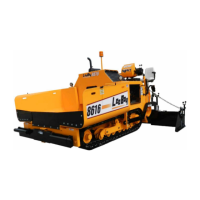
Figure 4-68. Paving Road with the 6150
Paving Tips
• Asphalt thickness is directly related to lasting
pavement. Only a half-inch makes a big difference.
• It’s easy to cover over failed or damaged asphalt,
but if the underlying cause of the failure/damage
isn’t repaired, the problem will reappear over time.
• Rocks and dirt below the asphalt that has not been
correctly compacted can fail. This is the most
common cause of asphalt failure in parking lots.
• Poor drainage and water seepage can cause the
asphalt base to fail.
• Less trafc can actually cause a road to fail due to
the lack of pavement compacting from trafc use.
• Extreme weather temperatures can cause the
pavement surface to fail if the apshalt is not sealed.
• If you want a quality pavement job, use quality
asphalt material. Sometimes, a thick single coat of
high-quality asphalt is better than two thin coats of
low-quality asphalt.
• Most defects to a mat occur when the paver is
stopped. Pave at a constant speed, limiting stops.
When stopped for extended periods, material
temperature drops and can cause the texture and
depth of the mat to change.
• One of the most important fundamentals of smooth
paving is maintaining a consistent paving speed.
Keep paving speed constant with limited stops.
• Keep your paver and any attachments in good
working condition and perform maintenance as
prescribed in this manual (and any accompanying
manuals). Equipment issues on the job site costs
production time and money.
• Always spray down the paver. Asphalt material can
build up and damage components.
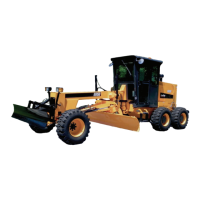
There are three adjusters in each screed extension,
however the adjusters at each end are preset by the
dealer and do not need adjustment. Adjust the mat
texture using the AOA adjustment screw in the center
to produce a smoother or coarser mat texture. (Figure
4-67)
NOTE: The screed extension should be hot before
making any adjustments.
Angle-of-Attack
Adjuster
Figure 4-67. AOA Adjustment
To make the AOA adjustment:
1. Spray down and heat the screed extension if
needed.
2. Turn the AOA adjuster in the direction for desired
result:
• Turning the AOA adjuster counterclockwise
will increase the pressure on the back of the
extension, which gives a smoother, slicker nish.
• Turning the adjusters clockwise will decrease
the pressure on the back of the extension,
resulting in a coarser nish.
• Dip the mat several times to determine the
average mat thickness and adjust the AOA or
mat depth as needed. Avoid overcorrection.
NOTE: Too much pressure on the back of the
screed extension will take the weight off the
screed wearplate and cause poor material
compacting, resulting in a poor nish.
NOTE: A cold screed, poor screed maintenance or
worn screed components will cause adverse
AOA variations.


 To Next Page