55
LeeBoy 6150 Conveyor Paver 5-23
Maintenance
Repack Front Wheel
It is important to repack the front “bogie” wheel bearings
with grease every year, or 1000 operating hours,
whichever comes rst. Repack the wheel bearings
with extreme-pressure, multipurpose grease using the
following procedure:
1. Jack up the paver, using jack stands for safety.
2. Pry off the hub cap cover, revealing the tapered
outer bearing inside. (Figure 5-24) Remove nut
and washer.
3. Slide the outer bearing (and washer in front of it) off
the spindle and inspect for damage.
Figure 5-24. Front Wheel
NOTE: If the outer bearings are damaged, the inner
bearings typically are, too. Both should be
replaced before operating the paver.
4. Wipe off all the old grease on the inner bearing
and clean the outer bearings with solvent. Be sure
to thoroughly rinse off the solvent and allow outer
bearing to dry.
5. Repack the hub with grease, ensuring the gaps in
the bearing is fully lubricated, and replace outer
bearing and hub cap cover.
6. Repeat on the other front tire.
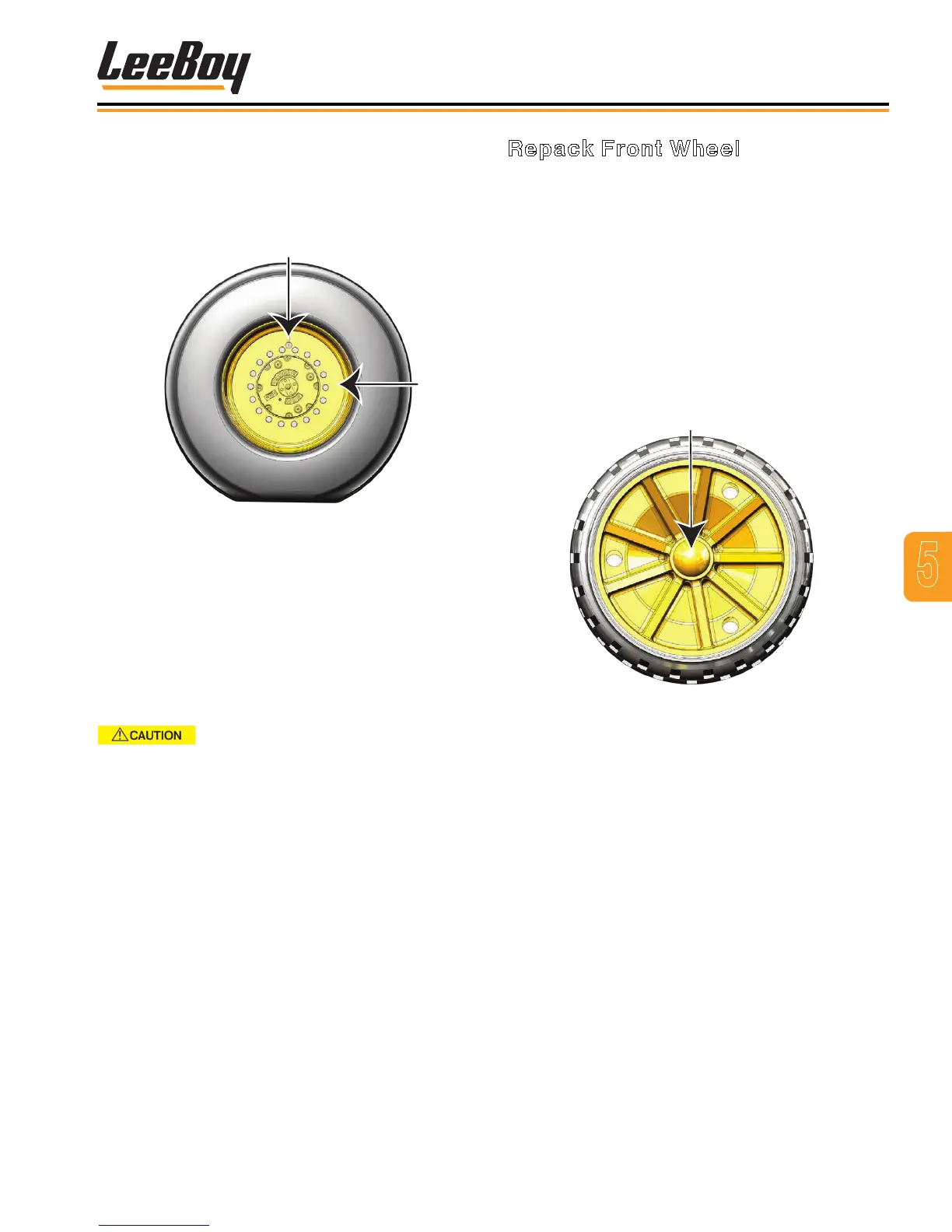
3. Rotate the wheel until the tire valve stem is at its
highest point (12 o’clock position) to ll with more
than 50 percent ballast. Rotate tire valve stem to
the 3 o’clock position if lling less than 50 percent
ballast. (Figure 5-23)
Figure 5-23. Tire Stem Positions
4. Attach ll nozzle to tire stem plug, bearing in mind
pressure will build up inside as the tire lls. You may
need to evacuate air to release pressure. Fill tires
until solution begins to seep from the tire stem. Do
not ll tire completely.
5. After pumping the solution into the tires, remove
the axle support and add more air to achieve the
correct PSI with full weight of the machine resting
on the tires.
DO NOT inate tires beyond the tire
manufacturer’s recommended PSI.
• Always rinse tire rims when adding or evacuating
liquid ballast, especially if using corrosive or toxic
solutions.
• Evacuate liquid ballast by supporting the axle and
pumping out solution, then lling with air to the correct
PSI.
• If using any of the toxic solutions previously
discussed, be sure to dispose of liquid ballast in
compliance with local and federal environmental laws.
Never pump toxic chemicals onto the ground.


 To Next Page