62
PARAMETERS
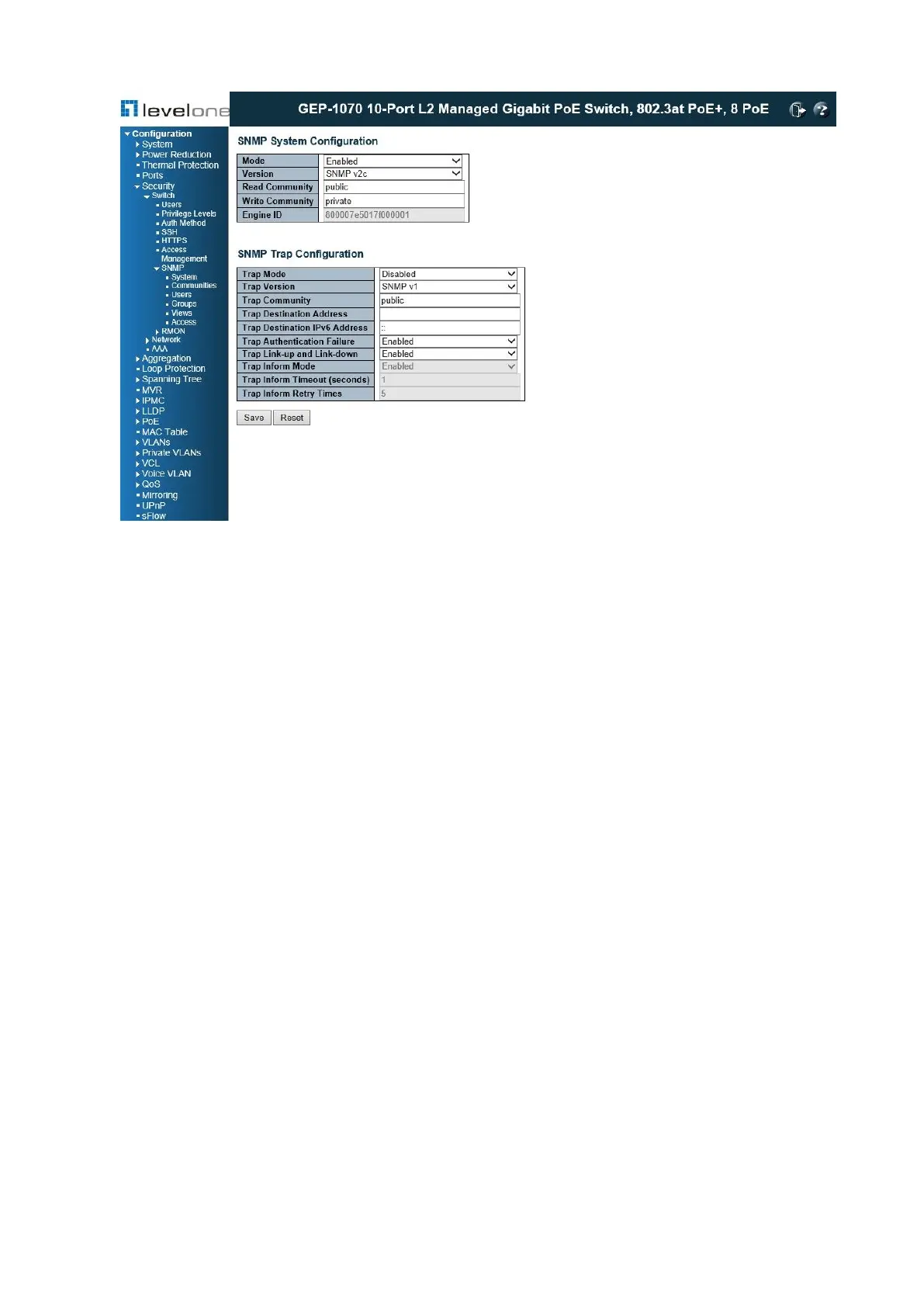
These parameters are displayed:
SNMP System Configuration
◆ Mode – Enables or disables SNMP service. (Default: Disabled)
◆ Version – Specifies the SNMP version to use. (Options: SNMP v1, SNMP v2c, SNMP v3;
Default: SNMP v2c)
◆ Read Community – The community used for read-only access to the SNMP agent.
(Range: 0-255 characters, ASCII characters 33-126 only; Default: public) This parameter
only applies to SNMPv1 and SNMPv2c. SNMPv3 uses the User-based Security Model
(USM) for authentication and privacy. This community string is associated with SNMPv1
or SNMPv2 clients in the SNMPv3 Communities table (page 60).
◆ Write Community – The community used for read/write access to the SNMP agent.
(Range: 0-255 characters, ASCII characters 33-126 only; Default: private) This parameter
only applies to SNMPv1 and SNMPv2c. SNMPv3 uses the User-based Security Model
(USM) for authentication and privacy. This community string is associated with SNMPv1
or SNMPv2 clients in the SNMPv3 Communities table (page 60).
◆ Engine ID – The SNMPv3 engine ID. (Range: 10-64 hex digits, excluding a string of all 0’s
or all F’s; Default: 800007e5017f000001) An SNMPv3 engine is an independent SNMP
agent that resides on the switch. This engine protects against message replay, delay, and
redirection. The engine ID is also used in combination with user passwords to generate
the security keys for authenticating and encrypting SNMPv3 packets. A local engine ID is
automatically generated that is unique to the switch. This is referred to as the default
engine ID. If the local engine ID is deleted or changed, all local SNMP users will be




 To Next Page