57
Reference Manual
00809-0100-4108, Rev CA
Operation and maintenance
March 2017
Operation and maintenance
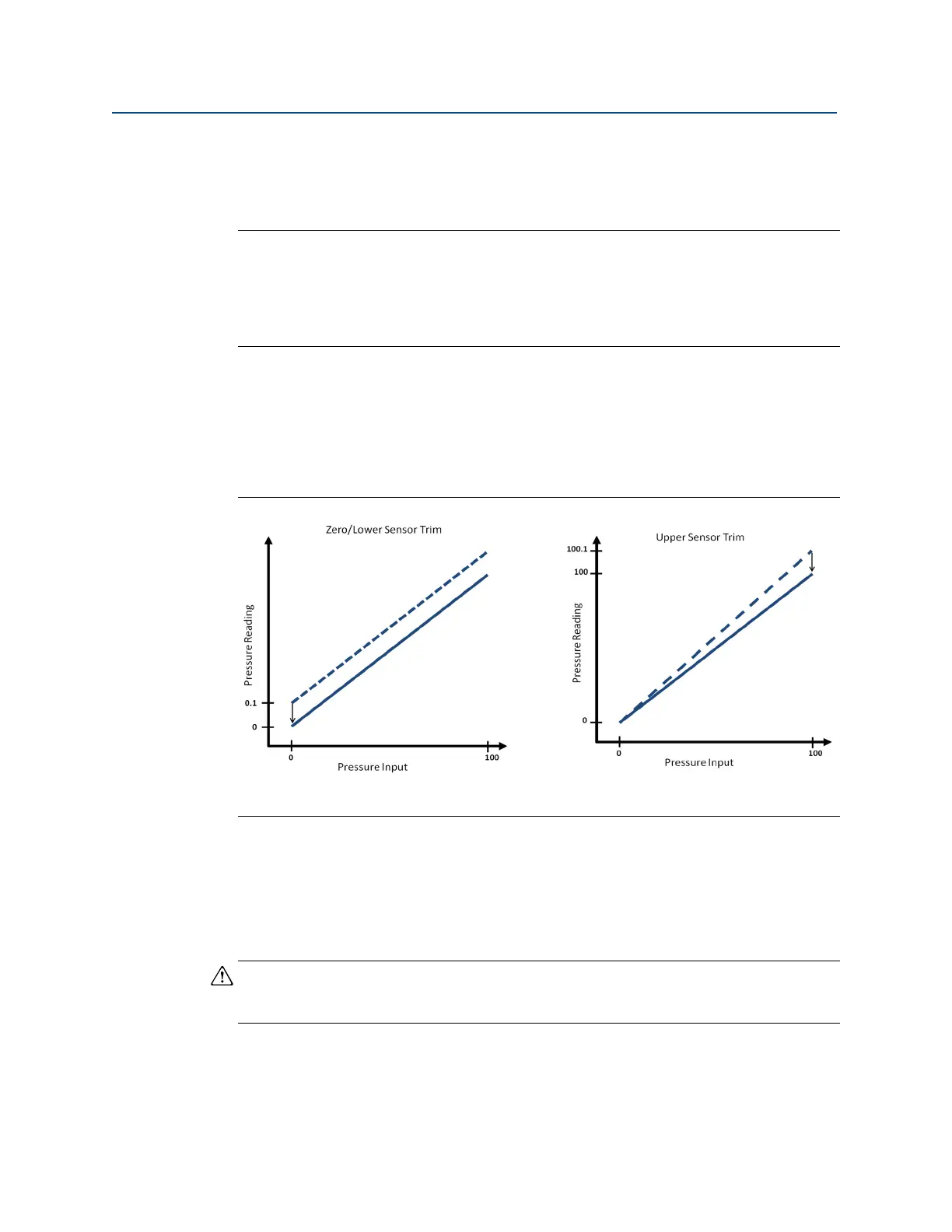
Zero trim is a single-point offset adjustment. It is useful for compensating for mounting
position effects and is most effective when performed with the transmitter installed in its
final mounting position. Since this correction maintains the slope of the characterization
curve, it should not be used in place of a Sensor Trim over the full sensor range.
Note
Do not perform a zero trim on Rosemount 2088A, 2090FA, 2090PA Absolute Pressure
Transmitters. Zero trim is zero based, and absolute pressure transmitters reference absolute
zero. To correct mounting position effects on an Absolute Pressure Transmitter, perform a
low trim within the sensor trim function. The low trim function provides an offset correction
similar to the zero trim function, but it does not require zero-based input.
Upper and lower sensor trim is a two-point sensor calibration where two end-point
pressures are applied, all output is linearized between them, and requires an accurate
pressure source. Always adjust the low trim value first to establish the correct offset.
Adjustment of the high trim value provides a slope correction to the characterization curve
based on the low trim value. The trim values help optimize performance over a specific
measurement range.
Figure 5-2. Sensor trim example
A. Before trim
B. After trim
5.5.2 Perform a sensor trim
When performing a sensor trim, both the upper and lower limits can be trimmed. If both
upper and lower trims are to be performed, the lower trim must be done prior to the upper
time.
Note
Use a pressure input source that is at least four times more accurate than the transmitter,
and allow the input pressure to stabilize for 10 seconds before entering any values.



 To Next Page