Need help?
Do you have a question about the Sam4s ER-260EJ and is the answer not in the manual?
Describes the flexible electronic cash register's features and benefits.
Explains the manual's structure and how to navigate its seven sections effectively.
Details how to interpret and follow flowchart diagrams used throughout the manual.
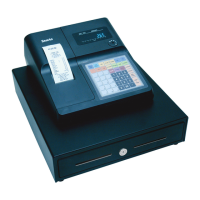
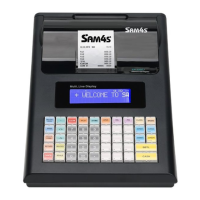
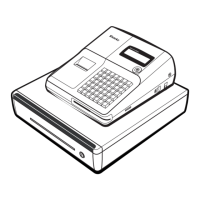
Illustrates and describes the physical components and connection ports of the ECR.
Explains the different display modes: Register, Void, Manager, Z, Program, and Service.
Guides users on navigating through various mode menus using navigation keys.
Details the 7 positions of the control lock and the functions accessible by each key.
Shows the default key assignments and NLU locations for the ER-260EJ model.
Provides a comprehensive explanation of the function and purpose of each key on the ECR.
Outlines the steps to perform an initial clear to reset the register to a default state.
Provides initial steps for setting up and preparing the ECR for basic operation.
Instructions for unpacking the cash register and initial setup.
A step-by-step guide on how to load and install the printer paper roll.
Details the security-sensitive procedure for clearing all totals and counters before initial use.
Introduces the ECR's capabilities for sales operations and lists common procedures.
Explains the functionality of various keys used in register operations.
Covers managing clerk sign-on and sign-off procedures and modes.
Explains how items are registered using PLUs, including keyboard and code entry.
Details different methods like Open, Preset Price, and Gallonage PLU entries.
Explains how to multiply item quantities and price items in groups.
Describes using single item PLUs and entering PLUs via code.
Explains how to correct errors, void last item, or void previous items.
Details how to cancel transactions or use void mode for complete transaction correction.
Describes handling payments received outside sales and tracking cash paid out.
Explains how to finalize sales using cash, check, charge, and split tenders.
Explains how to program and use currency conversion for foreign sales.
Introduces interfacing the ECR with optional load-cell scales.
Covers managing PLUs not found in the file and using the Not Found PLU list.
Introduces management functions accessible via the X mode control lock position.
Explains how to access and navigate the Manager Mode menu.
Details how to generate various X reports for examining sales data.
Guides on printing selected parts of the electronic journal memory.
Explains the procedure for counting and reporting cash drawer contents.
Describes how to enable training mode for practice without affecting totals.
Details how to enter stock levels for PLUs, including single PLU and ranges.
Explains how to enable or disable the register printer for receipts.
Introduces the functions available in the Z mode, primarily for resetting reports.
Details how to generate Z reports, which reset totals and counters.
Procedures for clearing the electronic journal and not found PLU entries.
Overview of secure operations performed in Service Mode.
Explains how to navigate and access the Service Mode menu.
Guides on running self-tests for various ECR components.
Details the various options for clearing specific areas of the ECR memory.
Explains how to allocate memory for PLUs, clerks, groups, etc.
Describes how to reprogram key locations with different functions.
Guides on configuring serial and USB ports for connected devices.
Covers ROM info, print density, LCD contrast, and network settings.
Introduces utilities for backing up and restoring ECR programs via SD or USB.
Details procedures for updating the ECR's flash ROM via SD card or PC.
Instructions on formatting SD/USB cards as FAT32 for ECR use.
Introduces the program mode for configuring PLUs, groups, keys, options, etc.
Explains two methods: Overlay and Code for programming descriptors.
Lists the ten main programming categories available in Program Mode.
Introduces PLU programming, covering adding, deleting, and stock management.
Step-by-step guide for adding or modifying individual PLUs or ranges.
Detailed explanation of various options available for PLU programming.
Covers procedures for deleting single PLUs or ranges of PLUs.
Details how to manage PLU inventory levels, including add, subtract, or replace.
Guides on organizing PLUs into groups for sales analysis.
Describes how to assign functions to programmable keys on the keyboard.
Details configuration options for various keys like #/No Sale, %, ADD CHECK, and CANCEL.
Explains the extensive options for programming charge keys for payment processing.
Guides on recording and performing sequences of keystrokes using macro keys.
Introduces the organization of options into categories for easier configuration.
Covers setting up clerk information, passwords, and access permissions.
Details the procedure for setting the ECR's internal clock and calendar.
Overviews tax calculation options: Add-On, VAT, and GST.
Guides on setting up complex tax rates using tax table programming.
Details how to set up mix and match discounts, including name, quantity, and price.
Shows a sample of the financial report output, detailing sales and tax information.
Displays a sample time report, showing sales activity by time period.
Illustrates a sample PLU report, showing sales counts and totals for each PLU.
Shows a sample clerk report detailing sales and drawer totals per clerk.
Displays a sample report showing sales aggregated by item groups.
Illustrates sample daily sales reports and PLU stock level reports.
Shows a sample report detailing cash, check, and charge amounts in the drawer.
Provides formulas for balancing net and gross sales figures.
Overview of integrated payment systems using EMV Datacap equipment.
Lists necessary items like SD cards and Datatran equipment for EMV implementation.
Illustrates network configurations for single and multi-ECR setups.
Details essential ECR settings, including port configuration for EMV devices.
Covers system options specific to EMV and payment processing.
Guides on programming charge keys for various payment types like credit, debit, and gift.
Explains specific options for programming charge keys, including card types and tips.
Instructions for loading device parameters required for EMV functionality.
Illustrates a typical EMV transaction process from sale to approval.
Step-by-step guide for manually entering credit card details when reader fails.
Covers processing merchandise returns using EMV transactions.
Explains the process for voiding sales transactions with EMV payment.
Introduces EMV related operations using Datatran functionality.
Instructions for loading EMV parameters into the PIN-Pad device.
Details how to enter customer tips using the Datatran Tip Key.
Provides crucial notes and considerations for EMV integration and card processing.
Defines activity count increments and the cancel function for transactions.
Explains cash declaration procedures and the role of clerks in sales.
Defines compulsory operations, tendering, and condiment requirements.
Explains currency conversion features and decimal multiplication for fractional units.
Describes the electronic journal capability and how error conditions are signaled.
Defines terms related to flash memory, gallonage sales, and PLU group organization.
Explains managing PLUs not found in the file and open PLU pricing.
Defines override operations and over/under-tendering scenarios.
Defines PLUs, post tender operations, and preset PLU functionality.
Defines tax calculation methods via rate or table, tax exempt, and tax shift.
Defines VAT, void operations, and the function of X and Z reports.
 General
| Brand | Sam4s |
|---|---|
| Model | ER-260EJ |
| Category | Cash Register |
| Language | English |


 To Next Page