5-12 Metering and Monitoring Date Code 20080110
SEL-387E Instruction Manual
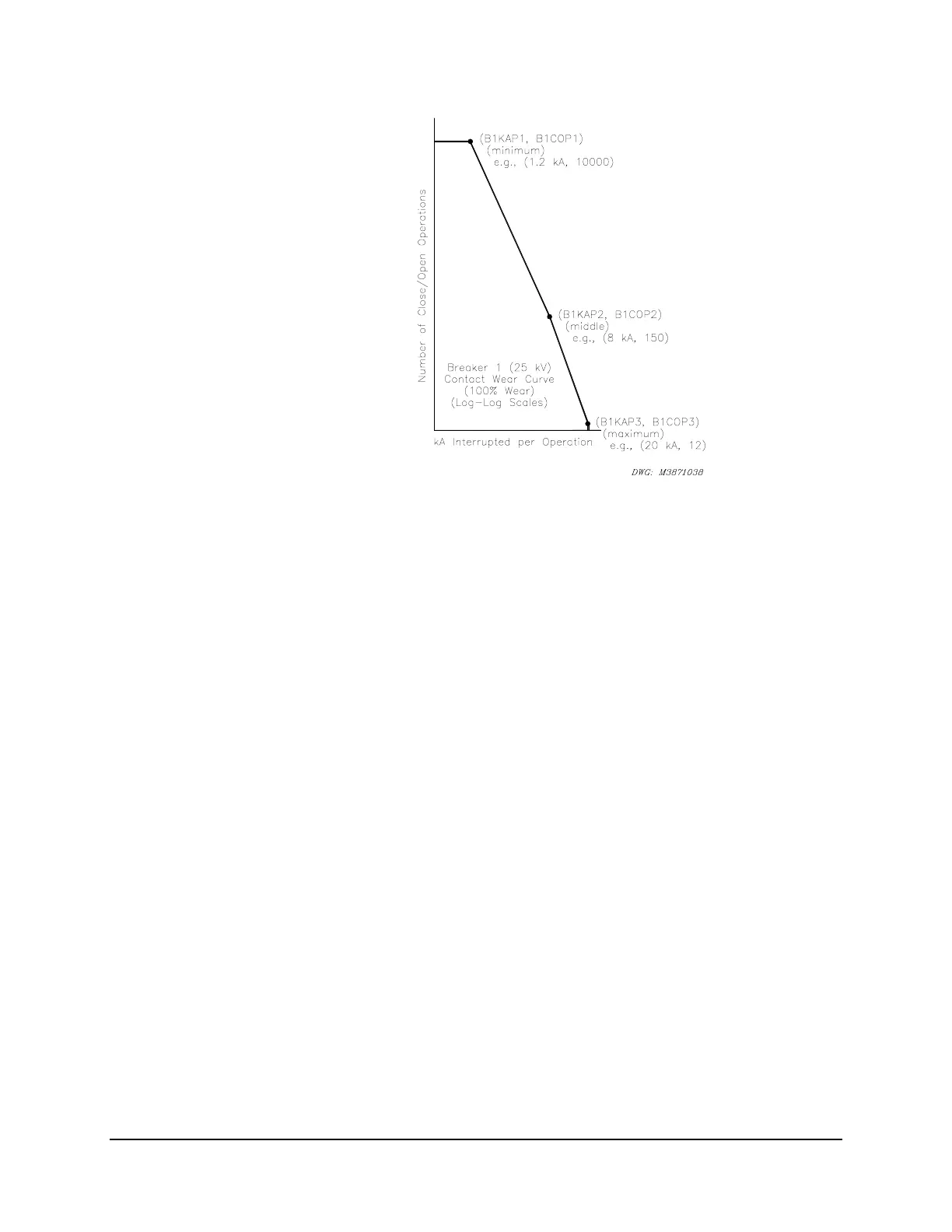
Figure 5.5: Breaker Contact Wear Curve
The curve is a plot of close/open operations versus interrupted current in kiloamperes (kA). The
scales are logarithmic on both axes. For each Breaker
n
, three points are input in the Global
setting area as relay settings. The points are defined by pairs of coordinates of current and
operations. For Breaker
n
, these are the points (B
n
KAP1, B
n
COP1), (B
n
KAP2, B
n
COP2), and
(B
n
KAP3, B
n
COP3). As shown in Figure 5.5, the point (B
n
KAP1, B
n
COP1) must represent the
lowest current value, point (B
n
KAP2, B
n
COP2) an intermediate current value, and point
(B
n
KAP3, B
n
COP3) the maximum current value. The relay will not accept the settings unless
B
n
KAP1 < B
n
KAP2 < B
n
KAP3.
For values of current in kA (I) below B
n
KAP1, the number of operations is assumed to be the
same as for B
n
KAP1. In this part of the curve, the number of operations may be governed more
by the cumulative mechanical wear and tear on the breaker operating mechanism, rather than
actual contact degradation. For values of current in kA above B
n
KAP3, there is assumed to be
no breaker capability to interrupt, and 100 percent contact wear is assumed. B
n
KAP3, then, is
typically set at the maximum rated interrupting current for the particular breaker. B
n
KAP1 is set
at a value approximating the continuous load current rating of the breaker. B
n
KAP2 is set at
some intermediate value of current, chosen to provide the closest visual “fit” to the
manufacturer’s curve.
The two straight line segments of the curve between the three defined points define the number
of operations as a function of current in kiloamperes by an equation of the form:
α
= I•KIO


 To Next Page