Date Code 20080110 Testing and Troubleshooting 10-33
SEL-387E Instruction Manual
Step 5.
Purpose: Repeat the test for each phase overvoltage element.
Method: Repeat Steps 1–4 for the
59P2
overvoltage element.
Step 6.
Purpose: Verify the expected phase-to-phase overvoltage pickup setting.
Method: Execute the
SHOWSET
command via the relay front panel or serial port
and verify the setting (i.e.,
SHO 59PP1 <Enter>
).
Step 7.
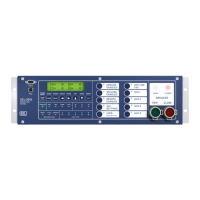
Purpose: Display the appropriate Relay Word bit on the front-panel LEDs.
Method: Execute the
TARGET
command (i.e.,
TAR F 59PP1 <Enter>
). The
SEL-387E Relay now displays the state of the overvoltage elements on
the bottom row of front-panel LEDs.
Step 8.
Purpose: Apply balanced three-phase voltage above the setting and raise one phase
voltage until the appropriate LED illuminates.
Method: Apply balanced three-phase voltages as shown in
Figure 10.5, adjusted to
a value below the
59PP1
setting. Raise one phase voltage until the
59PP1
LED illuminates. The phase-to-phase voltage should equal the
59PP1
setting ±2 V and ±5% of setting. Repeat the test for the other two phase-
to-phase voltages.
Step 9.
Purpose: Repeat the test for each phase-to-phase overvoltage element.
Method: Repeat Steps 6–8 for each
59PP2
overvoltage element.
Step 10.
Purpose: Verify the expected positive-sequence overvoltage pickup setting.
Method: Execute the
SHOWSET
command via the relay front panel or serial port
and verify the setting (i.e.,
SHO 59V1P <Enter>
).
Step 11.
Purpose: Display the appropriate Relay Word bit on the front-panel LEDs.
Method: Execute the
TARGET
command (i.e.,
TAR F 59V1 <Enter>
). The
SEL-387E Relay now displays the state of the overvoltage elements on
the bottom row of front-panel LEDs.
Step 12.
Purpose: Apply balanced three-phase voltage below the setting and raise one phase
voltage until the appropriate LED illuminates.
Method: Apply balanced three-phase voltages as shown in
Figure 10.5. Raise one
phase voltage until the
59V1
LED illuminates. The positive sequence
voltage,
V1
, may be calculated as (VA + VB +VC)/3 if the voltages are
120 degrees apart in proper phase rotation.
Step 13.
Purpose: Verify the expected negative-sequence overvoltage pickup setting.
Method: Execute the
SHOWSET
command via the relay front panel or serial port
and verify the setting (i.e.,
SHO 59QP <Enter>
).


 To Next Page