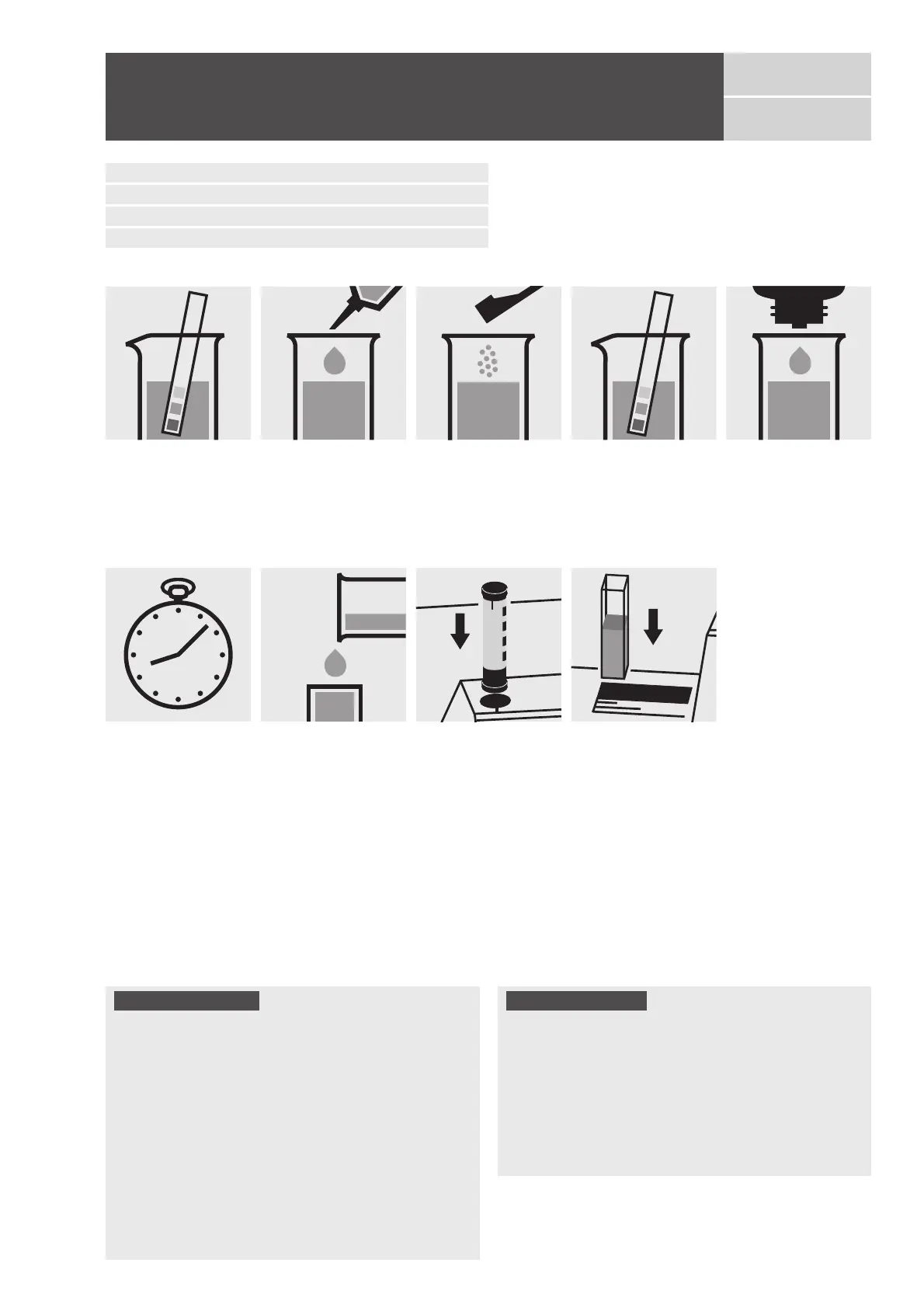
Add 1 green dosing
spoon of Cu-1 and
dissolve the solid
substance.
Check the pH, specified
range:
pH 7.0 – 9.5.
If required, add dilute
sodium hydroxide
solution or sulfuric acid
drop by drop to adjust
the pH.
Add 5 drops of Cu-2 and
mix.
Measuring 0.10 – 6.00 mg/l Cu 10-mm cell
range: 0.05 – 3.00 mg/l Cu 20-mm cell
0.02 – 1.20 mg/l Cu 50-mm cell
Expression of results also possible in mmol/l.
Copper
114767
Test
Reaction time:
5 minutes
Transfer the solution into
a corresponding cell.
Select method with
AutoSelector.
Place the cell into the
cell compartment.
Pipette 5.0 ml of the
sample into a test tube.
Quality assurance:
To check the measurement system (test reagents,
measurement device, and handling) w
e recommended
to use Spectroquant
®
CombiCheck 30, Cat.No. 114677.
Ready-for-use copper standard solution
Certipur
®
,
Cat.No.
119786, concentration 1000 mg/l Cu, can also
be used after diluting accordingly.
To check for sample-dependent effects the use of addition
solutions (e.g. in CombiCheck 30) is highly recommended.
Important:
Very high copper concentrations in the sample produce
turquoise-colored solutions (measurement solution should
be blue) and false-lo
w readings are yielded.
In such cases the sample must be diluted (plausibility
check).
For the determination of total copper a pretreatment with
Crack Set 10C, Cat.No. 114688, or Crack Set 10, Cat.No.
114687 and thermoreactor is necessary.
Result can be expressed as sum of copper ( Cu).
To measure in the 50-mm cell, only the sample volume
has to be doubled.
Alternatively, the semi-microcell, Cat.No. 173502, can be
used.
Check the pH of the
sample, specified range:
pH 4 – 10.
If required, add dilute
sodium hydroxide
solution or sulfuric acid
drop by drop to adjust
the pH.
Release 06/2014 - Spectroquant
®
UV/VIS Spectrophotometer Pharo 300



 To Next Page