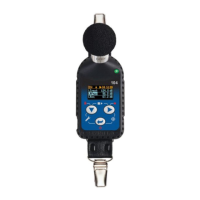
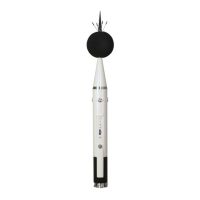
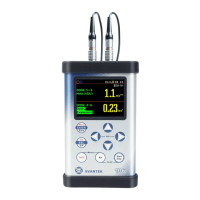
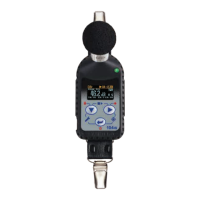
In some views you can toggle sub-views by pressing
the <Enter> key.
All icons are described in Chapter 2.7, other fields and view control functions - in Chapter 5.
Starting measurements
To start a measurement, press the <Start> key. The
icon will appear, and the measurement will be performed
with the current instrument settings, which are stored in
the instrument’s internal memory. During the
measurement the shape of the icon will be changing
from self to contoured.
The time passed from the measurement start (elapsed time) is displayed in the
right lower corner of the measurement screen in the format ⌛mm:ss in the range
from 00:00 to 59:59, or in the format ⌛hh:mm:ss in the range from 01:00:00 to
99:59:59, or in the format ⌛xxxh from 100h to 999h, and ⌛>999h if the elapsed
time exceeds 999 hours. Its maximum value is equal to the Integration Period
and the elapsed time is zeroed when the new measurement cycle starts (see
Chapter 4.1).
Pausing measurement
To pause a measurement, press the <Shift> and <ESC>
key together. The measurement will be paused and the
icon will appear together with the Pause screen.
The Pause mode allows you to erase up to 30 last
seconds of the measurement with the ◄ key. One press
deletes one second of the measurement and this
reduces also the elapsed time.
It may be useful if, for example, the measurement is
temporarily disturbed by some event that should not
normally occur.
To continue the measurement, press <Enter>.
To configure a measurement or the instrument, use the menu, which is switched with the <Menu> key.
The menu consists of different type of screens, which include main menu, sections, lists of options, lists
of parameters, text editor screens, information screens etc.
User interface mode
The user interface may be presented in three modes:
Start/Stop, Simple or Advanced. These modes can
be selected in the User Inter. screen of the Instrument
section. The Simple mode enables basic instrument
settings, while the Advanced mode enables full scope
of available settings. Many screens can therefore have
different view depending on the selected operational
mode.


 To Next Page