V4.7 | 06/24/2024 | 11165414
73
7.3.15 ReadoutMode
Species the operation mode of the readout for the acquisition.
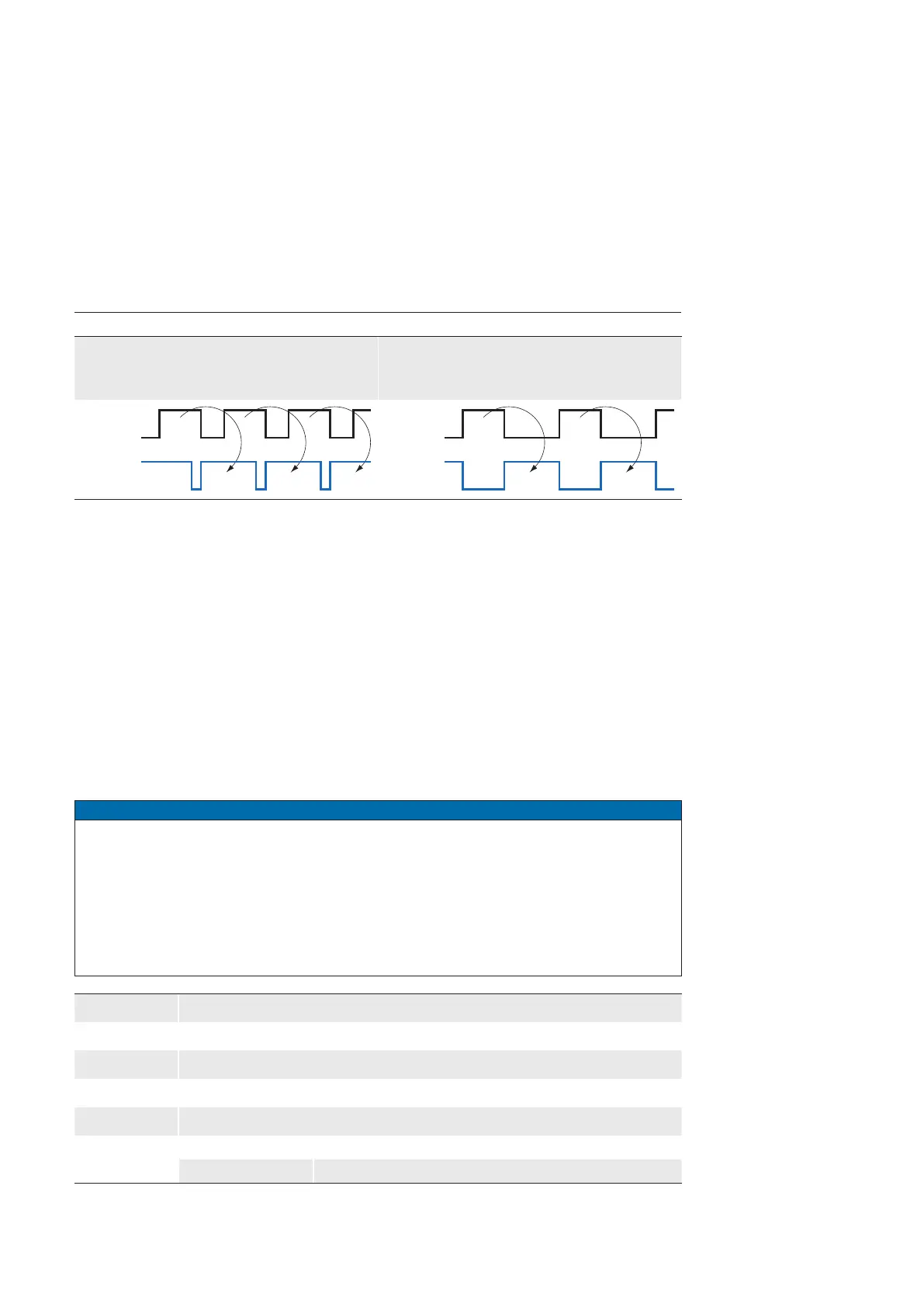
Image acquisition consists of two separate procedures carried out in succession.
Exposing the pixels on the photosensitive surface of the sensor is only the rst part of the
image acquisition process. Once this rst step is completed, the pixels are read out.
The exposure time (t
exposure
) can be adjusted by the user, however, the time needed for the
readout (t
readout
) is determined by the particular sensor and image format in use.
The cameras can be operated sequential or overlapped depending on the mode and the
combination of exposure and readout times used:
Overlapped Sequentiell
In this operation mode, frame (n+1) is ex-
posed whilst frame (n) is being read out.
Here, the time intervals are long enough
for the exposure and readout to be pro-
cessed successively.
e
e
If the camera is unable to process incoming trigger signals, which means the camera
should be triggered within the interval t
notready
, these triggers are skipped. The user will be
informed about this fact by means of the event "TriggerSkipped".
Depending on the ReadoutMode t
notready
is determined as follows:
ReadoutMode:Overlapped
t
notready
= t
exposure(n)
+ (t
readout(n)
- t
exposure(n+1)
) + t
Triggerdelay
ReadoutMode: Sequentiell
t
notready
= t
exposure(n)
+ t
readout(n)
+ t
Triggerdelay
Notice
In Sensor Shutter Mode: Global Reset t
TriggerDelay
is constant and independent of image
settings.
In Sensor Shuttter Mode: Rolling Shutter t
TriggerDelay
is not constant (expect t
exposure
< T
Read-
out
)T
TriggerDelay
depends on image settings like:
▪ ExposureTime
▪ PixelFormat
▪ ...
Name ReadoutMode
Category AcqusitionControl
Interface IEnumeration
Access Read / Write
Unit -
Values
Overlapped Overlapped ReadOutMode
Sequential Sequential ReadoutMode



 To Next Page