24
25
USE
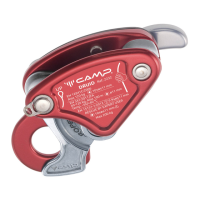
These instructions must be provided to the worker or to the rescuer. During use it is essential that the device
always remains under the user's control. We recommend wearing gloves; in case of long descents, avoid the
contact with the surfaces that are likely to become hot. Avoid to use the device or take proper precautions in case of
working areas with electrical, thermal, chemical hazards and/or around moving machinery, sharp edges, abrasive
surfaces. Use adequate rescue equipment and provide adequate training for the work crew so that they can quickly
rescue the injured person to minimise the suspension trauma effects.
Operating Principles
When a load is placed on the anchoring/climber side of the rope [11] the movable cam [6] rotates towards the fixed cam
[5] and presses the rope in between in order to lock the rope. The hand of the user must hold the braking side of the rope
at all times [10] in order to activate the movement of the movable cam [6] and therefore stop the sliding of the rope. For
correct operation, it is essential for the Giant and the movable cam [6] to be able to move freely (fig.2).
WARNING: Any obstacles that could block or restrict the movement of Giant or of the movable cam [6] can
prevent the braking action of the device: DANGER OF DEATH (fig.2).
By pulling the actuating lever [4] towards the “DESCENT” position [16c], you can gradually release the movable cam in
order to unlock the rope and by controlling the braking side of the rope [10] by hand, this allows for descent. Releasing
the actuating lever [4], the descent is stopped. In the event of excessive action on the lever, the anti-panic locking
system disengages the lever in the “ANTIPANIC STOP” position [16b] and reengages the movable cam in order to lock
the rope: the braking action of the device is conditional on keeping the braking side of the rope [10] in hand. When the
actuating lever is moved to the “ASCENT/BELAY/LOCK” position [16a], the lever is disengaged from the movable cam
and locks the rope when a load is applied (fig.3a). By moving the actuating lever towards the “BRAKE” position [16d]
you can get a gradual additional braking of the rope, until reaching a complete locking in the “FULL LOCK” position
[16e], even when no load is applied (fig.3b). Both “LOCK” and “FULL LOCK” positions are safe for hanging in a stand-
by position, the user can choose their preferred position depending on their specific use. In specific dangerous
scenarios it is also possible to create an additional safety locking to avoid any unintended movements of the lever
(fig.4).
Installation of the rope, operational test
The rope must be installed in the device in the direction indicated on the markings and in fig.5a, always carry out a test
operation by pulling firmly on the anchoring/climber side of the rope [11] while holding the braking side of the rope by
hand [10]: the device must stop the sliding of the rope during this test (fig.6). It's possible to install the rope while
keeping the carabiner connected to the device, just by opening the front plate [2]. Do not load the device when the front
plate [2] is open, fig.5b. Avoid external stresses to the locking gate [8]. In situations of partial or total lack of load on the
descender and/or external stresses to the locking gate [8], it is recommended to insert a second carabiner into the
attachment hole [3] in order to make the front plate [2] not openable, (fig.5c). When used as a belay device, connect the
Giant to a harness, do not connect to a fixed anchor point (fig.5d).
DANGER OF DEATH in the event of incorrect assembly.
Use as EN 12841C descender of the working line
Rope access use as a descender of a working line must always be combined with a safety line with an EN 12841A fall
arrest device. Maximum use load is 210-250 kg/two persons.
For the descent configuration see fig.7a. In the event of horizontal movements, movements on slightly inclined
surfaces or with low loads you can slide the device along the rope using the button for cam locking [7] as shown in fig.8.
Never release the braking side of the rope [10] during descent (fig.7b): it can only be released in the event that
the descent is halted and the actuating lever is moved to the “LOCK” [16a] or “FULL LOCK” [16e] position
(fig.7c); it's then possible to create an additional safety locking in case of specific dangerous scenarios (fig.4).
During descent always take care that the fall arrest device does not lock up on the safety rope.
Use as EN 12841B ascender of the working line
Rope access use as an ascender of a working line must always be combined with a safety line with an EN 12841A fall
arrest device and another EN 12841B ascender. Maximum use load is 210-250 kg/two persons. See fig.9.
Use as EN 12841A fall arrester for the safety line
It's possible to use two Giants by the same user on two separate lines: one for the working line (as descender/ascender)
and one for the safety line (as fall arrester)(fig.10). We recommend only occasional use of the Giant as fall arrester,
limited for example to rope transfer operations. The movement of the Giant on the safety line must be manually
operated by pushing the button for cam locking [7] or by pulling the braking side of the rope [10]. Consider a minimum
clearance distance of at least 2 m under the user's feet. Maximum use load is 120 kg/one person.
Use as EN 341/2A rescue and evacuation descender
Use of the device in compliance with EN 341/2A in combination with the appropriate rope is intended for rescue and
protection against falling from a height in a rescue system. This use is not intended for rope access and it is not
compliant with European regulation (EU) 2016/425.
For use to evacuate the user (device secured on the harness: the device slides on the fixed rope) fig.11a. For
evacuation of a person by a rescuer (device secured to anchoring: the rope slides in the device) see fig.11b. Never
release the braking side rope [10] during descent (fig.11c):
Use must be carried out by adequately trained personnel and/or following clear emergency protocols. If the device and
the rope are left permanently installed, they must be protected from environmental conditions.
Giant operating data with CAMP Iridium 10.5 mm rope Art.2810A
Descent weight m: 40-200 Kg
Descent height h: 200 m max
6
Descent energy W: 7.5 x 10 J max
Operating temperature T: -30/+60°C
Descent velocity V: 2 m/s max
Number of descents with minimum weight and maximum height n: 96 max (replace the rope after this number)
Number of descents with maximum weight and height n: 20 max (replace the rope after this number)
W= 9.81 x m x h x n
Use as ANSI/ASSE Z359.4 rescue and evacuation descender
The use of the Giant in compliance with the U.S. standard ANSI/ASSE Z359.4, in combination with the appropriate
rope, is intended for rescue and evacuation (multiple use). This use is not compliant with European regulation (EU)
2016/425.
Connect the device to the harness, see fig.11a. Never release the braking side of the rope [10] during the descent
(fig.11c).
Giant operating data with CAMP Iridium 11 mm rope Art. 2811A
Descent weight m: 60-141 kg (132-310 lb)
Descent height h: 200 m (656 ft) max
6
Descent energy W: 0.6 x 10 J (442500 ft-lbf) max


 To Next Page