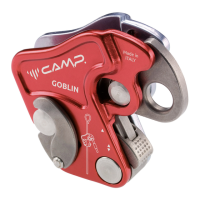
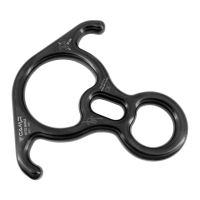
26
27
Descent velocity V: 2 m/s (6.6 ft/s) max
Number of descents with minimum weight and maximum height n: 5 max (replace the rope after this number)
Number of descents with maximum weight and maximum height n: 2 max (replace the rope after this number)
W= 9.81 x m x h x n
Use as EN 12841C and EN 341/2A with heavy loads (> 140 kg)
It's possible to use the Giant with heavy loads (one or two persons) with additional precautions compared to previous
paragraphs and instructions.
Consider an additional training to the users: intended for use only by expert and trained individuals. Avoid any possibility
of slack being created on the rope, avoid lateral shifts from vertical. Over 140 kg it's mandatory to insert a carabiner for
additional braking capacity on the braking side of the rope [10], see fig.12a for the installation to an anchoring point and
fig.12b for the installation to a harness.
For the EN 12841C use as a descender of the working line (fig.7), it's mandatory to check that the EN 12841A fall
arrester used on the safety line is rated for heavy loads.
Use as EN 15151-1 belaying and rappelling device for climbing
EN 15151-1 compliant use of the Giant is intended for climbing activity during work at heights (fig.13) by adequately
trained personnel. The Giant is not recommended for use in sport climbing or mountaineering. Even if the standard
does not fix a weight limit, we recommend avoiding this use for persons with a weight of more than 100 kg.
WARNING: during all phases of belaying and rappelling for rock-climbing, never leave the braking side of the
rope unattended [10]: DANGER OF DEATH.
Never use a rope other than a dynamic single EN 892 rope: DANGER OF DEATH.
Belaying
Take particular care during the first meters of climbing: there is a danger that the minimum clearance distance under the
user may not be sufficient.
To feed out rope see fig.14. To feed out rope quickly see fig.15. To take in rope see fig.16. To stop a fall hold the brake
side rope firmly [10] (fig.17): the belayer must pay attention to the imbalances caused by the fall force.
Rappelling
To rappel the climber see fig.18. To rappel in the event of high rope friction or limited weight see fig.8.
CHECKING AND MAINTENANCE
Before and after each use, check the correct operation of all moving parts including the function of the spring action of
the movable cam [6], the actuating lever [4], the button for cam locking [7], the locking gate [8] and the correct operation
of the anti-panic device. Check for the presence of dirt or foreign objects that can affect or prevent normal operation
(e.g. grease, grit, sand, pebbles, etc.).
Cleanliness: use a damp cloth (fresh water) and clean all the visible parts, then dry. Do not use solvents. Do not
submerge the product in water. After cleaning, lubricate the visible pins of the moving parts with a silicone-based
lubricant spray. Note: cleaning and lubrication are recommended after each use in a marine environment.
REVISION
The safety of users depends upon the continued efficiency and durability of the equipment. In addition to the normal
inspection required before, during and after each use, this product must be inspected by a skilled person every 12
months, starting from date the product is first used; this date and the subsequent checks must be recorded on the
product's life sheet: keep this literature for inspection and reference for the life of the device. Check the legibility of the
product's markings.
In case of one of the following defects are present, the product should be withdrawn from service immediately:
• Presence of cracks on any component,
• Presence of permanent deformations on any component,
• Unauthorized modification to the product (welding, drilling, etc.),
• Corrosion that severely affects the surface state of the metal which does not disappear after slight rubbing with emery
paper,
• Malfunction of the mechanisms of the actuating lever [4], the movable cam [6], the button for cam locking [7], the
locking gate [8],
• Burrs and/or sharp edges on any surfaces that could come in contact with the rope; especially on the movable cam
[6], the fixed cam [5], the front plate [2], and the rear plate [1],
• Disappearance of the galvanic plating near the wear-and-tear indication line of the mobile cam [6],
• significant wear on any part of the device (>1mm),
Any product or component showing any defect or wear, or if in doubt, should be withdrawn from service immediately.
Each product in the safety system can be damaged during a fall and must be always inspected before use it again. Do
not continue to use a product after a major fall because a damage may have occurred, even no external signs are
visible.
LIFETIME
The lifetime of the product is unlimited, unless any defect appears and provided that periodic inspections are made at
least once every 12 months from the date the product is first used and the results are recorded in the life sheet of the
product. The following factors can reduce the lifetime of the product: intense use, damage to components of the
product, contact with chemical substances, high temperatures, tears and abrasions, violent impacts, failure to maintain
as recommended. When suspect that the product is no more safety and reliable, please contact C.A.M.P. spa or the
distributor.
TRANSPORTATION Protect the product from risks such as those detailed above.
ITALIANO
INFORMAZIONI GENERALI
Il gruppo C.A.M.P. dà una risposta ai bisogni dei lavoratori in altezza con dei prodotti leggeri e innovativi. Sono
progettati, testati e fabbricati all'interno di un sistema qualità certificato, per offrirvi un prodotto affidabile e sicuro. Le
presenti istruzioni sono destinate ad informarvi sul corretto utilizzo del prodotto per tutta la sua durata: leggete,
comprendete e conservate queste istruzioni. In caso di smarrimento, le istruzioni sono scaricabili dal sito
www.camp.it. La dichiarazione di conformità UE è scaricabile da questo sito. Il rivenditore deve fornire il manuale
istruzioni nella lingua del paese in cui il prodotto è venduto.
UTILIZZO
Questo equipaggiamento deve essere usato solo da persone addestrate e competenti oppure sotto la supervisione di
persone addestrate e competenti. Con queste istruzioni non apprenderete le tecniche dei lavori in altezza o di qualsiasi
altra attività associata: dovete aver ricevuto una formazione adeguata prima di utilizzare questo equipaggiamento.
Arrampicare, e ogni altra attività per la quale questo prodotto può essere usato, è potenzialmente pericoloso.
Un'incorretta scelta o utilizzo, oppure un'incorretta manutenzione del prodotto può causare danni, gravi ferite o morte.
L'utilizzatore deve essere medicalmente idoneo ed in grado di controllare la sua sicurezza e di gestire le situazioni di
emergenza. Per i sistemi anticaduta, è essenziale per la sicurezza che il dispositivo o il punto di ancoraggio sia sempre
correttamente posizionato e che il lavoro sia effettuato in modo da ridurre al minimo il rischio di cadute e l'altezza di


 To Next Page