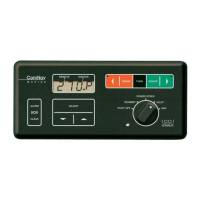
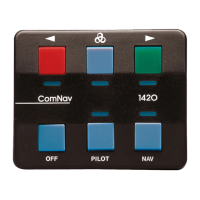
ComNav P4 Installation and Operation Getting Started
Document PN 29010100 V1r0 - 118 -
5. Highlight “Seastate” and set it to 1.
6. Highlight “Turn Rate.” Select a setting that is approximately ¾ of your boat’s
comfortable
turning rate
at a normal cruising speed (to find your “Comfortable
turning rate,” simply time a complete 360º circle while the vessel is performing a
safe yet tight turn, at the
normal cruising speed. A “Comfortable turning rate” is
360° divided by the number of seconds it took to complete the circle).
7. Exit the Auto menu.
8. Switch to AUTO mode (before
switching into POWER STEER, AUTO or NAV
modes, the rudder must be at the dead-ahead position). The autopilot will then
automatically take your current heading
and use that as the Course to Steer.
9. Run for about 5 minutes. If the boat “esses” back and forth more than about 3
degrees,
bring up the Auto menu and reduce the Rudder Gain setting by 1 step,
then test again.
On a P4, or P4VS with a Rudder Follower
Make a medium Heading change, say 15°– 20°, with the COURSE CHANGE knob.
Observe how the boat responds, as it turns and settles into the new heading:
If the boat stops turning before the new heading is reached and then approaches
it
slowly, either increase the Rudder Gain by 1, or decrease the Counter Rudder
by 1.
If the boat overshoots the new heading, and then makes several turns back and
forth
across the new heading before settling down (known as “essing” or
“overshooting”),
either decrease Rudder Gain, or increase Counter Rudder by 1.
If the boat approaches the new heading, shies away, then approaches and shies
away
again, decrease Counter Rudder by 1.
Continue making those medium heading changes, adjusting Rudder Gain and
Counter
Rudder as needed, until the boat settles smoothly onto the new heading
without
excessive overshoot.


 To Next Page