Document PN 29010100 V1r0 - 18 -
How Autopilots Work
The purpose of this introductory section is to briefly describe what an autopilot does and some of
the things you should expect when using an autopilot with your boat.
Manual Steering
Every vessel has unique dynamics, which depend on its design, shape and dimensions, as well as
current speed, loading, and sea conditions. The net result is that every boat (or rather, every
unique boat design) “steers” in a unique way.
To understand what an autopilot does when it is steering your vessel, it is helpful to think for a
moment about steering a boat by hand.
•
When you are holding the boat on a given Heading, you know from instinct and
experience how much rudder to apply, and how fast to apply it, to keep the boat
on-course. Corrections are usually just a small, quick movement of the helm to one
side, then
back to the dead-ahead position.
•
You won’t always try to correct when the boat rolls or accelerates off a wave,
especially in heavy seas – because when the boat rolls back the other direction, it will
usually
come right back on-course.
Instead, your experience reminds you to allow the boat to yaw those necessary degrees on
either side of the Heading, to reduce the fight.
•
To turn the boat to a new Heading, instinct and experience again remind you how
much
rudder to use, and how fast, to get the boat turning at your normal rate of steer.
If the boat is not turning as rapidly as you want (for example, with a cross- or
cross-current
holding back the bow), you slightly increase the amount of rudder.
On the other hand, if the boat is turning too fast, you reduce the applied rudder a bit.
You then gradually reduce the applied rudder, as the boat approaches the desired
Heading.
You might even put the helm over opposite for a moment, to stop the boat swing
more quickly –
in order to come to the desired Heading without overshoot.
The single most basic purpose of an autopilot is to control the vessel the same as a human operator
would … to let the boat
“work with the seas”, yet still maintain as straight a Track as possible in the
current conditions, on the desired Heading or Course.
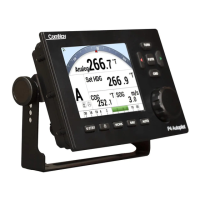
The P4 Autopilot System uses the latest generation of ComNav’s carefully-designed,
well-proven
steering control algorithms, which are based on many years of designing and
manufacturing
autopilots.
There are a number of parameters used in the steering algorithms, collectively referred to as
“Steering Parameters.” The P4 Autopilot system has been tested on a wide variety
of boats, of
different types and sizes. The default settings for the Steering Parameters are
average values
derived from that testing, and provide a good starting place for most boats.
During sea trials, and later on normal operation, you may want to adjust some of those
values, so
that they better match your boat’s unique design dynamics.
However, the information in this section can be applied in general to any ComNav autopilot, and is
not necessarily specific to the P-Series.
ComNav P4 Installation and Operation


 To Next Page