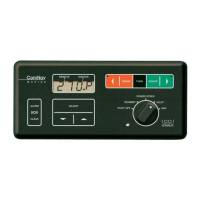
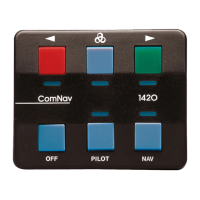
ComNav P4 Installation and Operation
Document PN 29010100 V1r0 - 25 -
Following a Track: AUTO/ALC Mode
Some ComNav autopilots (including the P4), provide another way to keep your boat on
a
specific Track: Automatic Leeway Correction.
This feature can be turned on in AUTO mode. ALC is similar to NAV mode, in that it uses
NMEA0183 or NMEA2000 Latitude and Longitude data to sense if
the boat is following the
desired Track.
Unlike NAV mode, however, a ComNav autopilot with the ALC feature only needs Latitude
and
Longitude data in AUTO/ALC mode. It does not need Cross-Track Error data from the
external Navigation System, nor to have any waypoints set in the system. The ALC feature
calculates the Cross-Track Error on its own, using the desired Heading active at the point
in
time when AUTO/ALC mode is first engaged.
Power Steer: “Drive by Wire”
Most ComNav autopilots have a POWER STEER mode, which provides a way for the user
to
control the rudder directly. In effect, the autopilot acts as a sort of “electronic steering
wheel”,
allowing the operator to steer the boat manually, in a similar way as when using a
standard
manual steering wheel or tiller – but instead steering the boat with the autopilot’s
Control
Head, or any remote controls it is equipped with.
Steering, when using the autopilot in this mode, is done with two buttons and/or a knob
on
the Control Head. Button 1 and/or a clockwise turn of the knob, will move the rudder to
Starboard, causing the boat to turn that way; the other button, and/or a counter-clockwise
turn of the knob, will move the rudder to Port so that the boat turns that way.
Using the buttons/knob, the rudder can be placed in any desired position where it will
remain.
This feature is useful when docking or manoeuvring, because the person steering
the boat
can take their hands off the controls between rudder movements.
Additional Technical Information
Mathematically, the autopilot’s steering algorithms are based on a control method known
as a
“PID Loop” … an acronym for a “Proportional, Integral, Derivative” error-correction
technique.
The amount of rudder movement to correct for any Heading error (or to make a turn), is
continuously re-computed, in a processing loop, as a value that is:
Proportional to the error (or how much more of the turn is still to be done).
An Integral of the error/turn … how big for how long.
A Derivative of the error/turn … how fast it is changing.
Many references can be found on PID Loops, on the internet and elsewhere, if you want to
know more. ComNav also occasionally holds training seminars – check with your dealer for
more information.


 To Next Page