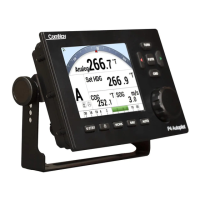
ComNav P4 Installation and Operation
Care and Maintenance
Document PN 29010100 V1r0 - 167 -
Care and Maintenance
The P4 Advanced Autopilot System has been designed to provide many years of reliable
service. The following periodic care and maintenance tips will help to ensure the longevity of
your autopilot.
Cleaning and Appearance
Both the Control Head and SPU should be regularly and carefully cleaned with a damp cloth
and mild soap. This is particularly important for the LCD screen overlay.
Caution! Do not use abrasive cleaners or chemicals.
The Control Head is designed to be weatherproof and splash resistant, but it should not be
immersed in water for a prolonged period of time.
Environments exceeding a maximum temperature of 140° F (60° C) or below a minimum
temperature of 5° F (-15° C) MUST BE AVOIDED.
Exposure to prolonged direct sunlight should be avoided in order to prevent damage to the
electronics and housing, and UV-induced fading of the LCD.
Protection of Wires and Cabling
After installation, ensure that the system components are securely mounted and will not
shake loose due to the vibrations that can be expected in a marine vessel.
Ensure that the cabling and wiring to all system components, ESPECIALLY REMOTE
CONTROLS, are well secured with clamps or alternative fasteners.
Many potential problems can be avoided by ensuring that cabling and wiring do not cause
strain on the connectors.
Periodic Checks
After the first six months of operation a thorough examination of the entire Autopilot system
must be undertaken. All electrical connections, cables, clamps, mounting brackets, and
mechanical connections (i.e. RUDDER FOLLOWER) must be secure. All hydraulic pumps
and lines must be inspected for leakage and loose mounting.
An annual inspection should be undertaken thereafter.


 To Next Page