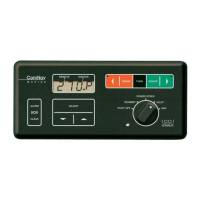
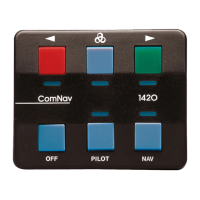
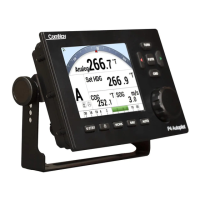
ComNav P4 Installation and Operation
Document PN 29010100 V1r0 - 23 -
Wind and Current Effects
If your vessel encounters a crosswind, and/or a tidal current at any given angle to the
desired
Heading, it will be pushed away, in the direction of the wind or current. At this point,
the autopilot
will constantly be making Heading corrections with the rudder, as it tries to
maintain your
desired Heading.
If that condition persists, the SPU will gradually begin to alter the rudder a few degrees
to
Port or Starboard of the centred position, to counter the effect of the wind and/or current.
This
feature, known as Automatic Rudder Trim, will keep your boat pointed in the right
direction,
despite the wind or current.
However, one side-effect of Auto-Trim is that your boat may not follow the Track you want;
it
will maintain your desired Heading, but the Track may “slip” sideways in the direction of
the
crosswind and/or current. This potential problem can be solved by using another mode
that
ComNav Autopilots provide, which is the NAV mode.
Following a Track: NAV Mode
So far, we have seen how an autopilot operates in AUTO mode, whereas a new desired
Heading must
be selected on the Control Head each time you wish to change direction.
This is useful for
short trips or when you know the direct course to your destination.
But for longer trips, which often involve a number of “legs” at different headings, it would
be
useful to be able to have your autopilot steer your boat along all the legs, in sequence.
ComNav autopilots allow you to do just that, with NAV mode.
The autopilot must be connected to an external source of navigation information (commands
and data), such as a chart plotter, or a Navigation program running on a PC. A source of
position data is also required, it may be built into the external Navigation System, or it may be
another device or system, like a GPS receiver (such as a ComNav GPS Compass), a
LORAN C receiver, etc. (all such external devices are in general referred to in this manual
using the generic term Navigation System).
ComNav Autopilots implement the industry-standard NMEA 0183 protocol for reception
and
transmission of navigation information. Almost all modern Navigation System
equipment
complies with NMEA 0183, so interfacing with a ComNav autopilot is
relatively simple.
A long voyage will consist of a series of waypoints, which are specific locations on the
Earth’s surface, as defined by their Latitude and Longitude. These
waypoints define the
route you want the boat to travel on, from your staring position to
your destination. You
enter them into the external Navigation System when creating the
route.
The system determines the current location of the boat (from the position data source),
and then calculates the course that must be steered in order to reach the next waypoint.
When the Autopilot is switched into NAV mode, it begins to look for some specific
navigation
information from the Navigation System: the course to steer to the next
waypoint, and the
Cross-Track Error (which is the distance from the boat to the desired
Track, from the last
waypoint to the next one). Using these two pieces of information, the
autopilot steers the
boat on the shortest possible Track to the next waypoint.


 To Next Page