xii 1.5 Open Network Glossary
Introduction
Term Explanation
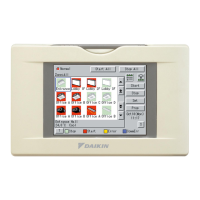
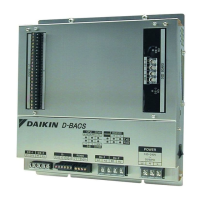
D-BACS It stands for D
aikin Building Air-conditioning Control System.
Means centralized air-conditioning management and control system based on highly expandable DAIKIN
original network communication
technology, DIII-NET. It is DAIKIN products that can be mainly controlled
through DIII-NET on D-BACS. And with various expander adapters connected , functions and usage of
control system can be expanded for following 3 sections of devices : 1) Equipment (electricity, plumbing,
elevator, ventilation, fire alarm, lighting, car park and crime/disaster prevention panel), 2) meters (electricity,
gas and water supply) and 3) environmental monitoring sensors (temperature, pressure, humidity and
voltage/current).
Di Unit Device by which DAIKIN centralized controllers are able to monitor operation and malfunction of up to 8
individual building facility equipment through DIII-NET, and pass them to centralized controllers. 'I' in Di
stands for INPUT from building facility equipment, and Di unit is only able to receive INPUT signal from
equipment, while Dio unit can receive operation signals from centralized controllers, and dictribute OUTOUT
signals to individual building equipment.
Dio Unit Device that is able to control operation, and monitor operation and malfunction for building equipment. 'I' in
Dio stands for INOUT from building facilities, while 'o' stands for OUTOUT to building facilities. This means
Dio unit can control building facility equipment for both ON and OFF operation. Di unit can only monitor ON
and OFF operation from building facility equipment.
DIII-NET Refers to Daikin Industries original communication network for A/C communications. (closed network)
Echelon The U.S. company that developed the LON.
Ethernet Refers to the name of and standard pertaining to a LAN product developed by Xerox.
Jointly developed by Xerox, DEC and Intel in 1980, Ethernet is the LAN used within BASs.
Free Topology Refers to a branched free-type connection arrangement within a network.
Daikin's Interface for LONWORKS
®
only supports free topology.
Gateway Refers to a device that translates the different communication codes sent between central monitoring panels
and A/C units to enable mutual communication.
It is used when more than one network is connected.
Interface for LONWORKS
®
and the Master Station are two such examples.
General Refers to the term 'general' used when conducting general or batch control. When controlling an entire
system, control is not conducted on each particular A/C unit, but on a generalized basis (all of the A/C units
together).
Group System of up to 16 indoor units controlled simultaneously from single or double remote controllers.
Heartbeat Refers to a function that cyclically communicates values of specific network variables.
Even if a main monitoring node does not request the data (does not confirm the status of the A/C unit), the
machine itself will automatically send the values. It allows the user to conclude that the node is operating
normally while this value is being sent.
HIM H
uman Interface Module
A device that incorporates the concept of the standard BAS protocol supported by the Institute of Electrical
Installation Engineers of Japan (IEIEJ). It enables the setting of parameters for status display, control and
monitoring of building equipment. It refers to a human interface device that performs On/Off operations and
the like.
Icont I
ntelligent Controller
A device that incorporates the concept of the standard BAS protocol supported by the IEIEJ. It is a control
device that is connected to either the building equipment or devices targeted for control via an interface. It
refers to a device that can support functions of independent monitoring, control and the like.
IEIEJ I
nstitute of Electrical Installation Engineers of Japan


 To Next Page