
 Need help?
Do you have a question about the EVVA AirKey and is the answer not in the manual?
Legal framework and terms of use for AirKey system, including data protection and product liability.
Information on obtaining support, certified partners, and online support forms.
Explanation of symbols and command notations used in the manual for clarity.
Guidance on using keyboard shortcuts for efficient document navigation.
Overview of AirKey's locking components, including cylinders, wall readers, and padlocks.
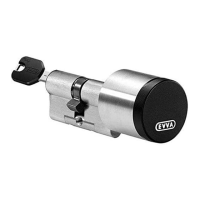
Details on battery-operated AirKey cylinders, their types, features, and installation notes.
Information on the AirKey hybrid cylinder, its features, and access methods.
Description of the AirKey lever cylinder, its applications, and operation.
Details on the AirKey padlock, its use cases, and features.
Information on AirKey wall readers, their installation, and connection to control units.
Introduction to the AirKey mobile application, its availability, and core functionalities.
Minimum requirements for smartphones used with the AirKey system, including OS and connectivity.
Overview of available AirKey media types, such as cards and key fobs, and their initial setup.
Description of the AirKey Online Administration software solution for managing access control.
Specifies the necessary operating systems, browsers, and internet connection for the AirKey system.
Explanation of KeyCredits and their necessity for operating access control systems.
Information on the optional coding station for adding/updating components and media.
Details on the emergency power device for operating locking components when batteries are depleted.
Steps for downloading and installing the AirKey application on a smartphone.
Guide to registering for the AirKey Online Administration using an email address.
Instructions for logging into the AirKey Online Administration to configure the system.
How to access and use the interactive help feature within the AirKey Online Administration.
Information on installing and using coding stations for adding/updating components and media.
Step-by-step guide to installing and using the coding station through the web interface.
Instructions for installing and configuring the coding station application via the command line.
How to configure the coding station application's settings and menu options.
Troubleshooting common issues encountered with the coding station setup and operation.
Process for adding KeyCredits to the account using a KeyCredit card.
Steps for creating new user profiles within the access control system.
Guide on importing personal data from external files (CSV) into the system.
Procedures for logging into the AirKey Online Administration, with and without two-factor authentication.
Detailed steps for logging into the system using user ID and password.
Instructions for logging in using two-factor authentication via SMS code.
Steps for resetting a forgotten password for the AirKey Online Administration.
How to safely log out of the AirKey Online Administration session.
Overview of administrator roles (system and sub-administrator) and their management.
Process for creating new system or sub-administrators within the system.
How system administrators can modify details and rights of other administrators.
Steps for system administrators to delete other administrator accounts.
Configuration of general settings for the entire access control system.
Settings related to Bluetooth, Hands-free mode, and AirKey app configurations.
Setting default values for new locking components, including time zones and holidays.
Managing holidays in the system, affecting periodic access and office mode.
Managing the electronic access control system via tiles and menus.
Viewing a list of all integrated cylinders, wall readers, and their statuses.
Modifying details, settings, and repair options for existing locking components.
Using smartphones for unlocking components via NFC or Bluetooth.
How to use passive media like cards and key fobs for access.
Procedures for updating locking components using smartphones or coding stations.
Reference to the section detailing smartphone app version updates.
Updating media like cards and key fobs using smartphones or coding stations.
Steps to update the firmware of locking components via smartphone or coding station.
Process for updating the Keyring version of passive access media.
Guidance on replacing batteries in locking components and using emergency power.
Detailed instructions for replacing batteries in AirKey cylinders.
Options for repairing or replacing faulty locking components.
Steps for issuing and installing replacement locking components for faulty ones.
Procedure for removing faulty components without replacement, marking them as faulty.
Steps to remove faulty locking components from the system using a smartphone.
Process for removing faulty locking components via the AirKey Online Administration.
How to delete or revoke maintenance tasks related to repair options.
Creating and assigning emergency media like cards for critical access situations.
Process for transferring AirKey authorisations and settings to a new smartphone.
Steps to initiate smartphone replacement directly from the source smartphone.
How administrators can start the smartphone replacement process.
How to share locking components with other access control systems for cross-system access.
Steps to add locking components from external access control systems to the current system.
How to assign authorisations to locking components shared from other systems.
Checking media authorisations for locking components shared from other clients.
Process to revoke shared locking components from other access control systems.
Registering and using a smartphone across multiple access control systems.
Steps to activate the AirKey Cloud Interface, requiring KeyCredits.
Procedure for generating API keys for communication with third-party software.
Options to regenerate, delete, or deactivate/activate existing API keys.
Information on using the test environment for the AirKey Cloud Interface.
Steps to generate test data for the AirKey Cloud Interface test environment.
Process for generating an API key specifically for the test environment.
How to reset test data in the AirKey Cloud Interface test environment.
Explains visual and audible signals indicating events and status of locking components.
Describes the maximum configurations per medium and locking component in the AirKey system.
Explains when KeyCredits are deducted for system operations like authorisations and API activation.
Steps to resolve issues with smartphone registration or component updates due to communication errors.
Troubleshooting steps when locking components fail to identify or detect media correctly.
Solutions for when media are no longer detected by the locking component or coding station.
Guidance on how to unscrew the thumb turn of an AirKey cylinder, especially with European profiles.
Troubleshooting steps when a locking component reports a hardware error.
Specific checks for AirKey cylinders when a hardware error is indicated.
Checks for AirKey wall readers when a hardware error is indicated.
Potential causes and solutions when the electronic thumb turn is difficult to operate.
General system information, port requirements, and security best practices for AirKey.
Steps to activate the RS485 interface on Bluetooth wall readers for event log forwarding.
Details on configuring the serial RS485 interface parameters for data transmission.
Specification of the APDU format for event log entries, including timestamp and status.
Breakdown of the 14-byte event log entry structure and fields.
Explanation of the byte structure for the timestamp format within event log entries.
Interpretation of the unlocking status codes within the event log entry.
A practical example illustrating the APDU and event log entry components.
Declaration of conformity for AirKey products, indicating compliance with EU directives.
Formal declaration of conformity for AirKey products, listing relevant directives and standards.
A comprehensive list of all figures included in the AirKey system manual.
Definitions of key terms and designations used within the AirKey system documentation.
Legal information, copyright, disclaimer, and publisher details for the system manual.
 General
| Technology | RFID, Bluetooth |
|---|---|
| Frequency | 13.56 MHz |
| Mobile Access | Yes |
| Power Supply | Battery |
| Operating Frequency | 13.56 MHz |
| Battery Life | Up to 2 years |
| Encryption | AES-128 |
| Operating Temperature | -20°C to +60°C |
| Compatibility | iOS, Android |

 To Next Page