Section 3: Model 9500B Controls: Modes of Operation 3-3Descriptions assume 9500B/1100
3.2.2 Front Panel Features
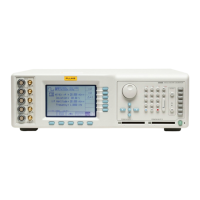
3.2.2.1 Liquid Crystal Display and Screen Keys
The 9500B communicates with the operator by presenting essential information on the LCD screen. For example: the output value generally
appears in large characters below the center of the screen, accompanied by its units. An operator can move through a series of menu screens,
choosing options from those presented on the screen.
Eleven soft keys ('screen' keys) are grouped below and to the right of the screen. These are labelled by characters or symbols representing menu
choices, which appear in reserved display areas on the screen next to the keys. Main functions are selected by buttons on the 'Oscilloscope
Calibrator' panel.
3.2.2.2 'OSCILLOSCOPE CALIBRATOR' Panel
This panel carries the main controls used to select the operational functions and modes of the calibrator:
a. Major Function keys are used mainly in Manual mode (Section 4) and Calibration mode (Section 10). They are arranged down the right
edge:
: Waveform (select Square with direction, or ±DCV using screen keys).
: Sinewave (select amplitudes and frequency using screen keys and cursor controls).
: Edge (select polarity using screen keys).
: Timing Markers (select Waveform and Frequency/Period using screen keys — including Line Frequency).
Aux : Auxiliary Functions (select Current, Composite Video, Linear Ramp, Overload Pulse, UUT Input Leakage Test, Auxiliary
Input, Channel Skew, and Load Resistance or Load Capacitance measurement using screen keys).
b. Mode Key, under the Function keys. The modes are: 'Procedure', 'Manual', 'Configuration', 'Calibration' and 'Test' (refer
to sub-section 3.4).
c. Preferences Key, the bottom key. The user-preferences provided are display adjustments of: 'Screen Contrast', 'Amplitude
step' factor sequence, 'Time step' factor sequence and Deviation/UUT Error toggle (refer to sub-section 3.3).
d. OUTPUT OFF and ON keys, with an 'ON' state indicator LED, in a separate column due to their importance.
e. Alpha-numeric keypad, used for various purposes, to be described later.
f. The
(Tab) key, Cursor keys and Spinwheel: These select and increment or decrement displayed quantities.
3.2.2.3 Output Connections
The ten output connectors are located on the left of the panel. Use of these connectors is described in Section 4.
3.2.2.4 PCMCIA SLOT 1 and PCMCIA SLOT 2
These slots are included mainly for Procedure mode (Section 5), although there are secondary uses.
3.2.2.5 'Standby' Push-Button
Pressing this button, in the bottom right corner of the front panel, will toggle between normal operation (LED green) and 'standby' (LED red).
The instrument will transfer automatically from normal operation to standby some 15 minutes after the most recent operation, then pressing the
button will immediately restore normal operation.
3.2.2.6 Power On/Off Switch
Line power to the 9500B is switched On and Off using a switch at the left of the instrument, on the rear panel. Up is On; Down is Off.


 To Next Page