4.6-4 Section 4: Using the Model 9500B — Sine Function
Final Width = 215mm
Descriptions assume 9500B/1100
When two channels are used, it is necessary to
choose one of the channels as 'Master', and one
as 'Slave'. The Master channel controls the
feedback, whereas the Slave repeats the signal.
To select two channels, press the CHANNEL
SELECT soft key to select the Master channel,
in this case Signal Channel 3:
TODAY'S DATE TIME
OFF
SIGNAL CH3 5ØΩ
TRIGGER NONE
O/P
Amplitude
= 3Ø.ØØØ mV
pk-pk
Frequency
= 5Ø.ØØØ kHz
SIGNAL
CH 2
CHANNEL 1
>
150ps Head
CHANNEL 2
>
150ps Head
CHANNEL 3
>
Standard Head
CHANNEL 4
>
No Head
CHANNEL 5
>
No Head
SIGNAL
CH 4
SIGNAL
CH 5
SIGNAL
CH 1
EXIT
TRIGGER
CHANNEL
LOAD
5ØΩ 1MΩ
DUAL
CHANNEL
SIGNAL
CH 3
TODAY'S DATE TIME
OFF
DUAL CH3, 2 5ØΩ
TRIGGER NONE
x 1Ø
÷ 1Ø
∆ = Ø
5.ØØ mV/div x6 = 3Ø.ØØØ mV
pk-pk
Deviation
= ØØ.ØØ %
O/P
Amplitude
= 3Ø.ØØØ mV
pk-pk
Frequency
= 5Ø.ØØØ kHz
CHANNEL
SELECT
1
2
5
1.Ø
REF
4.6.5 Dual Channel Operation
4.6.5.1 Dual Channel Selection
(Two channels/heads
activated)
For certain oscilloscope test and calibration
procedures, such as 'channel trigger sensitivity'
and 'X/Y test', it is necessary to provide the
oscilloscope with two identical sinewave
signals. Dual Channel Sine function allows
the 9500B and UUT oscilloscope to remain
connected, without the need to insert physical
cable couplers. This is particularly useful
during automated calibration and test.
N.B. For this function two heads must be
connected and activated.
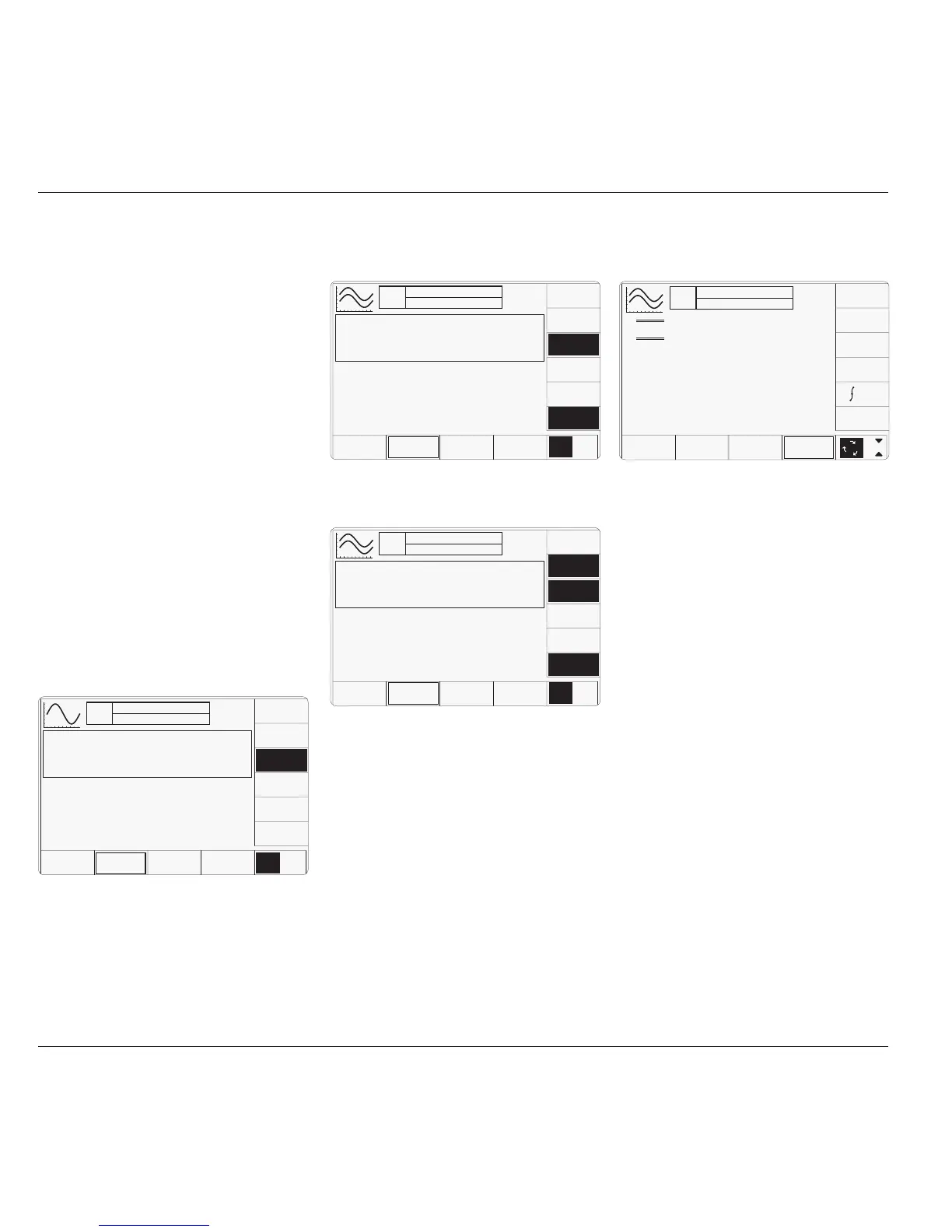
Now press the DUAL CHANNEL soft key,
and the Dual Channel screen icon will appear.
Both channel key labels and the Dual channel
label are highlighted, and the legend in the box
at the top of the screen shows the two channels
selected, the Master written first.
Pressing EXIT will return to the main Dual
Channel Sine screen, so that other parameters
can be set:
Next select the Slave channel, in this case
Signal Channel 2:
Note that the upper sinewave amplitude range
limits are halved by invoking Dual Channel
Sine function.
TODAY'S DATE TIME
OFF
DUAL CH3,- 5ØΩ
TRIGGER NONE
O/P
Amplitude
= 3Ø.ØØØ mV
pk-pk
Frequency
= 5Ø.ØØØ kHz
CHANNEL 1
>
150ps Head
CHANNEL 2
>
150ps Head
CHANNEL 3
>
Standard Head
CHANNEL 4
>
No Head
CHANNEL 5
>
No Head
SIGNAL
CH 4
SIGNAL
CH 5
SIGNAL
CH 1
EXIT
TRIGGER
CHANNEL
LOAD
5ØΩ 1MΩ
DUAL
CHANNEL
SIGNAL
CH 2
SIGNAL
CH 3
TODAY'S DATE TIME
OFF
DUAL CH3, 2 5ØΩ
TRIGGER NONE
O/P
Amplitude
= 3Ø.ØØØ mV
pk-pk
Frequency
= 5Ø.ØØØ kHz
CHANNEL 1
>
150ps Head
CHANNEL 2
>
150ps Head
CHANNEL 3
>
Standard Head
CHANNEL 4
>
No Head
CHANNEL 5
>
No Head
SIGNAL
CH 4
SIGNAL
CH 5
SIGNAL
CH 1
EXIT
TRIGGER
CHANNEL
LOAD
5ØΩ 1MΩ
DUAL
CHANNEL
SIGNAL
CH 2
SIGNAL
CH 3


 To Next Page