4.5-10 Section 4: Using the Model 9500B — DC/Square Function
Final Width = 215mm
Descriptions assume 9500B/1100
9500B and UUT Oscilloscope Setup
1. Preparation
Ensure that both instruments are powered ON
and warmed up.
2. UUT 'Scope
Select the required function for amplitude
calibration.
3. 9500B
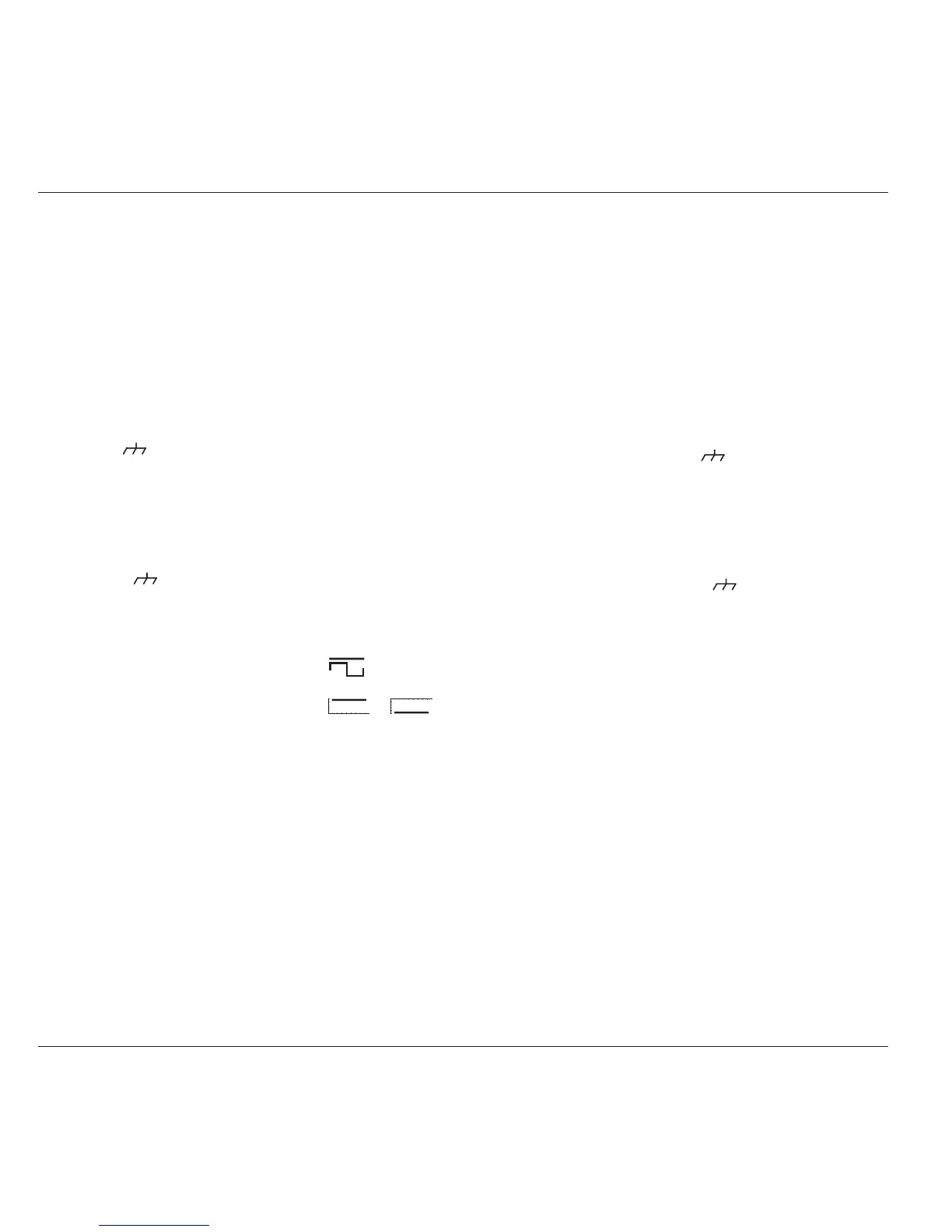
Ensure that the 9500B is in DC Function with
Output OFF. If in any other function, press the
soft key at the top right of the screen,
then press the
WAVEFORM screen key. Select
or as required.
Sequence of Operations
Refer to the table or list of UUT Oscilloscope
amplitude calibration points in the UUT
Oscilloscope Manufacturer's Calibration
Guide.
Follow the sequence of calibration stages as
directed by the guide, and carry out the
following operations (1) to (8) at each stage.
4.5.8 Using the 9500B DC Function to Calibrate the Amplitude Response of a UUT Oscilloscope (Contd.)
Use the front panel controls to set the 9500B
Output to the required DC voltage, polarity
and load impedance for the UUT 'Scope
amplitude cal point:
2. UUT 'Scope
a. Select the correct channel for the cal point.
b. Select 'DC-Coupled', if required.
c. Select the correct range for the cal point.
3. 9500B
a. Press the
screen key on the bottom
row to provide a zero reference.
b. Set Output ON.
4. UUT 'Scope
a. Set the Y controls to place the trace on
graticule zero.
5. 9500B
Repress the
screen key on the bottom
row to remove a zero reference.
6. UUT 'Scope
a. Auto-trigger the oscilloscope or use the
100Hz Trigger from the 9500B. Adjust
the UUT for a stable display.
b. Observe and note the DC level change
from graticule zero.
7. Calibration
a. If a calibration adjustment is provided,
adjust the UUT's response to be appropriate
to the settings on the 9500B screen, as
detailed in the UUT Oscilloscope
Manufacturer's Calibration Guide.
b. If no adjustment is provided on the UUT
'Scope, record its response at the calibration
point as detailed in the UUT Oscilloscope
Manufacturer's Calibration Guide.
8. 9500B Set Output OFF.
1. 9500B
Use the front panel controls to set the 9500B
Output to the required DC voltage, polarity
and load impedance for the UUT 'Scope
amplitude cal point:
2. UUT 'Scope
a. Select the correct channel for the cal point.
b. Select 'DC-Coupled', if required.
c. Select the correct range for the cal point.
3. 9500B
a. Press the
screen key on the bottom
row to provide a zero reference.
b. Set Output ON.
4. UUT 'Scope
a. Set the Y controls to place the trace on
graticule zero.
5. 9500B
Repress the
screen key on the bottom
row to remove a zero reference.
6. UUT 'Scope
a. Auto-trigger the oscilloscope or use the
100Hz Trigger from the 9500B. Adjust
the UUT for a stable display.
b. Observe and note the DC level change
from graticule zero.
7. Calibration
a. Use the 9500B Deviation control to slew
the 9500B Output voltage until the UUT's
response is appropriate to the 9500B
settings, as detailed in the UUT
Oscilloscope Manufacturer's Calibration
Guide.
b. Record the 9500B screen output voltage as
detailed in the UUT Oscilloscope
Manufacturer's Calibration Guide.
8. 9500B Set Output OFF.
1. 9500B 4.5.8.4 UUT Scope — Amplitude
Calibration using the 9500B
as an Adjustable Source of
DC Voltage
The following procedure assumes that the
9500B instrument is in Manual Mode. It is also
assumed that the user will be familiar with the
methods of editing screen values. In the case
of difficulty, re-read the paragraphs earlier in
this Section 4.


 To Next Page