Revision 14
93 August 02, 2019
5.7.3.4 Log Configuration
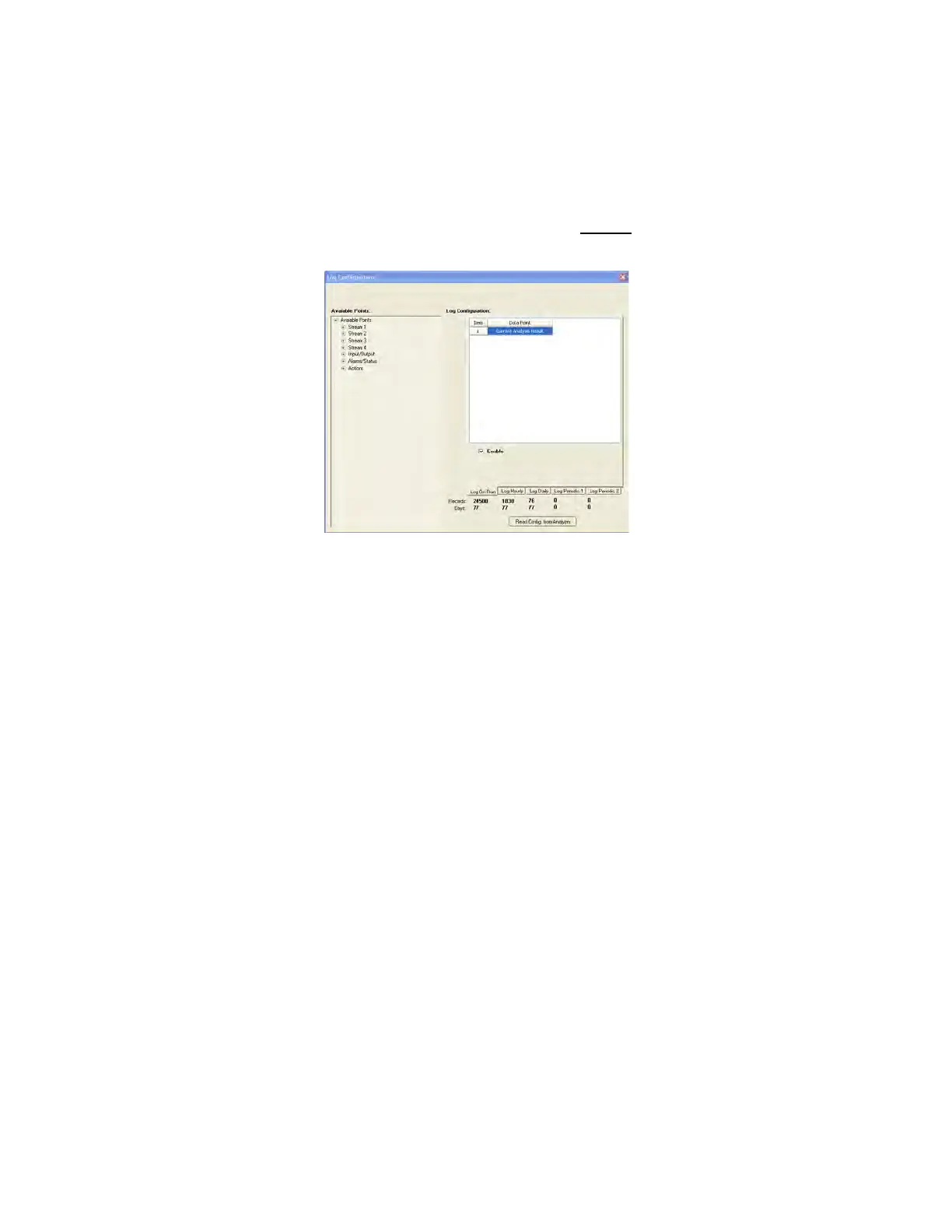
If desired, the analyst can format the log in a different manner than the default log (Figure 5-
10). To configure the analyzer to log values in data points other than those set up at the
factory, press the Log Setup button at the top of the Archive tab to present the Log
Configuration dialog box (Figure 5-16).
Figure 5-17: Log Configuration Dialog Box
The following six log formats are available:
• Log On Run – the values of the data points logged in this log will update after every
completed analysis cycle.
• Log Hourly – the hourly average of the data points logged in this log will update every
hour. The log is updated at the top of every hour.
• Log Daily – the daily average of the data points logged in this log will update every day.
The time at which the log is updated can be set in the Hour Taken column. The log can only
be updated at the top of the hour. Enter a value of 0 (midnight) to 23 (11pm) in this column.
• Log Periodic 1 and 2 – these two logs are empty by default when the analyzer is set up at
the factory. Any data point of the user’s choosing can be logged in each of these three logs,
at a frequency of the user’s choosing. The frequency of logging, in seconds, is entered into
the column entitled Frequency (Seconds). The frequency of logging for each data point
within a given periodic log must be the same; that is to say, if one data point in Log Periodic
1 has a logging frequency of 1000 seconds, all the data points in Log Periodic 1 will have a
logging frequency of 1000 seconds.
The tree on the left side of the Log Configuration On dialog box contains 7 nodes. Within
each of these nodes are data points that can be logged. Many of these data points are static
or rarely changed values that should not need to be continuously logged. The data points of
the most interest are stored in the two nodes called Input/Output and Alarm/Status.
• Input/Output contain data points such as the current concentration readings for all four
stream types (normal, calibration, reference, and zero), the gain, status of various alarms
and latches, and the status of discrete inputs and outputs.
• Alarm/Status contains data points such as the live sensor output, hourly and daily minima,
maxima, and averages, and the tape remaining.


 To Next Page