Section 4 – REMOTE CONTROL SYSTEM VERIFICATIONS Mini-Crawler Crane M A E D A
4-100 3/2019 MC305C-3
Checking after Starting Engine
WARNING! Precautions shown in this
section must be practiced prior to the day’s
work, without fail.
Serious injury or death may arise when
these inspections are neglected.
Further, see "Pre-Start Visible Checks" on
page 5-22 for the checking of the crane
structure.
Whenever any failures are revealed in such
inspections, repair them, or contact us or
our sales service agency.
Verification for the Engine Start and
Stop
WARNING!
• Ensure that the boom and outriggers are in
the stow position, entirely.
In case where they are not in those
positions, manipulate applicable levers of
the Crane to make them stowed.
Otherwise, the Transmitter operation may
cause damages to the Crane or tipping that
results serious injury or death.
• The Crane is inoperable in such event
where the LCD screen in the Transmitter
shows an error message or the Monitor
display in the Receiver shows an error
code.
Without fail, examine the cause of the error
and perform appropriate service when any
fault is identified, or contact us or our sales
service agency.
Checking Engine Start Operation
1. Position the Starter Switch of the Crane to
ON.
2. Next, push the Power switch of the
Transmitter, to power ON.
3. Then turn ON the Main switch of the
Receiver.
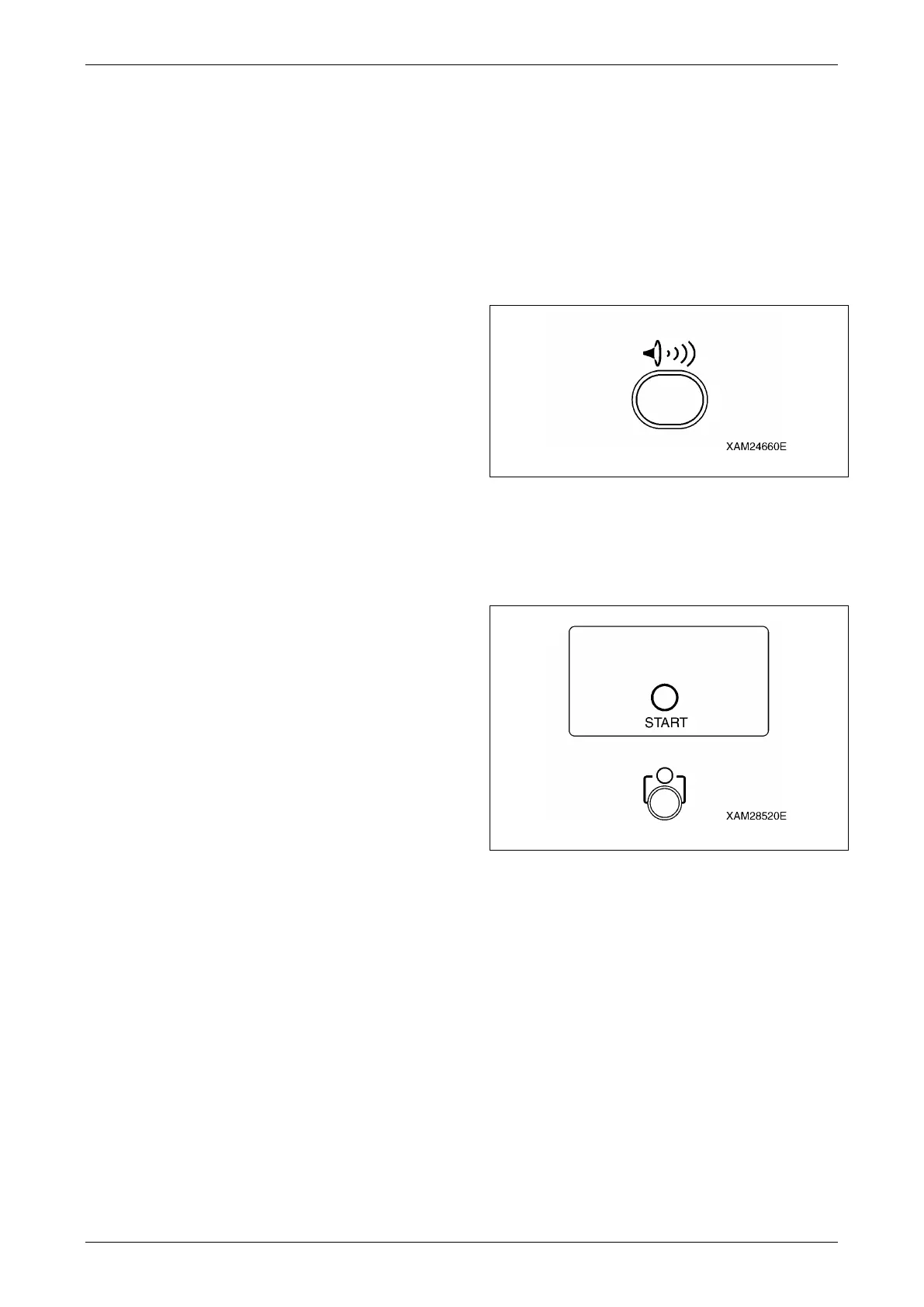
4. Here, push the Horn button and confirm that
the horn toots.
Fig. 4-285
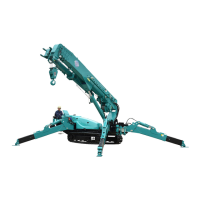
5. Use the Start/Reset button to check that the
engine starts properly.
6. Check whether the indication as "START"
appears in the LCD screen, at that time.
Fig. 4-286
CAUTION: Prior to start the engine, perform
following practices in the Crane.
1. Set the Acceleration Lever to the medium
speed (nearly middle in its stroke).
2. Pull out the choke knob, unless otherwise
the sufficient idling has been completed.
3. Return the chock knob to its initial
position, when the engine starts.


 To Next Page