18 ASPIRATION SYSTEM
To check and adjust the operation of the
waste-gate18A-04
If the waste-gate valve does not operate at the
correct pressure, it can affect the engine
performance.
If the valve opens at a low pressure, this can cause
black exhaust smoke and loss of power at lower
engine speeds.
Caution: A high pressure setting can cause high
cylinder pressures. This can cause failure of the
cylinder head gasket and damage to the bearings
and pistons.
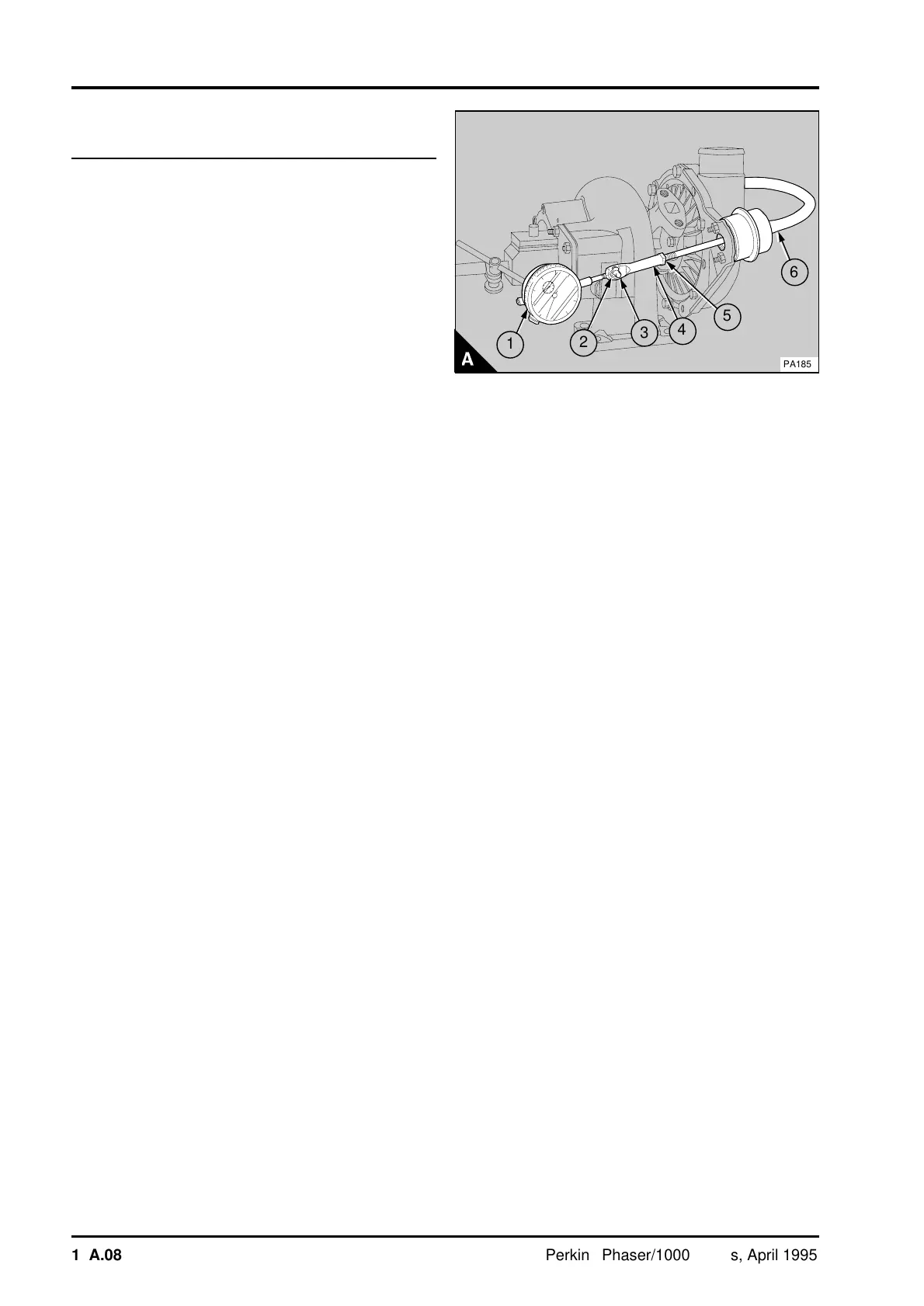
1 Disconnect the boost sensor pipe (A6) at the
actuator. Connect to the actuator an air supply
which can be adjusted accurately and is fitted with
an accurate gauge.
2 Fasten a dial test indicator (A1) to the
turbocharger with its plunger in contact with the end
of the actuator rod (A4) to measure the axial
movement of the rod.
3 Slowly apply air pressure. Check that the
pressure necessary to move the rod 1,00 mm
(0.039 in), is within the limits shown in the data and
dimensions at the end of this section. Ensure that
the pointer returns to zero when the pressure is
released. Repeat the test several times to ensure
that an accurate reading is obtained. It may be
necessary to lightly hit the turbine housing with a
soft hammer during the test operation.
4 If the operation of the waste-gate is not correct,
the actuator rod can be adjusted.
5 Remove the dial gauge from the end of the
actuator rod.
6 With the air pressure still applied, release the
lock nut (A5) on the actuator arm. Remove the clip
(A2) and remove the actuator rod from the pin (A3)
on the arm of the waste-gate valve.
a
a
1
5
a
a
6
PA185
2
3
a
a
4
18A.08 Perkins Phaser/1000 Series, April 1995




 To Next Page