13 PISTON AND CONNECTING ROD ASSEMBLIES
General description
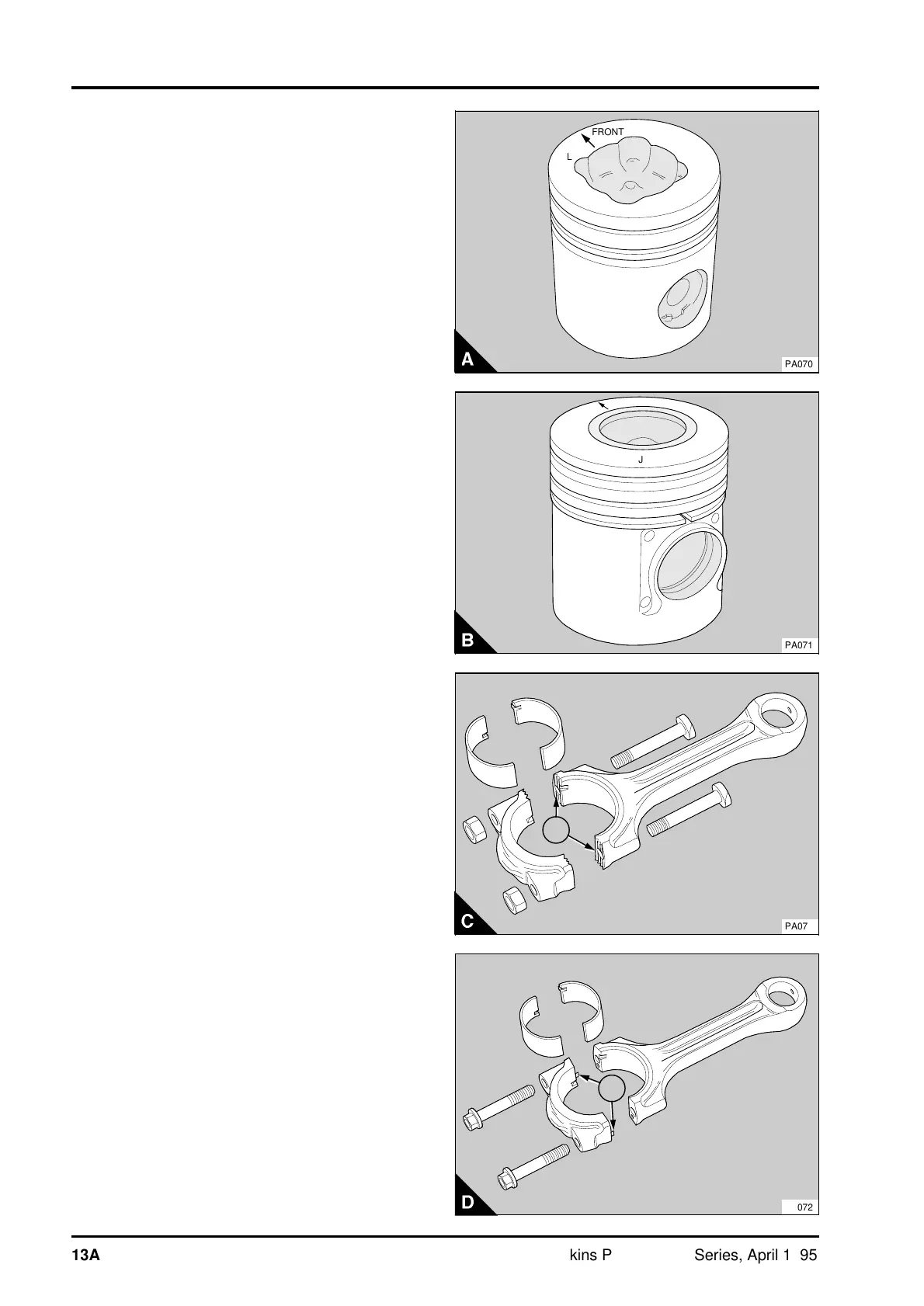
The pistons used in Phaser and 1000 Series
engines have either a "Quadram" (A) or a
"Fastram" (B) combustion chamber in the top of
the piston. These combustion chambers are
designed to give an efficient mix of fuel and air.
The latest engines have pistons, with a "Fastram"
combustion chamber and are available with different
height grades.
The pistons have two compression rings and an oil
control ring. The groove for the top ring has a hard
metal insert to reduce wear of the groove. Axial
location of the fully floating gudgeon pin is by
circlips.
Expansion controlled pistons have a steel insert in
the piston skirt.
Turbocharged engines which are rated higher than
2300 rev/min have an anodised area on the top
face of the piston.
Turbocharged engines have cooling jets fitted in the
cylinder block to spray lubricating oil onto the inner
surface of the pistons.
The connecting rods are machined from "H"
section forgings of molybdenum steel. The
connecting rods of turbocharged engines have
wedge shaped small ends. Generally, the location
of the bearing caps to the connecting rods is made
by serrations (C1) and the cap is retained by two
nuts and bolts (C).
On some turbocharged engines, used in vehicle
applications, the location of the bearing cap to the
connecting rod is made by dowels (D1) fitted in the
bearing cap (D). The faces of these connecting
rods and caps are flat and the caps are retained by
two setscrews.
Note: Always use the engine identification number
to order new parts.
a
a
a
a
a
FRONT
L
PA070
J
PA071
PA073
a
a
a
1
a
a
13A.02 Perkins Phaser/1000 Series, April 1995




 To Next Page