CRANKSHAFT ASSEMBLY 14
General description
The crankshaft is a chrome-molybdenum forging
which has five main journals for four cylinder
engines and seven main journals for six cylinder
engines.
End-float is controlled by two half thrust washers on
both sides of the centre main bearing.
The main bearings have steel backs with a
aluminium/tin bearing material except the centre
main bearing of six cylinder engines, which has a
bearing material of lead bronze with a lead finish.
The main bearing caps are made of cast iron or
spheroidal graphite (SG) iron.
Note: The bearing material of all the main bearings
used on Phaser 210Ti engines is lead bronze with a
lead finish.
The front and the rear oil seals are Viton lip seals
with a dust lip to the outside of the main lip and
with oil return grooves on the face of the main lip.
Engines which have a flywheel housing that is oil
filled have an arrangement which uses two "Viton"
lip seals. These seals are narrower than the
standard seal and are fitted back to back on the
crankshaft palm. They do not have a dust lip.
Warning! Read the safety precautions for "Viton"
seals on page 10A.08.
The crankshaft pulley of the four cylinder engine,
usually fitted without a damper, is held in position
by a plain thrust block and three setscrews. The
nose of the crankshaft is serrated for location.
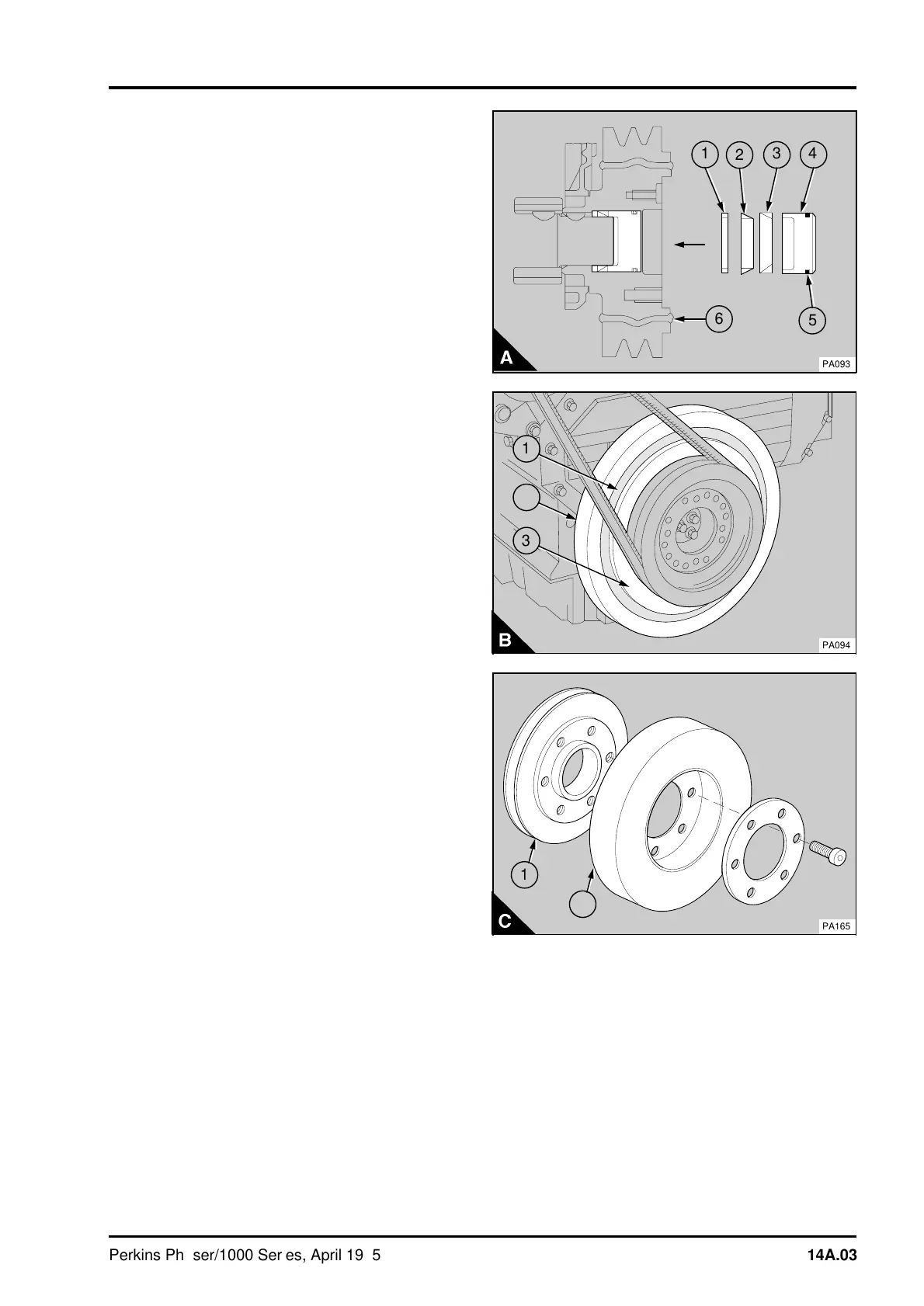
The location of the front pulley of six cylinder
engines is by a key in the crankshaft nose and the
pulley is held in position by a tapered rings
arrangement (A).
An integral damper, with a rubber insert (A6) is built
into the pulley of early six cylinder engines and
some four cylinder engines. Later six cylinder
vehicle engines have a separate plate damper
which has an outer plate (B2), bonded by a rubber
insert (B1) to an inner plate (B3) and fastened to
the rear face of the crankshaft pulley. The latest six
cylinder engines have a viscous damper (C2) which
is fastened to the front or rear face of the pulley
(C1). All of the dampers are designed for the
suppression of torsional vibrations in the engine
crankshaft.
A balancer unit is fitted to certain four cylinder
engines which have rigid mountings or which are
part of the chassis or frame. The purpose of the
balancer unit is to reduce the effect of the
out-of-balance forces to an acceptable condition.
a
a
4
a
a
3
2
a
a
1
a
a
5
a
a
6
PA093
a
a
1
a
a
2
a
a
3
PA094
PA165
1
a
a
2
Perkins Phaser/1000 Series, April 1995 14A.03




 To Next Page