ELECTRICAL EQUIPMENT 23A
Drive belts
To check23A-01
1 Check the belt(s) for wear and damage and
renew the belt(s), if necessary. If twin belts are
fitted, they should both be renewed.
2 Check the belt tension. If twin belts are fitted,
check/adjust the tension on the tighter belt. To
ensure maximum belt life, it is recommended that a
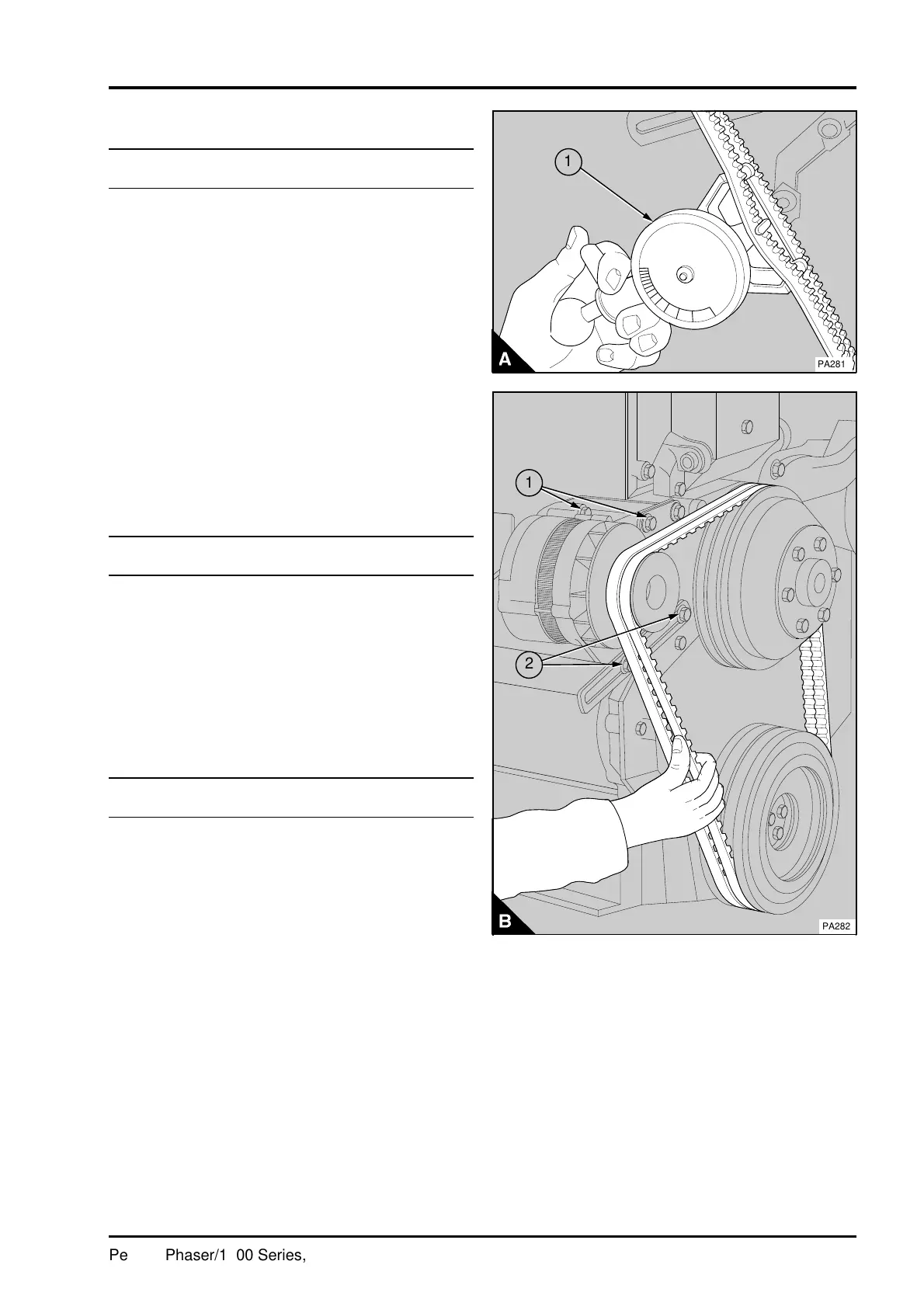
belt tension gauge is used. Fit the gauge (A1) at
the centre of the longest free length and check the
tension. If a Burroughs gauge is used, the correct
tension is 355 N (80 lbf) 36 kgf. If the tension is
equal to or less than 220 N (50 lbf) 22 kgf, adjust it
to 355 N (80 lbf) 36 kgf, operation 23A-02. If no
gauge is available, press down the belt with the
thumb at the centre of the longest free length and
check the deflection (B). With moderate thumb
pressure, 45 N (10 lbf) 4,5 kgf, the correct belt
deflection is 10 mm (3/8 in).
To adjust tension23A-02
1 Loosen the pivot fasteners (B1) of the alternator
and the fasteners of the adjustment link (B2).
2 Change the position of the alternator to give the
correct tension. Tighten the adjustment link
fasteners and then the pivot link fasteners. If there
are two pivot fasteners, tighten the front fastener
and then the rear fastener.
3 Check the belt tension again to ensure that it is
still correct.
To remove and to fit23A-03
Where twin belts are fitted, they are supplied as a
set and must be renewed as a set.
1 Loosen the pivot fasteners (B1) of the alternator
and the adjustment link fasteners (B2).
2 Release all of the tension from the belt(s) and
remove the belt(s).
3 Fit the new belt(s) and adjust the tension,
operation 23A-02. The belt tension must be
checked again after the first 1000 km (600 miles) or
20 hours of operation.
a
a
a
1
PA281
2
1
PA282
Perkins Phaser/1000 Series, April 1995 23A.03




 To Next Page