B-SERIES INSTALLATION, OPERATION AND SERVICE MANUAL
74 of 147
SECTION 16: GAS PIPING
16.1 Gas Manifolds
All gas piping to the air handler must comply with:
United States: Refer to NFPA 54/ANSI Z223.1 - latest
revision, National Fuel Gas Code.
Canada: Refer to CSA B149.1 - latest revision,
Natural Gas and Propane Installation Code.
The air handlers are available with three gas manifold
options.
• American National Standards Institute (ANSI)
compliant manifold: (
See Page 75, Figure 32
for
2005.
See Page 75, Figure 33
for 2010 - 2030.
•Factory Mutual (FM)-compliant manifold:
(
See Page 75, Figure 32
for 2005.
See Page 76,
Figure 34
for 2010 - 2030.
• XL compliant manifold: (
See Page 75, Figure 32
for 2005.
See Page 76, Figure 35
for 2010 - 2030.
16.2 Gas Piping and Pressures
The air handler is equipped with a gas manifold
suitable for connection to supply pressure of up to:
•14 in wc maximum (34.9 mbar) (2005 - 2030 with
ANSI-compliant manifold.)
•5 p.s.i. maximum (2005 - 2030 with FM or XL
compliant manifold).
When gas supply exceeds the above-listed maximum
gas pressures, an additional high pressure gas
regulator will be required to assure that the correct
gas pressure is supplied to the regulator. Pressure
should be measured between the high pressure gas
regulator and safety shut off valve. Minimum gas
pressure as indicated on data plate must be
measured with the burner operating in high fire.
Table 12: Gas Manifold Size
16.3 Gas Manifold Venting
Vent valves fitted on XL compliant manifolds must be
piped to the atmosphere outside the structure and in
accordance with applicable codes. This is the
responsibility of the installer.
16.3.1 Main Gas Regulator Venting
The main regulator used on 1¼" and larger manifolds
must be piped to the atmosphere outside the
structu
re. This is the responsibility of the installer.
16.3.2 Vent Line Installation
The following may be used as a guideline for
installation, but all applicable codes and regulations
must be followed.
•Natural gas and LPG are toxic and flammable
substances. They must be released where they
will not cause personal injury or property damage.
The end of the vent line must be located where it
is safe to release gas.
• Pipe the vent line outside the structure.
• Use as short a vertical run of pipe as possible.
• Do not run pipe from a high point to a lower point
to avoid obstacles.
• Use a minimum number of bends.
• Do not downsize the pipe from the origination
point (must be same size or larger).
•Make sure vent line is free from obstructions.
• Do not group lines together into a common
header.
•The outside termination must have a
weatherproof cap or be directed downward for
protection from the elements and must be
screened to prevent the entry of any objects.
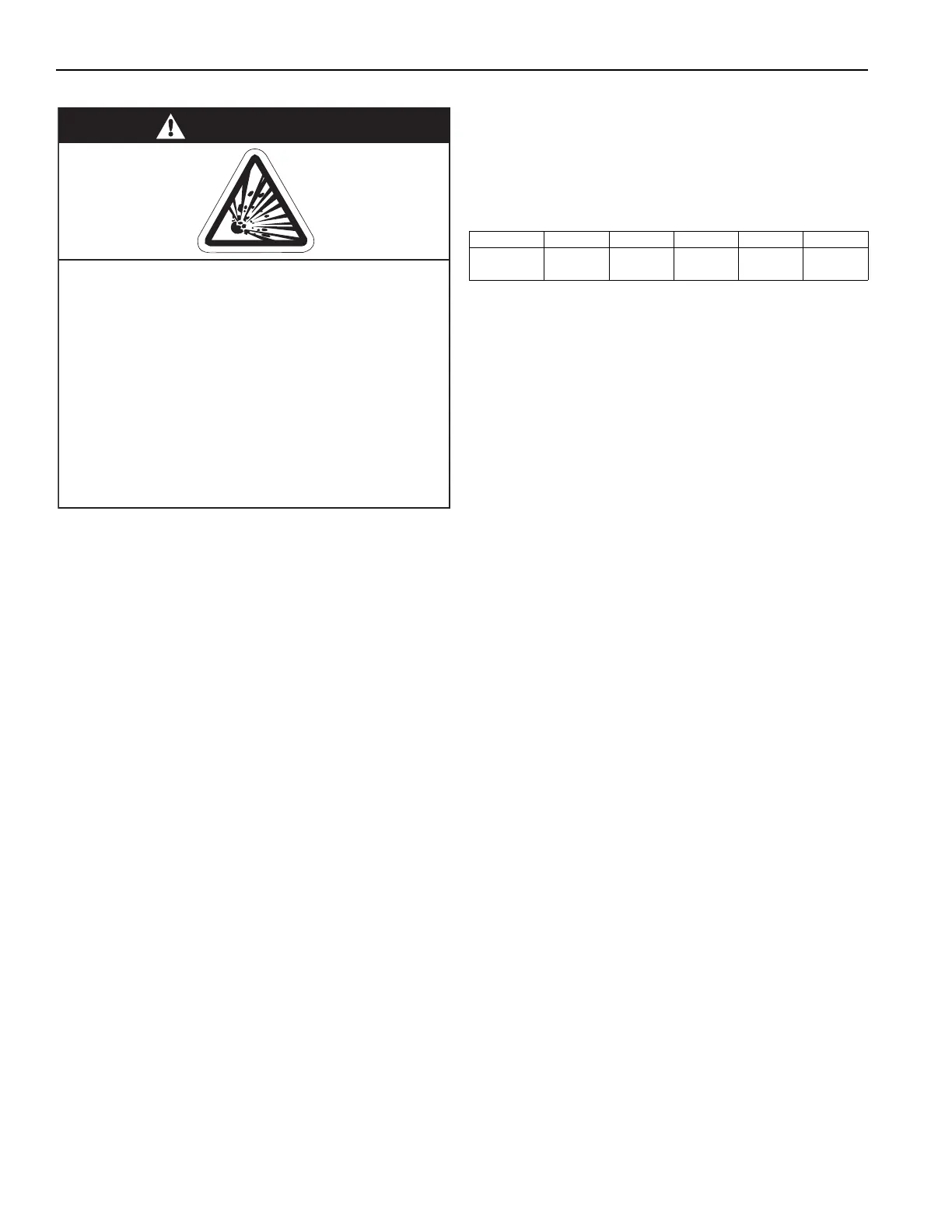
WARNING
Explosion Hazard
Leak test all components of gas piping
before operation.
Gas can leak if piping is not installed
properly.
Do not high pressure test gas piping with air
handler connected.
Failure to follow these instructions can result
in death, injury or property damage.
Model
2005 2010 2010B 2020 2030
Gas NPT
Connection
¾" 1" 1¼" 1½" 2"



 To Next Page