B-SERIES INSTALLATION, OPERATION AND SERVICE MANUAL
78 of 147
SECTION 17: ELECTRICAL
Each air handler is equipped with a wiring diagram
which will vary depending on the type of remote
panel supplied (See Page 80, Figure 38 through
Page 86, Figure 44). Depending on the air handler
configuration and optional equipment ordered, an
option sheet may also be included. This option sheet
overwrites the wiring diagram between the electrical
terminals indicated.
Air handlers can also be supplied as building
management system (BMS)-ready. In this case, a
remote panel is not supplied. See wiring diagrams on
Page 87, Figure 45 through Page 89, Figure 47.
Note: Spark testing or shorting of the control wires
by any means will render the transformers
inoperative.
Each unit is equ ipped with a fused rotary disconnect.
The rotary disconnects are for copper wire only.
17.1 Wiring and Electrical Connections
All electrical wiring and connections, including
electrical grounding, must comply with:
United States: Refer to National Electrical Code
®
,
NFPA 70 - latest revision. Wiring must conform to the
most current National Electrical Code
®
, local
ordinances, and any special diagrams furnished.
Canada: Refer to Canadian Electrical Code, CSA
C22.1 Part 1 - latest revision.
Check rating plate on air handler for supply voltage
and current requirements.
If any of the original control wire supplied with the air
handler must be replaced, replace it with type MTW
105°C, 600 V, 16 gauge wire or equivalent, except for
temperature control wiring, which must be a minimum
of 20 AWG Type Beldon 5401FE CMR 75C shielded
or equivalent.
For all other wires, replace with the equivalent size
and type of wire that was originally provided with the
air handler.
17.2 Remote Panel
The remote panel must be wired as shown on the
electrical schematic. For wire gauge sizes, see Page
78, Table 13. All power supply and motor wiring must
be minimu
m type THWN with a 167° F (75° C)
temperature rise.
17.2.1 Remote Panel Mounting Distance
If the interconnection wiring between the remote
panel and the air handler control enclosure is run in a
single conduit, the wire run can be as long as 100'
(30 m). For longer wire runs, consult the factory. If the
interconnection wiring between the remote panel and
the air handler control enclosure is run in two
conduits (separating the shielded cable and the 120
V power supply for the remote panel), the wire run
can be as long as 200' (60 m). For longer wire runs,
consult the factory. Care should be used to avoid
running the interconnect wiring near large industrial
loads or high voltage wire runs as that may further
limit the length of the interconnect wire run.
Table 13: Control Voltage Wiring For All Control
Systems
NOTE: Wiring for temperatu
re controls must be run in
shielded cable as indicated on the wiring diagram.
17.2.2 Low Voltage Control Wiring
Low voltage (24 V - AC/DC) control wiring in excess
of 100' (30.5 m) in length should be in its own
separate conduit run to prevent interference.
17.3 Motor Current Draw
For current requirements of the motor, refer to Page
79, Table 14. For specific current requirements, see
rating plate located on the blower motor. Current
draw may be adjusted downward by reducing blower
rotations per minute (RPM) or by increasing external
static pressure.
17.4 Control Current Draw
The maximum current draw for an air handler’s
controls and accessories is 3A.
17.5 Safety Systems
Safety systems are required for proper performance
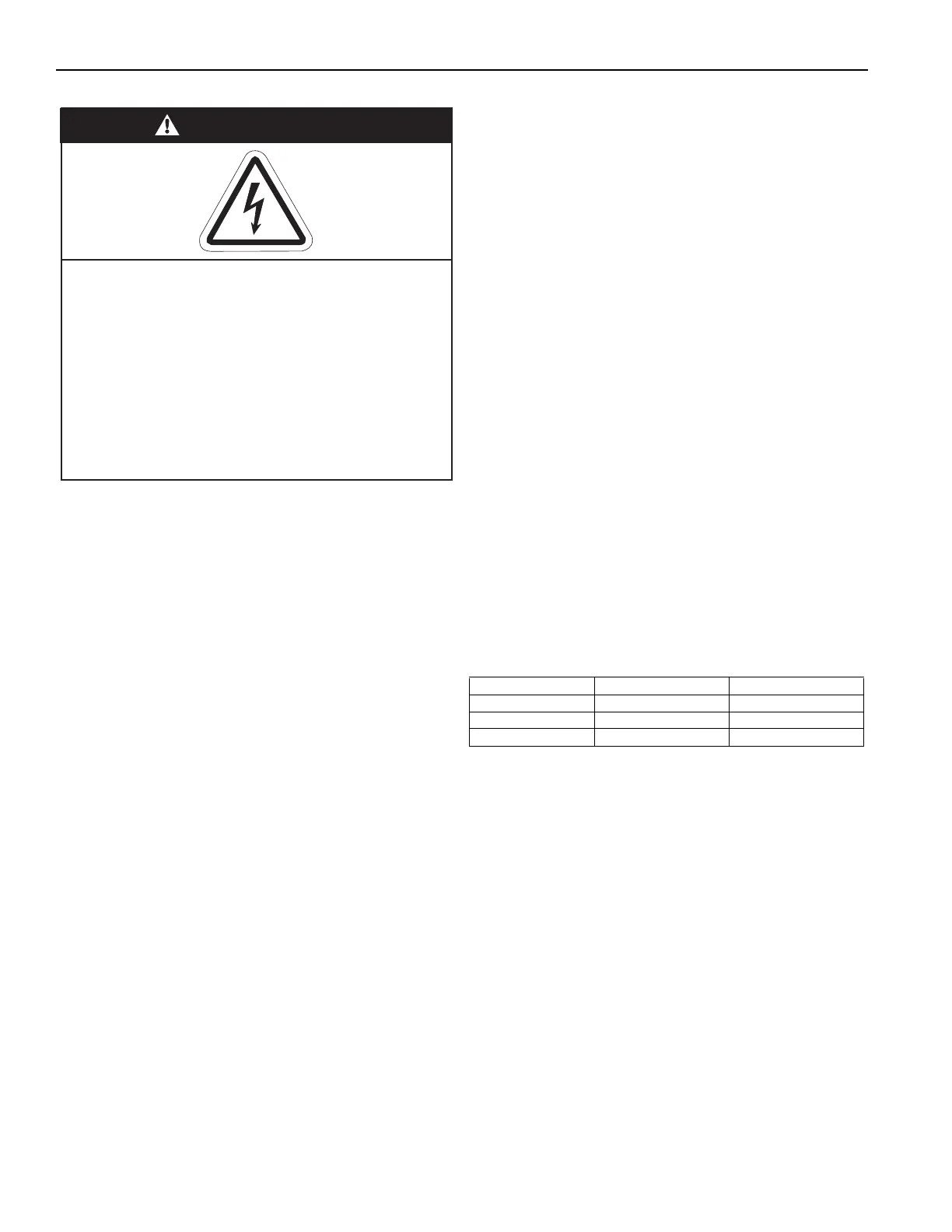
DANGER
Electrical Shock Hazard
Disconnect electric before service.
More than one disconnect switch may be
required to disconnect electric from
equipment.
Equipment must be properly grounded.
Failure to follow these instructions can result
in death or electrical shock.
Volts Wire Gauge Max Wire
120 18 150' (45 m)
120 16 250' (75 m)
120 14 350' (106 m)



 To Next Page