Measuring 0.00 – 3.65 mg/l NH
3
0.00 – 3.00 mg/l NH
3
-N 10-mm cell Method No. 2520
range: 0.00 – 1.83 mg/l NH
3
0.00 – 1.50 mg/l NH
3
-N 20-mm cell Method No. 2521
0.000 – 0.730 mg/l NH
3
0.000 – 0.600 mg/l NH
3
-N 50-mm cell Method No. 2522
Ammonia, free
(as ammonium)
Application
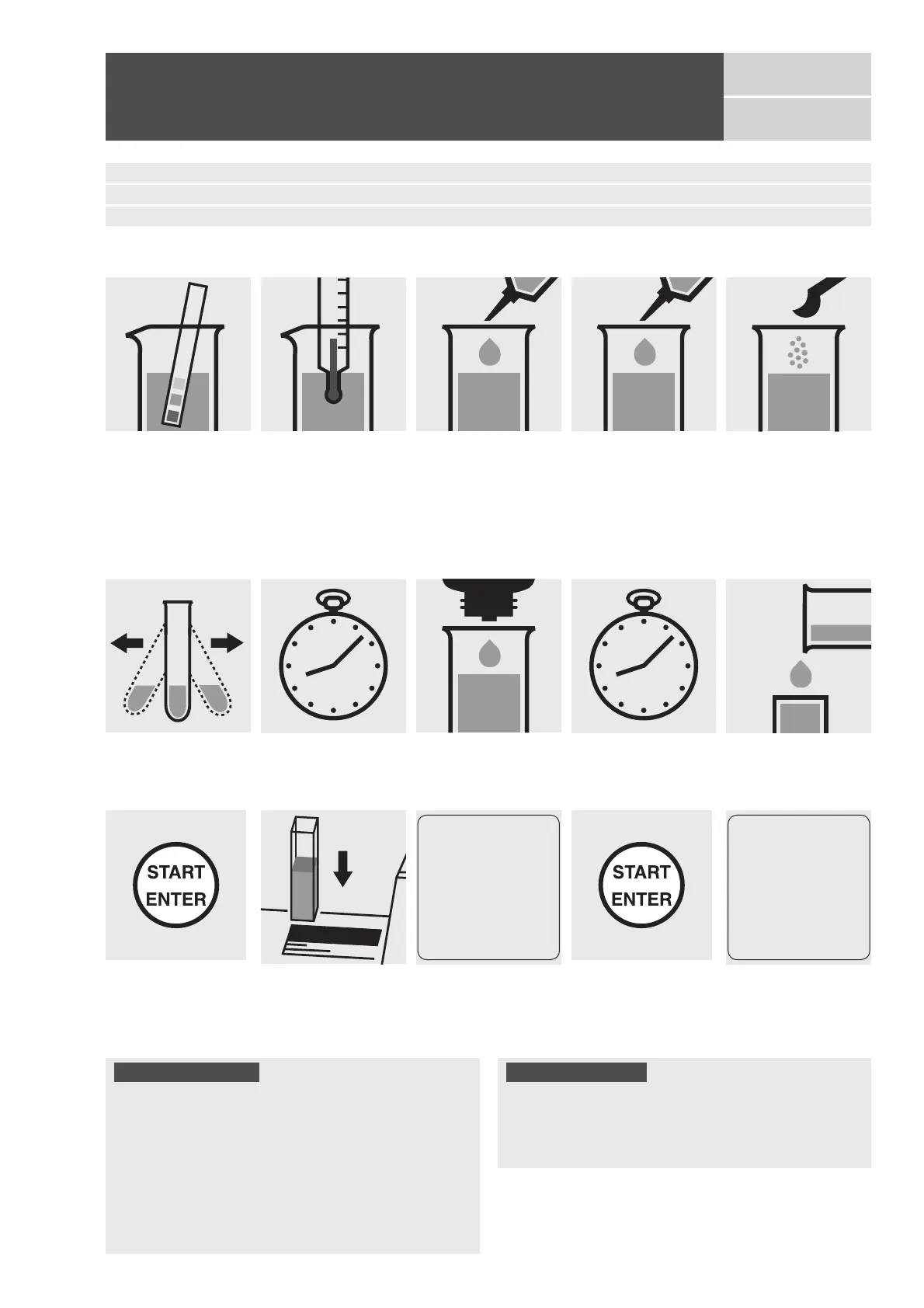
Add 4 drops of NH
4
-3
(from Spectroquant
®
Ammonium Test, Cat. No.
114752) and mix.
Reaction time:
5 minutes
Transfer the solution into
a corresponding cell.
Pipette 5.0 ml of the
sample into a test tube.
If required, add dilute
sodium hydroxide solu-
tion or sulfuric acid drop
by drop to adjust the pH
and bring the sample to
the appropriate tempera-
ture.
Add 0.60 ml of NH
4
-1
(from Spectroquant
®
Ammonium Test, Cat. No.
114752) with pipette and
mix.
Add 1 level blue
microspoon of NH
4
-2
(from Spectroquant
®
Ammonium Test, Cat. No.
114752).
Shake vigorously to
dissolve the solid
substance.
Reaction time:
5 minutes
Check the temperature
of the solution and note
.
Place the cell into the
cell compartment.
20 - 30 °C
pH 4 - 13
Check the pH of the
sample and note.
Select method no. 2520,
2521, or 2518.
Enter the pH and the
temperature of the origi-
nal sample.
0 - 60 °C
pH
Temp. [°C]
NH
3
[Abs]
NH
3
[mg/l]
NH
3
[mg/l]
pH
Temp. [°C]
NH
3
[Abs]
NH
3
[mg/l]
NH
3
-N [mg/l]
NH
3
-N [mg/l]
Release 06/2014 - Spectroquant
®
UV/VIS Spectrophotometer Pharo 300
Important:
The exact procedure as well as further details on the
method used can be found in the corresponding applica-
tion.
This application can be downloaded directly at
www.analytical-test-kits.com.
Important:
Very high ammonium concentrations in the sample
produce turquoise-colored solutions (measurement solu-
tion should be yellow-g
reen to green) and false-low read-
ings are yielded. In such cases the sample must be di-
luted (plausibility check).
To measure in the 50-mm cell, the sample volume and the
volume of the reagents have to be doubled for each.
Alternatively, the semi-microcell, Cat.No. 173502, can be
used.



 To Next Page